

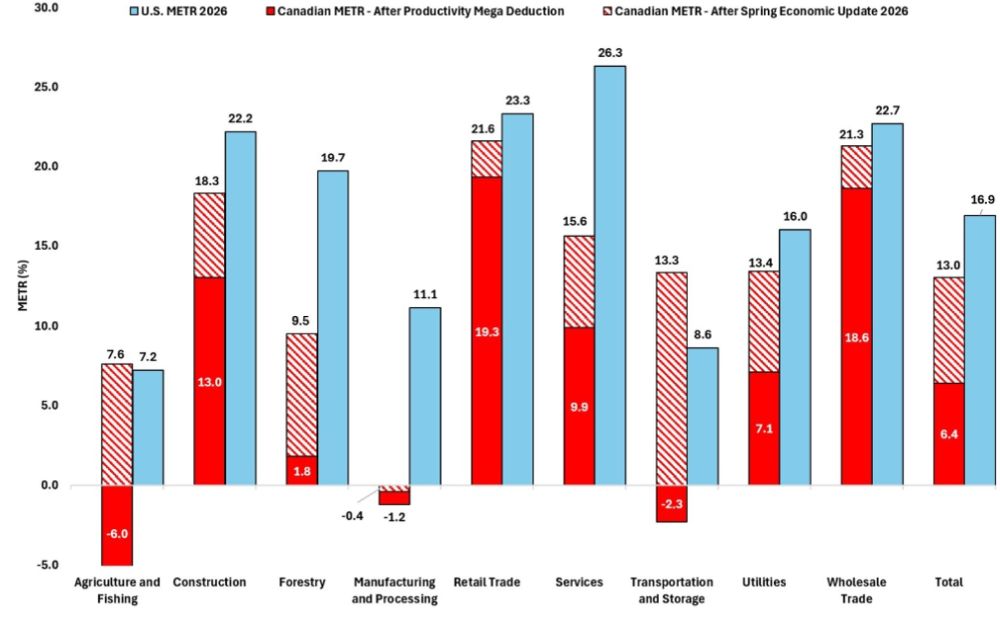
On September 15, 2026, at the first Canada Investment Summit in Toronto, Prime Minister Mark Carney announced the “Productivity Mega Deduction,” a proposal that will reportedly reduce Canada’s marginal effective tax rate on new business investment from 13% to 6.4%, making it “the lowest of any major economy in the world and less than half the rate in the United States.” The goal of the new rules, according to the Prime Minister, is to ensure that “investment dollars will go a lot further in Canada than anywhere else in the advanced world.”
For the full news release, see here. For the full backgrounder from the Department of Finance Canada, see here.
Current rules: Capital cost allowance & immediate expensing
Ordinarily, a business cannot deduct 100% of the cost of a capital asset at the time it is acquired. Rather, a business claims capital cost allowance (CCA) over many taxation years at a fixed rate depending on the asset's class under the Income Tax Regulations.
In the 2025 Budget, however, the “Productivity Super-Deduction” was introduced, which provided for immediate expensing for approximately 15% of investment in capital assets, including machinery, equipment, and buildings used for manufacturing and processing, clean energy generation and energy conservation equipment, zero-emission vehicles, patents, data network infrastructure, and computers.
Immediate expensing allows taxpayers to fully deduct the cost of an investment for income tax purposes in the year that it becomes available for use, as opposed to spread over many years. The effect of this is that taxpayers’ cost of capital is lowered and taxes are reduced, thereby freeing-up cash available for operations.
The new Productivity Mega Deduction
The new Productivity Mega Deduction is an extension of the Productivity Super-Deduction in the sense that it also allows for immediate expensing of the cost of an asset in the year such asset becomes available for use. However, the new Productivity Mega Deduction expands on the previously introduced Productivity Super-Deduction, most notably as follows:
-
Scope: The Productivity Mega Deduction extends to roughly 65% (as opposed to just 15% under the Productivity Super-Deduction) of investment in capital assets. Such assets now include fibre-optic cable, mining property, oil and gas pipelines, software, patents, R&D, computer equipment, aircraft and vehicles, rail track, bridges and roads and more.
The Productivity Mega Deduction will also allow taxpayers to immediately deduct 100% of Canadian development expenses incurred, as compared to the current 30% of declining balance (including certain Canadian development expenses deemed incurred as a result of a renunciation under a flow-through share agreement entered into on or after September 15, 2026).
Further, effective after November 4, 2025, immediate expensing in respect of liquefaction equipment used in liquefied natural gas facilities would take the form of an additional allowance that would bring the CCA rate for such property up to 100%. This additional allowance would only be able to be claimed against income of the taxpayer that is attributable to the liquefaction of natural gas at the relevant facility.
- Permanence: The Productivity Mega Deduction is proposed to be permanent rather than a temporary measure that phases out (like the Productivity Super-Deduction).
The Productivity Mega Deduction proposal also covers used assets, provided that the taxpayer that subsequently acquires such asset from a prior owner that was arm’s length from the taxpayer and the property was not transferred to the taxpayer on a tax-deferred rollover basis.
The Productivity Mega Deduction covers most depreciable property acquired on or after September 15, 2026, subject to certain exclusions. The exclusions from the Productivity Mega Deduction include:
- buildings (Classes 1 and 3);
- certain intangibles such as franchises, licences and goodwill (Classes 14 and 14.1);
- certain natural gas distribution pipelines (Class 51);
- certain vehicles (Classes 10 and 10.1); and
- property depreciated under Schedules V (industrial mineral mines and rights to remove industrial minerals from such mines) and VI (timber limits and cutting rights other than timber resource property).
Assets ineligible for immediate expensing will continue to receive an enhanced first-year deduction under the Accelerated Investment Incentive, so no asset is left worse off than before.
What this means for business in Canada
As set out in the Department of Finance’s backgrounder, the Productivity Mega Deduction will make Canada “more tax competitive than the U.S. across all major sectors of the economy.” Specifically, the Canadian and U.S. marginal effective tax rates, by sector, before and after the introduction of the Productivity Mega Deduction is expected to be as follows:
The new Mega Productivity Deduction provides several practical implications for businesses:
-
Faster cost recovery and reduced after-tax cost of investing:
As mentioned above, deducting the full cost up front raises the present value of those deductions and lowers the cost of capital. This ultimately frees up cash in the early stages of the lifecycle of a business.
-
Greater certainty for long-term projects:
For capital-intensive investments the permanence of this incentive matters. A temporary incentive is difficult to underwrite when a build takes years to complete, so businesses often discount it when weighing whether to proceed. A permanent deduction provides businesses with greater confidence when weighing their investments in Canada.
-
Limits on the benefit:
While the new measure may not tip an investment decision on its own, the benefit does incentivize investment in Canada from businesses already positioned to invest. A business with recurring losses, or too little projected income over the 20-year non-capital loss-carry-forward horizon to absorb the full deduction, may see little near-term benefit.
Next steps
Draft legislative proposals relating to the Income Tax Act and Income Tax Regulations accompanied the announcement (see here). Key mechanical questions remain open, including how the measure applies across classes and how it interacts with existing incentives. Should you have questions regarding these news measures, please contact a member of Gowling WLG’s Tax Practice Group.
Read the original article on GowlingWLG.com
The content of this article is intended to provide a general guide to the subject matter. Specialist advice should be sought about your specific circumstances.
[View Source]

