

Hi TCPAWorld!
You all know the battle that we have been following in the wake of Loper Bright Enters. v. Raimondo, 603 U.S. 369 (2024) and McLaughlin Chiropractic Assocs., Inc. v. McKesson Corp., 606 U.S. 146 (2025). Well, another New Jersey federal court just held that text messages are “telephone calls” under 227(c)(5) but the map that you are all too familiar with does not change as a result.
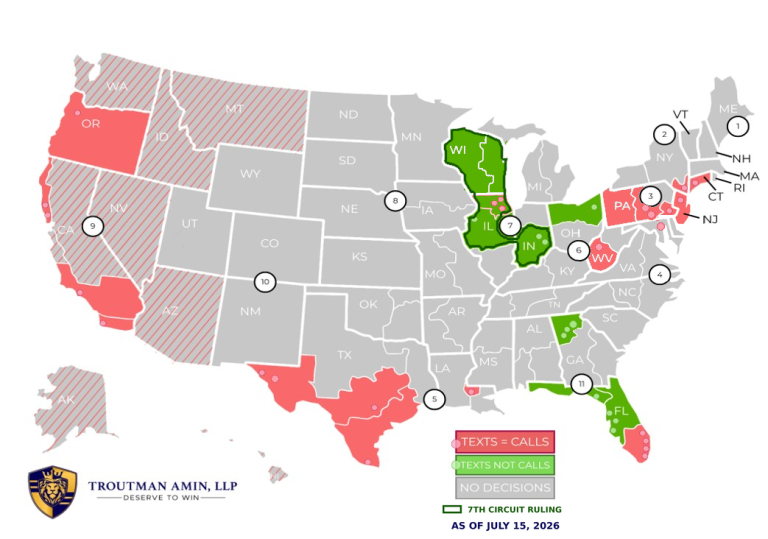
The case is Owen-Brooks v. Better Homes & Gardens Real Estate, LLC, No. 25-15801, 2026 WL 2455150 (D.N.J. Aug. 21, 2026).
However, this article is less interested in the holding than stress-testing the reasoning, especially since Owen-Brooks runs through every argument the Seventh Circuit in Steidinger v. Blackstone Med. Servs., 182 F.4th 532 (7th Cir. 2026) already considered and rejected as the first federal appeals court to actually directly answer this question.
The brief facts of the case here is that Plaintiff Susan Owen-Brooks placed her phone number on the National Do-Not-Call Registry in 2013. She alleges that around March 2025, she began receiving real estate marketing texts from individuals identifying themselves as agents of Better Homes and Gardens Real Estate and its New Jersey franchisee, Native American Group. She alleges that she never provided her consent to be contacted. Plaintiff subsequently sued under 227(c)(5) and the defendants moved to dismissed arguing that texts aren’t “calls,” that she consented and that BHGRE shouldn’t be liable for NAG’s actions.
Rather than arguing that “texts did not exist in 1991,” defendants proceeded with the Loper Bright and McLaughlin approach that said that courts do not owe deference to the FCC’s view and should only provide “appropriate respect” and that courts should independently review the statute. The court here sided with the plaintiff on three separate grounds, each of which Steidinger had already confronted and rejected last month.
First, the court read the 1991 dictionary definition of “telephone call” broadly, as any communication made by telephone, with no requirement that it be spoken or audible. That’s precisely where Steidinger parted ways as it worked from the same era’s dictionaries and landed on a narrower meaning: a telephone was understood as a device for reproducing sound, and a call meant getting into communication by telephone in that sound-based sense. A text doesn’t reproduce sound. Two courts, the same 1991 dictionaries, opposite conclusions, and only one of them is a court of appeals.
This is also worth noting: the opinion never cites Steidinger at all, so we can’t say whether the defendants raised it. This may mean that the motion was fully briefed before Steidinger was decided but for any motions where briefing is complete and is making this argument, make sure to provide the court a notice of supplemental authority that cites Steidinger. Going forwards, for defense counsel making this motion, Steidinger is the kind of authority that belongs (and should be) on page one of a motion like this, not held in reserve.
Returning to the case, the court here then leaned on the presumption that a word means the same thing throughout a statute, pointing to § 227(b)(1)(A)(iii), which courts have treated as covering texts without much controversy. Steidinger anticipated and rejected this exact move by pointing out that the provisions surrounding (c)(5) consistently use the broader term “telephone solicitation,” a term the statute itself defines to include both calls and messages, while (c)(5) alone uses the narrower “telephone call.” To the Seventh Circuit, that wasn’t an accident but rather Congress’s deliberate writing of a narrower remedy and the presumption of consistent usage doesn’t override language Congress intentionally varied.
Third, the court invoked the TCPA’s remedial purpose that letting telemarketers dodge liability by switching from calls to texts would defeat the point of the Do-Not-Call regime. Steidinger addressed this too, and wasn’t persuaded, holding that general policy concerns can’t override what it read as clear statutory text and structure.
Now this is where one should pay extra attention because Owen-Brooks draws on post-Loper Bright/McLaughlin district court decisions, including Mujahid v. Newity, LLC out of the Northern District of Illinois. This citation is worth pausing on given that Mujahid is a November 2025 district court decision that is within the Seventh Circuit and it reached the exact conclusion that the circuit court in Steidinger has rejected as its own circuit’s binding law last month. As a result, the holding here is built in part on authority that no longer reflects good law where it was decided. Hopefully, as more courts fall in line behind Steidinger, expect the citation string to be thinning out and defense counsel start to lead with Steidinger affirmatively in the motion itself from the very beginning and not just in a reply brief.
Additionally, Owen-Brooks in part relied on the Supreme Court’s language in Campbell-Ewald Co. v. Gomez that a text qualifies as a “call,” a citation that has powered plaintiff-side arguments and reinforced with Howard v. Republican National Committee, a Ninth Circuit decision holding the same thing. But recall that neither case actually resolves what a “call” means under § 227(c)(5). Campbell-Ewald and Howard were both decided under § 227(b), a differently worded provision, and the Campbell-Ewald language wasn’t even a holding on the meaning of “call” to begin with. The Supreme Court said as much in Facebook, Inc. v. Duguid, clarifying that Campbell-Ewald simply assumed the point because nobody contested it. Steidinger rejected reliance on both cases for exactly this reason, since neither one grapples with the narrower “telephone call” language actually at issue in (c)(5), and Owen-Brooks fails to address that distinction.
Looking at the totality of the court’s reasoning, Owen-Brooks is a holding that, while a majority of decisions have reached, is a case built on arguments and cases that a federal appeals court has already rejected, including at least one decision, Mujahid, that no longer reflects good law within its own circuit.
Lastly, in regard to the other two arguments that the defendants presented, the court wouldn’t consider the defendants’ consent evidence, a third-party website registration, at the motion to dismiss stage, since consent is an affirmative defense that generally can’t be resolved on a 12(b)(6) motion unless it’s apparent from the complaint itself. And it let vicarious liability claims proceed against the franchisor based on allegations that it trained franchisees on marketing practices and profited from the resulting business, which should serve as a reminder for everyone that training materials and marketing programs, not just the franchise relationship itself, can support an agency theory.
Owen-Brooks adds another decision holding that text messages are “calls” under § 227(c)(5). But its reasoning, based on the dictionary definition, the presumption of consistent usage, the statute’s remedial purpose, and its reliance on Campbell-Ewald and Howard, is nothing new. The Seventh Circuit already considered and rejected that framework when it became the first circuit court to actually decide the issue. So again, for defense counsel dealing with this issue, lead with Steidinger.
The battle continues and we will continue to bring you all developments and rulings as soon as they drop so stay tuned folks.
Until next time TCPAWorld and as always, be safe.
The content of this article is intended to provide a general guide to the subject matter. Specialist advice should be sought about your specific circumstances.
[View Source]