

On March 13, 2026, the United States Patent and Trademark Office (USPTO) issued supplemental guidance that provides design patent applicants with greater flexibility when claiming computer-generated interfaces and icons. Published in the Federal Register on March 13, 2026 (Docket No. PTO-P-2026-0133), the guidance revises prior examination practices under 35 U.S.C. § 171 and will be incorporated into the Manual of Patent Examining Procedure (MPEP) in due course. We last reported on this topic on February 6, 2024.
Background
In December 2020, the USPTO issued a Request for Information regarding the “article of manufacture” requirement and its application to emerging technologies such as projections, holograms, and virtual/augmented reality (PHVAR) designs. The USPTO issued Supplemental Guidance in 2023 and 2024 addressed design patent protection for computer-generated electronic images but retained certain drawing and claim-language restrictions. Following additional stakeholder feedback, the USPTO has now issued this updated guidance in an effort to modernize its approach and align with technological advancements.
Key Changes
The recently issued supplemental guidance introduces the following primary updates:
- Elimination of the Broken-Line Display Panel Requirement – The USPTO has removed the prior instruction in MPEP § 1504.01(a) that required drawings to depict a computer display panel or portion thereof in solid or broken lines. When both the title and claim properly identify an article of manufacture (e.g., a computer, computer display, or computer system), the design claim will satisfy the article of manufacture requirement under 35 U.S.C. § 171 without the need for such a depiction. Applicants may still elect to include broken-line display regions if desired.
- Acceptance of “For” Language in Titles and Claims – Claim and title language using the preposition “for” is now expressly accepted. Examples include “icon for a computer display screen,” “projected interface for a computer,” “graphical user interface for a computer system,” or simply “computer icon.” Examiners will no longer object to such phrasing under 37 CFR § 1.153 (or 37 CFR § 1.1067 for international design applications). The guidance clarifies that the term “for” sufficiently ties the design to an article of manufacture and distinguishes it from a mere transient or disembodied image.
- Expanded Eligibility for PHVAR and Other Emerging Designs – The guidance confirms that computer-generated interfaces and icons, including projections, holograms, virtual reality, and augmented reality designs, are eligible for protection when claimed as being “for” a computer, computer display, or computer system and when the appearance is more than a transient or disembodied picture. This expands upon the 2023 guidance and draws on precedents such as In re Hruby, 373 F.2d 997 (Cust. Ct. 1967) and the Supreme Court’s broad interpretation of “article of manufacture” in Samsung Electronics Co. v. Apple Inc., 580 U.S. 53 (2016).
The supplemental guidance emphasizes that the complete disclosure (title, claim, specification, and drawings) must still satisfy all other patentability requirements, including 35 U.S.C. §§ 102, 103, and 112, as well as the formal drawing rules under 37 CFR § 1.152.
Illustrative Examples
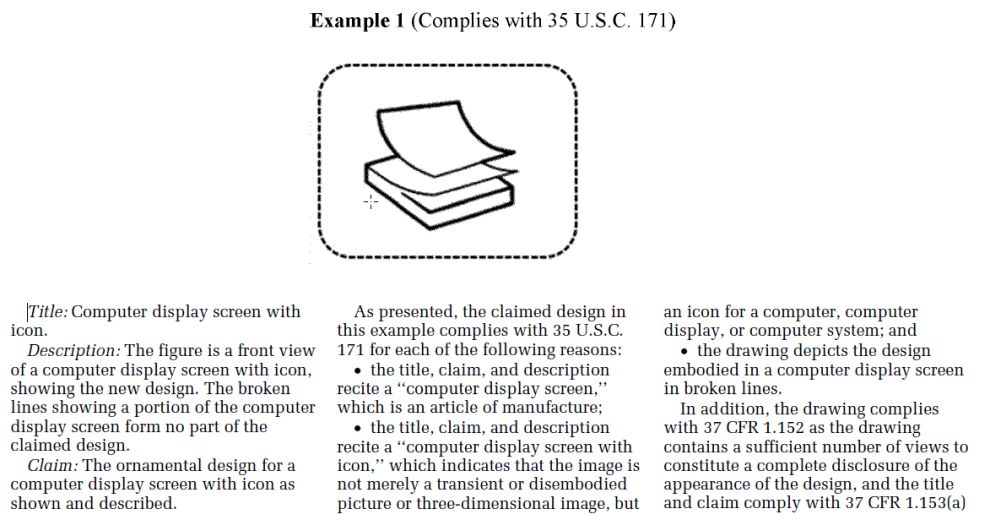
The guidance provides twelve detailed examples (Examples 1–4 and 6–10 comply with § 171; Examples 5, 11, and 12 do not) that include a title, description, and claim to help practitioners see how this guidance will be implemented by examiners. Example 1, which complies with § 171, is included below. The provided examples range from traditional GUI icons shown with optional broken-line displays to projected keyboards, holographic interfaces, and virtual reality designs claimed for a computer or computer system. The examples illustrate acceptable claim and title language as well as situations where the absence of any article-of-manufacture reference results in rejection.
Effective Date and Next Steps
This supplemental guidance is effective immediately and applies to all design patent applications and proceedings filed before, on, or after March 13, 2026. It does not constitute substantive rulemaking and does not create any enforceable rights. Any written comments must be received by May 12, 2026, via regulations.gov (Docket PTO-P-2026-0133).
Applicants and practitioners should review pending applications to determine whether amendments to titles, claims, or drawings can take advantage of the new flexibility. The USPTO has indicated that additional examiner training materials will be provided.
The content of this article is intended to provide a general guide to the subject matter. Specialist advice should be sought about your specific circumstances.
[View Source]