

- with readers working within the Law Firm industries
On March 13, 2026, the U.S. Patent and Trademark Office (USPTO) issued “Supplemental Guidance for Examination of Design Patent Applications Related to Computer-Generated Interfaces and Computer Icons.” This guidance clarifies and, in certain respects, expands the availability of design patent protection for graphical user interfaces (GUIs), computer icons, and emerging projection-based, virtual reality (VR), and augmented reality (AR) designs.
The Supplemental Guidance provides increased flexibility for applicants while reinforcing the importance of tying claimed digital designs to an article of manufacture, as required under 35 U.S.C. § 171.
Key Takeaways
Drawings no longer need to depict a display screen in applications directed to GUIs or computer icons, provided the design is clearly associated with an article of manufacture.
- The USPTO will accept a broader range of descriptive titles that explicitly identify an article of manufacture.
- Projected, holographic, virtual reality, and augmented reality interface designs may qualify for design patent protection when they are more than transient or disembodied images.
- Titles, claims, and descriptions remain critical to satisfying the statutory article of manufacture requirement.
Elimination of Mandatory Display Screen Depictions
Under prior USPTO practice, design patent applications for GUIs and icons were required to depict a display panel or a screen in solid or broken lines in the drawings. The Supplemental Guidance removes this requirement as long as an article of manufacture is otherwise identified.
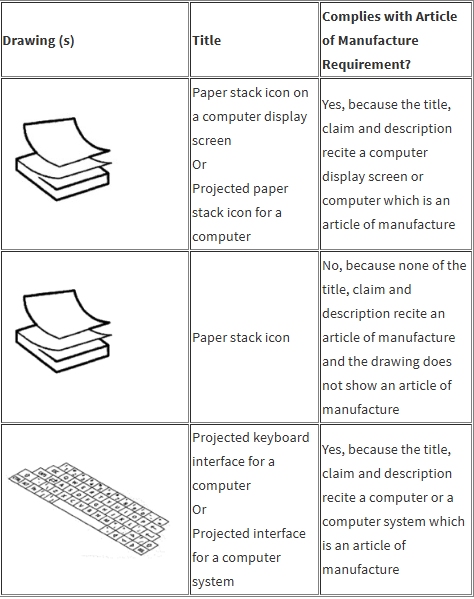
Specifically, applicants may now omit the display screen or display panel from the drawings so long as the title and claim identify an article of manufacture—such as a display screen, computer, or computer system—and the application as a whole makes clear that the claimed design is embodied in that article.
Expanded Acceptance of Titles
The Supplemental Guidance confirms that Examiners should accept a wider variety of titles that expressly link the design to an article of manufacture. Acceptable examples include “graphical user interface for a display screen,” “icon for display panel,” “projected interface for a computer,” and “interface for a computer system.”
In contrast, titles that recite only the icon or the graphical user interface (GUI) itself—without identifying an article of manufacture—may result in a rejection if the claim, the description, or the drawings do not otherwise describe an article of manufacture.
Eligibility of Projected, VR and AR Interface Designs
The Supplemental Guidance also addresses the design patent eligibility of projected, holographic, virtual reality, and augmented reality interfaces, referred to collectively as PHVAR designs.
According to the USPTO, such designs may qualify for design patent protection when the appearance of the digital design is separate from the computer display or computer system that generates it and when the digital design is more than a transient or disembodied picture or three-dimensional image.
Selected Examples
The Supplemental Guidance provided specific examples of graphical user interfaces and PHVAR designs that would and would not comply with the article of manufacture requirements. Select examples from the Supplemental Guidance are shown below:
Practical Implications
The Supplemental Guidance offers applicants greater drafting flexibility while emphasizing the continued importance of careful coordination between titles, claims, drawings, and descriptions.
Applicants with significant investments in software-driven products, digital branding, wearable technology, or immersive user experiences may consider whether new filings or continuation applications could benefit from the new examination standards.
Conclusion
The USPTO’s Supplemental Guidance reflects the evolving nature of designs in an increasingly digital and immersive environment. When properly claimed, GUIs, computer icons, and virtual interfaces can continue to serve as valuable assets protected under U.S. design patent law.
The content of this article is intended to provide a general guide to the subject matter. Specialist advice should be sought about your specific circumstances.
[View Source]