

Originally published in iP Frontline March 21, 2012
The object of this document is to provide the reader with a sense of the America Invents Act's effect on patents on the "back end" of patent procurement.
The America Invents Act (AIA) was enacted with enthusiastic bipartisan support on September 16, 2011. The AIA was promulgated in the spirit of promoting innovation, improving the quality of issued United States patents, and harmonizing United States patent law with international law. Expansive in scope, the AIA impacts many areas of substantive and procedural patent law and its contours will not come into clear focus for many years, if not decades, after the United States Patent and Trademark Office (USPTO) and the United States federal courts cast judgment on its meaning. However, as patent lawyers and clients alike become acclimated to the post-AIA business world, both will become more cognizant of both the opportunities and the pitfalls presented by the AIA, as well as how best to deal with each.
On the "front end" of patent procurement, i.e., before a patent application is filed, the AIA will drive new decision making concerning whether, when and how to file a patent application. For example, the AIA offers an inventor, at a substantial fee ($4,800), to pursue accelerated examination of his or her patent application before the USPTO. Accelerated examination should be of particular interest to those involved in rapidly evolving industries or those seeking a deterrent to imminent or actual infringement by competitors.
Thus far considerable attention has been paid to the AIA's "First Inventor to File" (FITF) requirement for determining invention priority versus the existing "First to Invent" standard. The FITF provisions become effective on March 16, 2013. Most countries other than the United States condition patentability of an invention on "absolute novelty". This means that, except for very few limited exceptions, there can be no public disclosure of an invention anywhere in the world prior to the filing of a patent application for the invention. If a patent application is filed after such a disclosure, it is void. FITF is the United States answer to the doctrine of absolute novelty. Relatedly, the AIA dramatically changes what constitutes so-called "prior art" that may be relied upon by the USPTO to refuse a patent application or by a United States federal court to invalidate an issued patent. Under the AIA, prior art now includes any public disclosure of an invention (including any patent, published patent application, sale, advertisement and trade/scientific journal publication, in any country and in any language) made prior to an applicant's effective patent application filing date in the United States. The new FITF and prior art provisions have generated voluminous discourse among the United States patent bar. Indeed, their many implications have already been widely debated and extend well beyond the scope of this article. In contrast, the object of this document is to provide the reader with a sense of the AIA's effect on patents on the "back end" of patent procurement, i.e., after a patent has been granted.
The following is a brief explanation of the most fundamental portions of a United States patent and how they relate to one another. The first is the specification which is a written description of the invention. The specification may also include one or more technical drawings. The second is the claim or claims. A claim is often analogized to a plat description in the real estate context. That is, the claim(s) set forth the scope of legal protection of the invention described in the specification. Lastly, all claims of a United States patent are presumed valid unless a challenger produces more persuasive evidence to the contrary (USPTO proceedings) or clear and convincing evidence of invalidity (federal court litigation).
With the preceding as context, what follows is an overview of the various methods by which one may seek to strengthen a patent (the patentee) or challenge a patent (a competitor). The strategic reasons for having an issued patent reviewed by the USPTO are nearly always litigation-driven, whether the litigation is merely contemplated or already underway.
By way of example, a patentee may discover that a competitor is preparing to sell or actually selling a certain product and then discover that his or her patent does not cover the competitor's product. At that point the patentee has two choices: (1) do nothing, in which case the competitor will cut into the patentee's market share, or (2) seek review of the patent by the USPTO in hopes of obtaining at least one claim of sufficient breadth to capture the competitor's product. If review is successful, the patentee would be able to prevent the competitor from making, selling or using its product without the patentee's consent.
Conversely, the patentee may threaten litigation or actually file suit for patent infringement against a competitor without seeking review of his or her patent before doing so. Under those circumstances, the competitor has several choices: (1) stop selling the disputed product, in which case the competitor is foreclosed from a potentially lucrative revenue stream, (2) challenge the patent in federal court, or (3) challenge the patent in the USPTO.1
Under the pre-AIA regime, United States patent law afforded the patentee and a challenger three different means by which to seek USPTO reconsideration of an issued patent: Reissue, Ex Parte Reexamination and Inter Partes Reexamination2. The AIA added three new post-grant review procedures to the list: Inter Partes Review (which will supplant Inter Partes Reexamination for patents issued after September 16, 2012), Post-Grant Review and Supplemental Examination.3
There are many significant differences between all of the post-grant review processes that will be available after September 16, 2012, and they should be carefully considered in order to achieve a party's desired ends. However, their procedures, merits and risks are sophisticated and would easily serve as an independent topic worthy of its own detailed analysis. Consequently, this article will not delve into the reasons a patentee or challenger might consider when selecting one form of USPTO post-grant review method over another. However, as TABLE 1 shows, whatever the party and whatever the contemplated method, the initiator will be facing daunting costs merely to file, let alone prosecute, a typical post-grant review proceeding. Note: as of the date of this writing, the cited AIA filing fees are merely proposed fees. Whether they remain the same or are modified by the USPTO, any such fees will take effect on September 16, 2012.
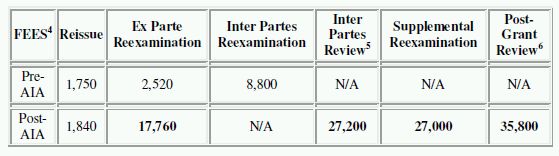
The reader may ask: why wouldn't the parties simply choose to elect the patent Reissue process noted in TABLE 1, whose filing fees have been essentially unaffected by implementation of the AIA? The reasons are simple: (1) reissue may only be initiated by the patentee, (2) a so-called "broadening" reissue application, filed for the purpose of procuring claims of expanded breadth sufficient to capture a competitor's product, machine, process, etc., may only be filed within two years of the patent's issue date, and (3) like any post-grant review mechanism, it places the reconsidered patent – including the already-granted claims – at risk of being denied by the USPTO.
Since its enactment, pundits have expended considerable time and energy praising and criticizing the AIA's potential impacts on United States patent law – from an academic perspective. However, most business people have little interest in the theoretical implications of a new law. They care about how it affects their bottom line. As a practical matter, at least as far as post-grant review is concerned, the AIA should leave them deeply concerned. The crushing fees associated with each of the AIA's new post-grant examination mechanisms and the astonishing increase in Ex Parte Reexamination filing fees – if ultimately adopted at or near their proposed levels – will likely place such procedures beyond reach of all but those who can comfortably afford them. Even then, those who do choose to employ them will likely do so only because they represent a "cheaper" alternative to even more costly, typically far more expensive, patent infringement litigation.
So, to the vast majority of patentees and their competitors, what is the AIA's real impact upon patent review opportunities? It has unmistakably narrowed them. While it is true that the AIA theoretically offers more options to strengthen or challenge a patent than ever before, only a select few will be in financial position to exercise these new rights. As a result, the USPTO will reconsider far fewer issued patents than ever before, and an increasing number of defective patents will enter the stream of commerce. Simultaneously, the USPTO wages a never-ending battle to reduce its patent examination backlog and is constantly seeking ways to achieve that goal. Hence, the upshot of the AIA's expanded post-grant review menu is that it may be a false "opportunity" for the public, "mission accomplished" for the USPTO, or both.
Footnotes
1. Options (2) and (3) may, and often are, pursued simultaneously. In such case, the federal court proceedings are typically stayed pending the outcome of the USPTO proceedings.
2. Very generally, the fundamental distinctions between Reissue, Ex Parte Reexamination and Inter partes Reexamination proceedings are as follows: (1) Reissue: filed by the patentee, does not typically include submission of newly-discovered prior art, usually seeks to broaden the patent's claims; (2) Ex Parte Reexamination: filed and prosecuted solely by the patentee, includes submission of newly-discovered prior art, seeks to distinguish the patent's claims from the newly-cited prior art; and (3) Inter Partes Reexamination: filed by a challenger and prosecuted by both the patentee and the challenger, includes submission of newly-discovered prior art, seeks (from the challenger's perspective) to invalidate the patent's claims in light of the newly-cited prior art.
3. Very generally, the fundamental distinctions between post-AIA Inter Partes Review, Post-Grant Review and Supplemental Examination are as follows: (1) Inter Partes Review: similar to existing Inter Partes Reexamination, but cannot be filed until nine months after grant of the patent; (2) Post-Grant Review: similar to existing Inter Partes Review, but must be filed between the date of grant of the patent and nine months after grant; and (3) Supplemental Examination: filed by the patentee, includes submission of prior art known to the patentee but not submitted to the USPTO during prosecution of the original patent, seeks to negate allegations by a challenger in subsequent infringement litigation that the patentee obtained the original patent by inequitable conduct ("unclean hands").
4. All fees are in US dollars. Reissue fees are expressed as "large entity" fees (i.e., a for-profit business entity with more than 500 employees, including affiliates). For "small entities" (i.e., individuals, non-profit entities and for-profit business entities having less than 500 employees, including affiliates), the listed reissue fees are reduced by 50%. All other fees apply to both large and small entities.
5. 20 or fewer claims under review. Fees increase dramatically beyond 20 claims.
6. 20 or fewer claims under review. Fees increase dramatically beyond 20 claims.
The content of this article is intended to provide a general guide to the subject matter. Specialist advice should be sought about your specific circumstances.
