
There has been an unexpected twist in the tortuous proceedings in which Jack Daniel’s claimed that VIP’s use of the BAD SPANIELS mark and trade dress for a dog toy (a) infringed the JACK DANIEL’S mark and other marks and trade dress used for its whiskey, and (b) diluted its famous marks by tarnishing their reputation through an association “dog excrement.”
The BAD SPANIELS dog toy is one of a “parody line” of dog toys that includes “Smella R-Crotches,” Heinie Sniff’n,” and “Pissness,” among others.
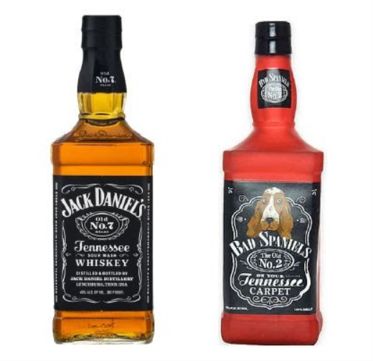
One court described the dog toy labelling and overall appearance as follows:
“Bad Spaniels” replaced “Jack Daniel’s”; “Old No. 2” replaced “Old No. 7”; and “Tennessee carpet” replaced “Tennessee whiskey.” At the bottom of the toy are the words “43% POO BY VOL.,” in place of standard alcohol-by-volume language, and “100% SMELLY.” The top of the label features, as the district court put it, “a wide-eyed spaniel.” The back of the toy includes a disclaimer stating that the “product is not affiliated with Jack Daniel Distillery.” The toy is in the shape of a square liquor bottle, and, like Jack Daniel’s Old No. 7 whiskey, features a black label with white lettering and filigree.
History of the Case
Multiple decisions ensued over a decade at every level of the federal judiciary:
- District Court for Jack Daniel’s. VIP sought a declaration that it did not infringe or dilute the Jack Daniel’s trademarks. The U.S. District Court for the District of Arizona held for Jack Daniel’s on both claims after a four-day trial, resulting in a permanent injunction.
- Ninth Circuit for VIP. VIP appealed to the U.S. Court of Appeals for the Ninth Circuit. The Court of Appeals vacated the District Court’s decision on infringement and reversed the decision on dilution. On the infringement claim, the Court of Appeals deemed BAD SPANIELS an “expressive work” communicating a humorous message possibly protected by the First Amendment of the U.S. Constitution and returned the case to the District Court for a further determination. The Court of Appeals viewed the parody of Jack Daniel’s famous marks to be a “noncommercial use” that was a “fair use” protected against the dilution claim.
- District Court for VIP. On remand, the District Court granted summary judgment to VIP on both the infringement and dilution claims.
- Ninth Circuit for VIP. Jack Daniel’s appealed to the Court of Appeals, which summarily affirmed in favor of VIP on both infringement and dilution.
- Supreme Court for Jack Daniel’s. At Jack Daniel’s request, the U.S. Supreme Court took the case. It reversed the decision of the lower court. Jack Daniel’s Properties, Inc. v. VIP Products LLC, 599 U.S. 140 (2023).
The Supreme Court began by saying, “This case is about dog toys and whiskey, two items seldom appearing in the same sentence.”
Expressive message defense. As our Firm previously reported in VIP Products in the Doghouse over “Bad Spaniels” Dog Toy Parody of “Jack Daniel’s” Whiskey, VIP defended on the ground that it was delivering an “expressive message” of the kind held to be protected speech under the First Amendment in Rogers v. Grimaldi, 875 F.2d 994 (2d Cir. 1989).
Rogers test. Under the Rogers test, an infringement claim against a mark having an “expressive message” must be dismissed, unless the complainant shows either that (1) the challenged mark “has no artistic relevance to the underlying work,” or (2) it “explicitly misleads as to the source or content of the work.” Jack Daniel’s could not make either showing, so the VIP “expressive message” defense would have prevailed under the Rogers test.
Infringement limitation. The Supreme Court limited the application of this infringement defense in cases such as this. Although some Justices questioned the viability of the Rogers test, the Court unanimously held that the Rogers test does not apply where the challenged use of a mark is “as a mark” to indicate the source of the defendant’s own goods, whether or not the mark conveyed some message in addition to “source.” This appeared to be an important decision favoring plaintiffs like Jack Daniel’s in trademark infringement cases.
The Supreme Court nevertheless held that a trademark’s “expressive message,” particularly a parodic one, may properly figure in assessing likelihood of confusion, “because consumers are not so likely to think that the maker of a mocked product is itself doing the mocking.” Therefore, the case was sent back for the lower courts to consider if VIP’s parody defense would yield a different result on the infringement claim.
Dilution limitation. The Supreme Court more easily dispatched the claim of dilution by tarnishment, holding that the statutory non-commercial “fair use” dilution exclusion expressly “does not shield parody or other commentary when its use of a mark is similarly source-identifying.”
- District Court for Jack Daniel’s. On remand, Court of Appeals further remanded the case to the District Court, which held that (a) on infringement, Jack Daniel’s did not show a likelihood of confusion, but (b) on dilution, VIP was liable for associating the famed whiskey with “dog excrement,” a form of reputational tarnishment. Based on this tarnishment finding, the District Court again issued a permanent injunction and final judgment.
- Ninth Circuit for VIP. VIP again appealed the dilution by tarnishment determination to the Court of Appeals. In its latest decision, VIP Products, LLC v. Jack Daniel’s Properties, Inc., Appeal No. 25-2027 (9th Aug. 4, 2026), the Court of Appeals again reversed the District Court’s decision, ordering the injunction vacated.
The Latest Ninth Circuit Opinion Favoring VIP
Famous marks. The Court of Appeals observed that dilution protects only a famous mark that the general consuming public regards as a “household name.” It ruled that JACK DANIEL’S and the whiskey’s registered trade dress were proved to be famous, but “Old No. 7” was not. The parties did not dispute that BAD SPANIELS and the dog toy’s trade dress were similar to the two famous marks.
Failure to prove that the parody caused reputational harm. The sole issue to be considered was whether Jack Daniel’s had carried its burden of proving that the contested marks were likely to tarnish the reputation of its two famous marks. The Court of Appeals held that Jack Daniel’s had not met its burden.
Jack Daniel’s attempted to show its reputational harm through survey expert testimony. The expert acknowledged that “[n]o [consumer] would think that there’s poo in the Jack Daniel’s product” but concluded that VIP nevertheless “created a mental association between Jack Daniel’s and poo. . ..”
The Court of Appeals accepted the expert’s conclusion that “the point of VIP’s product was to bring Jack Daniel’s whiskey to mind,” but rejected as “pure conjecture” his conclusion that this had a tarnishing effect. Notably, the expert had based his conclusion on “some broad concept of defecation and consumption of food and drink products,” but he had not conducted any study specific to the BAD SPANIELS dog toy, which the Court of Appeals described as “a parodic dog toy not intended for human consumption.” The expert’s analysis had ignored the effect of the “humorous difference” of the VIP’s parodic mark.
The Court of Appeals concluded that the failure “to consider the impact of VIP’s obvious parody on the likelihood of tarnishment was a critical misstep, and the district court erred in adopting the conclusions that followed.”
Conclusion. The Court of Appeals held that the evidence did not sustain the likelihood of dilution claim, given the obvious parody by VIP’s dog toy. The Court of Appeals vacated the District Court’s permanent injunction and ordered judgment entered in favor of VIP.
The content of this article is intended to provide a general guide to the subject matter. Specialist advice should be sought about your specific circumstances.
[View Source]