

- in Europe
- in Europe
- within Law Department Performance and Corporate/Commercial Law topic(s)
A recent EAPA evasion finding against a solar importer reveals how a single country-of-origin misclassification can trigger steep consequences, even when the importer fully cooperates with CBP.
KEY TAKEAWAYS
- CBP issued a Notice of Determination as to Evasion in an EAPA case, finding that a major solar-module importer evaded antidumping AD/CVD orders on crystalline silicon photovoltaic cells.
- Report the cell, not the module. For solar modules assembled in a third country, the AD/CVD-relevant country of origin is where the cell was made, not where the module was assembled. Declaring the assembly country can be a material, false statement under EAPA.
- Cooperation does not erase the duty. The company fully cooperated, but CBP found evasion anyway.
- The exposure is severe. Cash-deposit rates reached up to 271.28% (Vietnam AD) and 238.95% (China-wide AD).
- If you assemble abroad and import into the U.S., audit your country-of-origin declarations now — before an allegation does it for you.
The Evasion Case
On June 23, 2026, U.S. Customs and Border Protection (CBP) issued a Notice of Determination as to Evasion in EAPA Consolidated Case No. 8163, finding substantial evidence that a major solar-module importer evaded antidumping (AD) and countervailing (CVD) duty orders on crystalline silicon photovoltaic cells. The finding reached the Vietnam Circumvention Determination and the Malaysia and Vietnam AD/CVD Orders.
The company, Waaree Energies Ltd., cooperated fully with the investigation. It answered every CF-28, RFI, and supplemental RFI on time. Its supplier responded too. It hosted a five-day on-site CBP verification at its facility in India, opened its SAP traceability system, and let officers watch live production. CBP expressly declined to apply adverse inferences because of that cooperation, and verification confirmed the company did not import modules made with Chinese-origin cells into the United States.
CBP found evasion anyway.
The trap was not the transshipment of Chinese products. It was how the country of origin was reported. For roughly four years, the importer declared India, the country of assembly, as the country of origin on its entry summaries, filing as non-AD/CVD Type 01 entries. For AD/CVD purposes, origin follows the solar cell, not the module. That reporting gap is what CBP called a material, false statement resulting in unpaid cash deposits.
Key Learnings for Importers
- Origin is determined by the cell, and the effective dates are everything
Commerce’s circumvention finding contains a specific exclusion: cells made in Cambodia, Malaysia, Thailand, or Vietnam (even from Chinese wafers) that are exported to a non-inquiry country like India and assembled into modules are not covered by the circumvention inquiries. So, during the window from April 1, 2022, to October 4, 2024, Southeast-Asian cells assembled into modules in India were outside the circumvention determination.
Coverage attached in two distinct ways. First, where the importer shipped cells that remained in their original, unassembled state out of India, those entries fell under the Vietnam Circumvention Determination. Second, once the Malaysia and Vietnam AD/CVD Orders took effect – CVD cash deposits from October 4, 2024, and AD from December 4, 2024 – modules assembled from those cells and entered on or after the cash-deposit dates became subject to the orders. The exclusion that protected earlier entries simply stopped applying.
The practical rule: know your cell’s origin and the precise cash-deposit effective dates, and re-test your declarations against both whenever an order or circumvention finding moves.
- “We assemble abroad” is not a country-of-origin answer
The importer relied on Indian customs rules, under which origin tracks where the module was constructed. That logic does not govern U.S. AD/CVD reporting. CBP’s position is that Commerce’s third-country case numbers created a practice of reporting the origin of the cell, not the country of module assembly. Foreign origin rules and U.S. trade-remedy origin rules are not interchangeable, and assuming they are is how a compliant-looking importer ends up with an evasion finding.
- Cooperation governs the record — it does not cure the misdeclaration
This is the most misunderstood feature of EAPA. Cooperation determined how CBP built its case: because the importer cooperated, CBP relied on verified production and accounting records rather than adverse inferences, and it narrowed the finding to the entries actually covered rather than sweeping in everything. That is a meaningful, quantifiable benefit.
But cooperation cannot retroactively make a four-year stream of misdeclared entries correct. The duties were owed; the declarations were wrong; the finding followed. Importers who believe a clean verification equals a clean outcome are reading EAPA backwards.
- The consequences are retroactive and expensive
On an affirmative determination, CBP suspends liquidation on all covered entries, rate-adjusts and converts extended entries to Type 03, and may demand single-transaction bonds. The cash-deposit rates in play here:
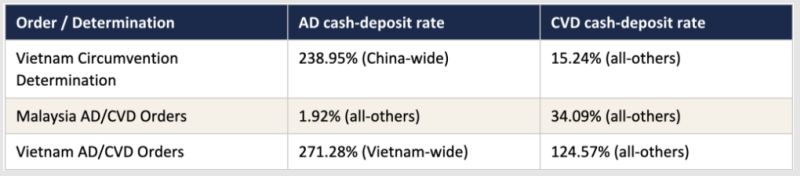
And CBP was explicit that none of this precludes additional enforcement actions or penalties, including, potentially, 19 U.S.C. § 1592 penalties layered on top.
The Outcome: What Importers Should Do Now
If you assemble solar modules or any AD/CVD-sensitive product outside the country where the dutiable input is made, treat this determination as a direct instruction. The following actions are ranked by urgency:
- Audit your origin declarations against the input, not the assembly. For every entry, confirm whether the AD/CVD-relevant origin is the cell/component or the finished good. Map each to the correct case number.
- Build cell-level traceability before CBP asks. Waaree’s SAP system that matched each module to a specific cell batch is exactly what verification tests require. If you cannot trace the input origin batch-by-batch, you cannot defend your declarations.
- Re-test declarations against every effective date. Circumvention findings, preliminary determinations, and final orders each carry their own cash-deposit dates. An entry that was excluded last quarter may be covered this quarter.
- Consider a prior disclosure if you find a gap. A voluntary prior disclosure under 19 U.S.C. § 1592(c)(4) made before CBP discovers the issue can substantially limit penalty exposure. Timing is the entire value.
- Do not assume cooperation alone protects you. Cooperate fully when an investigation starts — it materially improves the record — but pair it with a substantive legal position on coverage and effective dates.
Contact Diaz Trade Law for AD/CVD Assistance
EAPA investigations move on compressed statutory timelines with limited rights to respond and the consequences. Retroactive duties at triple-digit rates, suspended liquidation, and follow-on penalties can dwarf the value of the goods. Diaz Trade Law represents importers across the full EAPA lifecycle: pre-allegation compliance audits and origin reviews, CF-28 and RFI responses, verification preparation, written arguments, prior disclosures, and administrative review and CIT appeals of adverse determinations.
The content of this article is intended to provide a general guide to the subject matter. Specialist advice should be sought about your specific circumstances.
[View Source]