- within Government and Public Sector topic(s)
- in United States
| Go-To Guide: |
|
Background
On April 15, 2025, President Donald Trump issued Executive Order (EO) 14275, Restoring Common Sense to Federal Procurement, “to create the most agile, effective, and efficient procurement system possible.” EO 14275 explained that the FAR “has swelled to more than 2,000 pages of regulations, evolving into an excessive and overcomplicated regulatory framework and resulting in an onerous bureaucracy.” The policy focus is “[r]emoving undue barriers, such as unnecessary regulations, while simultaneously allowing for the expansion of the national and defense industrial bases is paramount.” EO 14275 directed the FAR Council and Office of Management and Budget (OMB) to create an efficient set of procurement regulations that contains only provisions required by statute or essential to sound acquisition strategies.
On May 2, 2025, OMB issued Memorandum M–25–26 to implement EO 14275, in which OMB announced the “Revolutionary FAR Overhaul” (RFO). During Phase I of the RFO, the FAR Council reviewed and revised the FAR via “model deviations.” Once the model deviations were published on the acquisition.gov website (note, not formally published in the Federal Register), all executive agencies had 30 days to implement the model deviations by issuing agency class deviations. The agency deviations adopted the model deviations, making them applicable by agency.
On June 23, 2026, as part of the Revolutionary FAR Overhaul (RFO) process, the FAR Council issued four separate proposed rules to amend various parts of the FAR to implement EO 14275.
In our first GT Alert concerning the RFO Rulemaking, we discussed the proposed FAR CUI Rule, contained in RFO Part 40. Our second GT Alert about the RFO Rulemaking discussed the proposed changes to the deadlines in FAR Part 49, concerning termination settlement proposals. In our third GT Alert, we discussed the proposed changes to FAR Part 33, which governs the bid protest process.
In this GT Alert, we discuss the proposed changes to FAR Part 5, which governs publicizing contract actions.
RFO Phase I: Changes from the Current FAR to the RFO Deviation
The most significant change implemented during Phase I of the Revolutionary FAR Overhaul was the complete restructuring of FAR Part 5. The traditional framework consisting of seven subparts was replaced with a streamlined structure organized around the three primary phases of a procurement lifecycle:
- Subpart 5.1 – Presolicitation
- Subpart 5.2 – Solicitation
- Subpart 5.3 – Award
In connection with this reorganization, the FAR Council removed Subpart 5.4 (Release of Information), Subpart 5.6 (Publicizing Multi-Agency Use Contracts), and Subpart 5.7 (Publicizing Requirements Under the American Recovery and Reinvestment Act of 2009). The FAR Council explained that these provisions were duplicative, obsolete, or no longer necessary. The deviation largely abandoned the FAR’s longstanding use of the term “synopsis,” and instead uses the broader concept of a “notice posted to the Governmentwide Point of Entry (GPE),” which is SAM.gov. The deviation also introduces new definitions for terms such as “notice,” which is defined as “a description of a business opportunity, contract action, or other information posted to the GPE,” and “presolicitation notice,” which is “a notice used to notify industry and the public that the Government intends to release a solicitation in the near future.”
The deviation replaced several narrative notice requirements with standardized tables specifying: required content, applicable thresholds, and minimum posting periods (Tables 5-1, 5-2, 5-3, and 5-4). This approach was intended to improve usability and make notice requirements easier to locate and apply.
Further, the deviation established a lower posting tier covering acquisitions greater than $20,000 but not greater than $25,000.
Finally, the deviation explained that solicitations generally need not be posted when a presolicitation notice was exempt or when the presolicitation notice itself serves as the required posting.
RFO Phase II: Further Changes to FAR Part 5 Under the Proposed Rule
Although the proposed rule largely adopts the Phase I deviation, the FAR Council proposes several notable refinements.
One notable change is the decision to move commercial acquisition publicizing requirements from FAR Part 5 to FAR Part 12. According to the FAR Council, commercial-acquisition notice requirements should be consolidated in Part 12 rather than scattered throughout Part 5. To accomplish this, the proposed rule would revise FAR 5.000, FAR 5.101(c)(4)(ii), and Tables 5-2 and 5-3 to remove commercial-acquisition-specific instructions.
Second, another important change is that the proposed rule would replace the $20,000 to $25,000 presolicitation notice threshold with a $20,000 to $45,000 threshold:
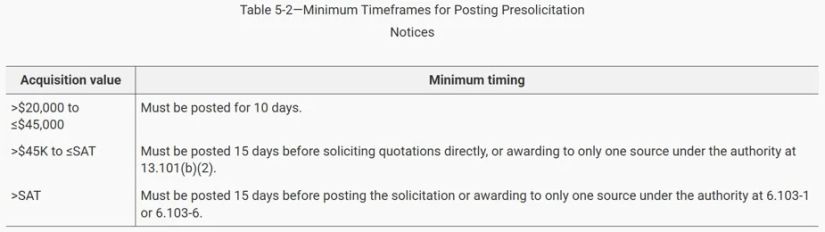
Third, the proposed rule clarifies that agencies using the national security authority in FAR 6.103-6 generally must still post a presolicitation notice unless the notice itself would reveal information that could compromise national security.
Fourth, the proposed rule goes further than the deviation by expressly identifying additional circumstances where solicitation posting is unnecessary, including:
- certain sole-source acquisitions conducted under FAR 6.103;
- acquisitions at or below the simplified acquisition threshold solicited from one source under FAR 13.101; and
- acquisitions at or below the simplified acquisition threshold solicited from at least three sources under FAR 13.201.
Finally, the proposed rule would revise FAR 5.302 to make public announcements of significant contract awards permissive rather than mandatory. Public announcements include announcements made in press releases, agency websites, media announcements, and other public communications not posted on SAM.gov. Agencies would be permitted — but no longer required — to publicly announce such awards. For awards below $5.5 million, there is no obligation to publicly announce the award separately from SAM.gov. Only for awards above $5.5 million does an agency need to consider whether to publicly announce awards. As a practical matter, contractors may see fewer public announcements regarding smaller and larger contract awards, even though separate SAM.gov notice requirements may continue to apply.
Takeaways
At first glance, the proposed changes to FAR Part 5 may not seem noteworthy. However, under the proposed FAR 5.301, a SAM.gov award notice is only required to state: (1) a description of the supplies or services; (2) contracting office and address; (3) contractor receiving the award; (4) contract award dollar amount, and (5) contract award date.
In contrast, public announcements frequently contain information that exceeds the amount of information posted on SAM.gov, such as: (1) contract value; (2) place of performance; (3) description of the work; (4) contract vehicle used; and (5) statements regarding the awardee’s capabilities. If agencies stop issuing detailed press releases, some of that information may become harder to obtain quickly for contractors to monitor competitors and procurement activity in developing potential protest grounds.
Comments on the proposed rule are due by July 23, 2026. Contractors that rely on public announcements to monitor contract awards where they may compete should consider whether the proposed reductions in notice and announcement requirements appropriately balance efficiency, competition, and transparency.
The content of this article is intended to provide a general guide to the subject matter. Specialist advice should be sought about your specific circumstances.
[View Source]