

Capitol Update
The first legislative funnel has come and gone, with approximately 770 subcommittee meetings scheduled thus far this session, 183 of which were scheduled this week alone. Any policy bills that did not advance out of both a subcommittee and full committee prior to the funnel deadline is considered "dead" for the session. Exceptions apply to bills referred to Appropriations, Ways and Means, Government Oversight, and leadership-sponsored bills.
Bills that cleared a full committee in either chamber remain eligible for further consideration until the second funnel deadline on March 20, 2026. By that date, legislation must pass one chamber and advance through a committee in the opposite chamber. The next week will focus largely on floor debate as members work to advance legislation.
Education Funding
The House debated education funding on Thursday afternoon. The Senate approved a 1.75% funding increase last week by the passage of SF 2201. The House Education Committee amended the proposal to 2%, aligning with the Governor's recommendation. The House passed SF 2201 with a vote of 58-35. In addition to funding discussions, the House Education Committee also advanced bills on play-base learning, the Condition of Education report, and teaching endorsements. Two charter school bills, HSB 676 and HSB 735, advanced by a 14-9 vote. House Study Bill 676 increases funding for charter schools, allows students to participate in activities at a public school, and requires drivers education classes. House Study Bill 735 increases funding to schools, adds charter school employees to IPERS, categorizes charter schools as local education agencies, and addresses various funding allocations. Both of these bills have companion bills that also advanced by a 9-5 vote in the Senate Education Committee. A homeschool tax-credit proposal, HF 2078, was not brought forward for a vote.
Energy Proposals
Several energy-related measures advanced this week. The House Commerce Committee approved HSB 629 which would establish a framework for community solar around the state and thereby reducing utility bills for certain Iowans and providing landowners an additional income stream. HF 2365 was unanimously approved by the House Commerce Committee. The bill requires investor-owned utilities to file Integrated Resource Plans (IRPs) to improve transparency in long-term resource planning. While initially requiring filings every three years, the committee amended the bill to require filings every five years. The legislation also establishes a framework for Virtual Power Plants, allowing customers to contribute energy resources to the grid which is particularly important during peak hours.
Alcohol-Related Matters
HSB 710 advanced through the House State Government and would allow native wineries to hold three Class C licenses. Transferring alcohol between facilities or businesses with the same owners, currently prohibited, would be permitted under HSB 712 which passed 13-8 in the same committee. HF 2403 relating to the state's monopoly on importing liquor passed also by a 13-8 vote, allowing imports starting in 2027.
E-Verify
Following the arrest and subsequent citizenship concerns of Des Moines Public School District's former superintendent, the Governor has called for all state agencies to use the federal E-Verify system to approve the citizenship status of new state employees. This would apply to any new applicants to any state agency or any Regents institutions. SSB 3169 and HSB 663 both moved through their respective committees, requiring E-Verify to be used for all new employees and for DIAL to set up a system for requests of professional licensing boards.
Scene on the Hill
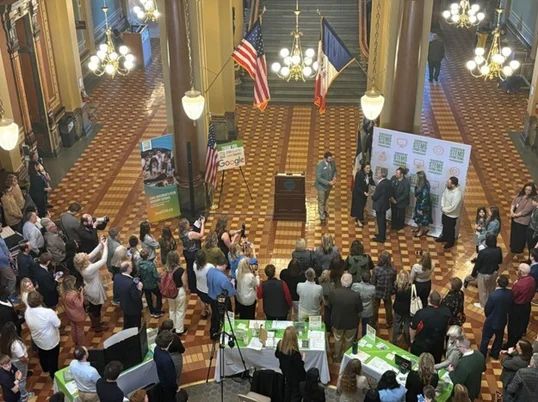
February 18, 2026: Lieutenant Governor Cournoyer presents STEM awards to recipients in the Capitol rotunda as part of the Iowa Governor's Stem Advisory Council Day on the Hill.
The content of this article is intended to provide a general guide to the subject matter. Specialist advice should be sought about your specific circumstances.


