

As the April 15 filing deadline approaches, lawful permanent residents should be aware of a new addition to Form 1040, U.S. Individual Income Tax Return that may carry implications beyond tax compliance, particularly in the evidentiary context of naturalization.
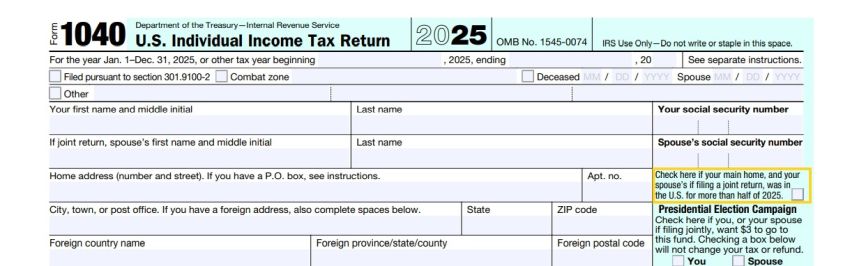
Beginning this year, the Form 1040 includes a prompt asking filers to:
“Check here if your main home, and your spouse’s (if filing jointly), was in the United States for more than half of 2025.”
While this question appears administrative, it introduces a data point for lawful permanent residents that may later be reviewed in the context of a naturalization application.
Why should this box be checked?
Most green card holders (lawful permanent residents) complete the Form 1040 each year when filing their tax returns, as required by law. Lawful permanent residents must show that they are domiciled in the U.S., meaning they currently live, or are planning to live, in the country for the foreseeable future.
In order to naturalize and become a U.S. citizen, green card holders must meet continual residence and physical presence requirements. They also must have submitted tax returns as proof of good moral character for naturalization.
Therefore, not checking this box when the statement is true could pose issues for lawful permanent residents during the naturalization application process in the future.
What if I’ve already filed my 2025 taxes and did not check this box?
Because this is a newly added question on the Form 1040, there is currently no formal guidance on how United States Citizenship and Immigration Services (USCIS) will weigh this factor in adjudications.
Additionally, USCIS officers could provide some discretion during the naturalization process, since the box was just added to the tax return form this year. However, that is far from certain.
Green card holders who have already completed their 2025 tax return but did not check the noted box should consult with experienced tax and immigration counsel to discuss their options.
Potential remedies may include filing a superseding return (before the April 15 deadline) or an amended return. The appropriate course of action depends on the broader factual and legal context.
Conclusion
In the naturalization context, a single inconsistency, particularly in a filing such as a tax return, may not be disqualifying, but it can influence how the totality of the evidence is interpreted.
As additional data points are incorporated into an application, alignment across filings becomes increasingly important in presenting a coherent record.
Lawful permanent residents should contact experienced counsel to learn more about their specific circumstances.
(Photo of Form 1040 via IRS.gov)
The content of this article is intended to provide a general guide to the subject matter. Specialist advice should be sought about your specific circumstances.
[View Source]