

- within Finance and Banking topic(s)
- in United States
- with readers working within the Banking & Credit and Law Firm industries
- within Finance and Banking topic(s)
- in United States
- within Transport, Media, Telecoms, IT, Entertainment and Family and Matrimonial topic(s)
- with Inhouse Counsel
- with readers working within the Law Firm industries
As recently as 2019, the total value of stablecoins in circulation was just $1 billion. Today it's nearly $300 billion, and forecasts suggest that figure could reach $4 trillion by 20301. Demand from Generation Z, active non-bank issuers, and a new payments paradigm mean that banks cannot ignore stablecoins. Where are we now, what's next, and what does it mean for banks?
Stablecoin 101
Stablecoins store and transfer value, linking digital and traditional finance. This article focuses on payment stablecoins - digital tokens issued on a blockchain, with values pegged to fiat currencies, making them convertible at par. It is the currency peg that distinguishes payment stablecoins from other digital money like cryptocurrencies or CBDCs2, and also from stablecoins underpinned by commodities, cryptocurrencies or algorithms. Currently, 99% of stablecoins are pegged to the US dollar.
To date, non-bank issuers have been the biggest stablecoin players, led by Tether's USDT and Circle's USDC. Now, however, growing regulatory clarity and political support are encouraging a range of financial and other institutions including Amazon and Walmart to issue stablecoins.
The benefits of payment stablecoins (which from here we will refer to as simply stablecoins) include immediate settlement and payment, global wallet-based access, lower payment costs than legacy networks, liquidity benefits and interoperability.
"Growing regulatory clarity and political support are encouraging a range of financial and other institutions including Amazon and Walmart to issue stablecoins."
Stablecoins have a wide range of use cases for individuals and institutions, including settling digital asset transactions, payments and remittances, capital markets settlements, and interbank transactions. They're especially valuable to users unable to access or afford conventional banks – and, in this way, banks issuing stablecoins can attract new customers.
Like any instrument, stablecoins are not without risk. It is possible for values to deviate from par, at times of dislocation, as happened in 2023 when a slice of USDC's reserves were jeopardised by the collapse of Silicon Valley Bank3. Where stablecoins have insufficient liquidity or reserves there is scope for a 'run' with potential systemic effects; in 2021 Tether settled a case alleging misrepresentation of reserves4.
In the event of a failure, whether arising from technological or reserving problems, holders would not be protected by conventional deposit protection. Users are also exposed to counterparty risks, like the 2022 collapse of digital exchange FTX. Finally, the anonymity of stablecoins creates obvious potential for their unregulated use to facilitate money laundering, terrorist financing or sanctions evasion.
Regulation: A shifting picture
Stablecoin regulation is evolving rapidly, with policymakers rushing to address potential risks and promote innovation. The geo-economic implications of stablecoins mean that a degree of 'regulatory competition' is also at work.
Key considerations include:
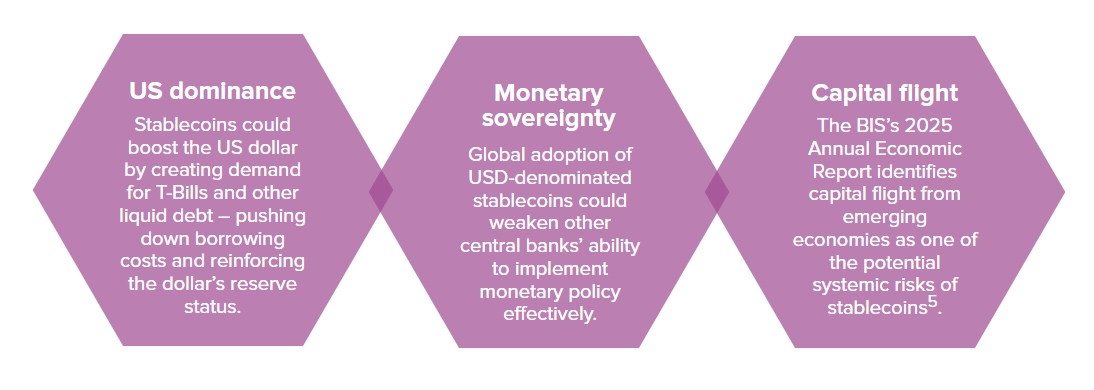
The features of reliable stablecoins are well understood: full backing by cash or fungible, liquid assets; convertibility at par; no payment of interest; segregated reserves; transparent reporting; and periodic external verification.
In practice though, different jurisdictions use a variety of regulatory techniques, sometimes via dedicated stablecoin legislation and sometimes via existing financial rules.
To view the full article please click here.
The content of this article is intended to provide a general guide to the subject matter. Specialist advice should be sought about your specific circumstances.
[View Source]


