

2025 proved to be a challenging year in court for the Federal Trade Commission (FTC), as it was unsuccessful in challenging the Tempur Sealy/Mattress Firm acquisition, the GTCR/Surmodics acquisition, a decade-old Meta Platforms acquisition, and (on appeal) the Microsoft/Activision Blizzard acquisition. These decisions provide several key takeaways for companies contemplating future M&A.
In Depth
Overly aggressive, narrow product markets hurt the agencies' claims
Courts have rejected relevant markets proposed by the FTC where the narrow segmentation is belied by the record and industry norms. In Tempur Sealy, the FTC alleged a "premium" market for mattresses over $2,000. The district court disagreed, finding competition for mattresses "fierce" and noting that the FTC's own expert admitted that he picked $2,000 as a threshold merely because it gave Mattress Firm higher shares. In the retroactive challenge to Meta, the FTC's proposed market included Facebook, Instagram, Snapchat, and MeWe but excluded YouTube and TikTok (which are not owned by Meta). The district court disagreed, finding that YouTube and TikTok were competitive substitutes to Facebook and Instagram. Ultimately, market definition is very fact dependent, and the agencies have won many cases by proving narrow markets where facts supported them, especially when business documents align with the narrow-alleged market. The FTC announced on January 20, 2026, that it will appeal the district court's decision in Meta, and it remains unclear whether retroactive challenges — brought after market conditions have significantly changed since the original acquisition — will gain traction on appeal.
Courts are inclined to accept remedies as a fix to merger challenges
In Tempur Sealy and GTCR, the courts found that the merging parties' proposed remedies mitigated any antitrust concerns. In GTCR, to address the horizontal overlap, the merging parties proposed a fix during the course of litigation to sell portions of GTCR's Biocoat to Integer. In Tempur Sealy, to address vertical concerns, the judge found that behavioral remedies (e.g., slot commitments and supply agreements) and a small divestiture of stores undermined the FTC's concerns. Similarly, in Microsoft, the court found that Microsoft's licensing agreements and pledge to keep Activision's key games on all platforms addressed the vertical foreclosure issues. Even when the regulators are unwilling to accept the proposed remedy, these cases demonstrate that courts are giving significant weight to remedies, enabling the parties to "litigate the fix" and prevail at trial.
Vertical challenges are hard to win
The courts have rejected vertical foreclosure theories of harm that rely solely on market share or a "big is bad" approach. In both the Microsoft/Activision Blizzard acquisition and the Tempur Sealy acquisition, the FTC failed to provide concrete evidence of likely foreclosure of competitors, post-acquisition. In Microsoft, the court found that Microsoft lacked profit incentives to only make games available on Microsoft's gaming system, Xbox. In Tempur Sealy, in addition to the behavioral remedies offered, the court found the potential foreclosure harm for competitors was overstated, as Mattress Firm was not a critical sales channel for mattress manufacturers. While Mattress Firm was a large retail outlet, there were many other channels through which mattress suppliers could reach customers.
The FTC is moving away from in-house challenges
In its most recent transaction challenge, the FTC signalled a significant change in its enforcement practices, opting only to challenge the Henkel and A-Paint merger in federal court via a permanent injunction, rather than initiating an administrative action in parallel. Historically, the FTC has utilized Section 13(b) of the FTC Act, which allows the agency to seek a preliminary injunction in federal court where an administrative challenge is pending at the FTC. Under Section 13(b), a court can grant a preliminary injunction enjoining the merger until the case is heard in the administrative action if the FTC raises questions on the merits of the deal that are "serious, substantial, difficult and doubtful." A permanent injunction, on the other hand, requires the FTC to succeed on the merits in proving that the merger may substantially lessen competition or tend to create a monopoly. While this change in practice means parties will only have to litigate one case at a time, the timeline for that challenge is likely to increase because of the additional legal and evidentiary standards that must be evaluated by the court. This change also aligns FTC antitrust enforcement more closely to that of the US Department of Justice (DOJ), which only utilizes a permanent injunction standard when challenging a merger.
Increased lobbying efforts in M&A prompts more state intervention
Twelve states and the District of Columbia have intervened in the latest settlement between the DOJ and merging parties, Hewlett Packard Enterprise (HPE) and Juniper Networks (Juniper). The HPE/Juniper settlement raised concerns after internal DOJ disagreements surrounding the deal became public, with former US Deputy Attorney General Roger Alford even calling the consent agreement "pay-to-play." The intervening states have decried the settlement as the product of undue influence by well-connected lobbyists.
The publicity surrounding the settlement agreement has also called renewed attention to the Antitrust Procedures and Penalties Act (Tunney Act). Under the act, the DOJ must file proposed settlements in federal court for review, and the court evaluates the settlement agreement to see if it is in the public interest.
The states' intervention in the HPE/Juniper settlement shows a pattern of increased state antitrust action amidst perceived politicized federal antitrust enforcement. Companies that are considering M&A activity should be cognizant that their lobbying efforts are likely to be monitored more closely, not just by the courts, but by state actors as well.
US Q4 2025 M&A activity: By the numbers
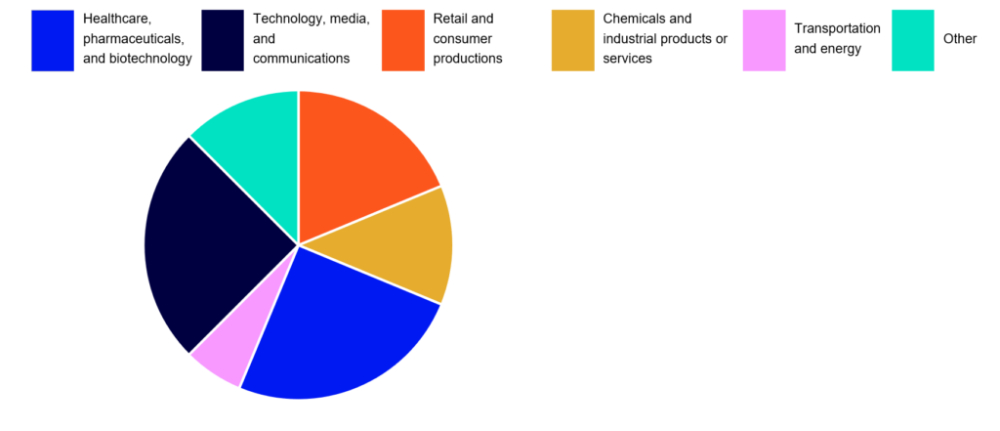
Number of enforcement actions in key industries1
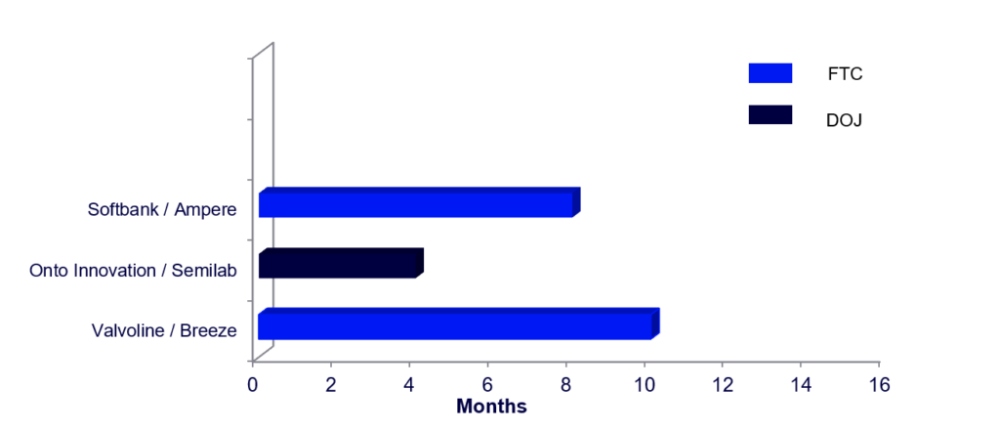
Snapshot of selected enforcement actions2
Time from signing to consent or investigation closing
Footnotes
1. For the United States, the graphs include cases we are aware of in which an antitrust enforcement agency issued a second request at some point and the investigation remained ongoing during the quarter, the agencies accepted a consent order or issued a complaint initiating litigation against the transaction, or the transaction was abandoned after an antitrust investigation.
2. These graphs are based on McDermott internal analysis and public press reports and filings. These graphs do not represent a complete list of all matters within a jurisdiction.
The content of this article is intended to provide a general guide to the subject matter. Specialist advice should be sought about your specific circumstances.


