

INTRODUCTION
After an 18-month period of consultation and review, Ofgem intends to publish its initial decision on the award of a cap and floor (C&F) for long-duration electricity storage (LDES) in Spring 2026. Ofgem plans to procure 2.7 to 7.7 GW of storage capacity in this first application window.1 The publication will follow the release of Ofgem’s project selection methodology, underlying financial parameters, and an initial draft of the licence.
Until recently, storage has been among the last technologies operating on a purely merchant model in the British electricity market. Ofgem and the Department for Energy Security and Net Zero (DESNZ) have expressed doubts that the market alone will address the expected peaks and troughs in a future renewables-led system. Instead, as is so often true of energy policy in the current environment, Ofgem and the National Energy System Operator (NESO) intend to replace imperfect market signals with imperfect market modelling. In response, industry stakeholders concerned by the distortive impact on market prices have already launched an appeal before the Competition Appeals Tribunal.2
Ofgem’s approach to setting C&Fs for LDES draws heavily on the C&F regime it developed for interconnectors in 2014.3 In this paper, we briefly describe Ofgem’s approach for assessing LDES applications for a C&F and highlight lessons learned from the interconnector regime. Ofgem’s decisions on interconnectors suggest that arguments over modelling assumptions and approaches to quantifying the benefits may have a material impact on which projects are approved for the C&F. The subjectivity inherent in Ofgem’s proposed approach for LDES is arguably even greater and risks inefficient outcomes. Depending on which projects are approved, Ofgem’s forthcoming decisions risk ending up where the whole process has begun—in dispute.
OFGEM’S THREE-STAGE PROCESS FOR SETTING CAPS AND FLOORS
The application process for the LDES C&F regime consists of three primary stages (see Figure 1): the eligibility stage, the project assessment (PA) stage, and the C&F determination stage. Ofgem plans that the process to final award will take up to 15 months from the beginning of the application period, ending in Q3 2026. During that period, Ofgem is designing the framework and assessing specific project applications in parallel.
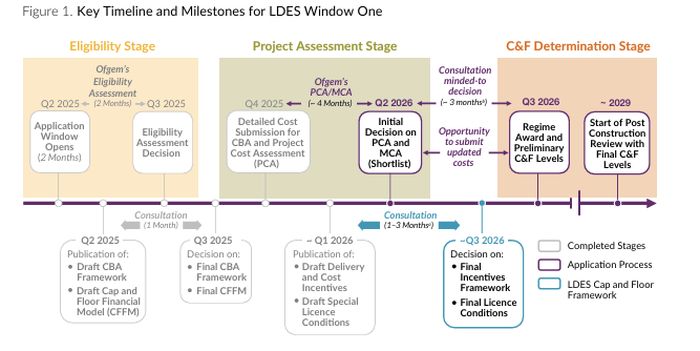
a The TDD only details the duration for consultation for the CFFM. Previous consultation periods on the interconnector scheme have lasted three months.
b Approximation based on duration of consultation period following minded-to decision for interconnectors.
Source: NERA adaptation of “Long Duration Electricity Storage: Technical Decision Document,” Ofgem, 11 March 2025, p. 13 and “LDES Window 1 Financial Framework Decision,” Ofgem, 23 September 2025, p. 11
Eligibility: Ofgem Approved 77 Projects
In the eligibility stage, Ofgem requires projects to demonstrate that they meet criteria set out in the Technical Decision Document (TDD), including:4
- The scheme is limited to new or refurbished projects that can be delivered by 2030 (Track 1) or 2033 (Track 2).
- The minimum capabilities the assets must be able to provide when operational. They include the minimum duration (eight hours) and the minimum discharge capacity (100 MW for established technologies with Technology-Readiness Level (TRL) 9 and 50 MW for more novel technologies with TRL 8).
- Further criteria that projects will be delivered to plan. They include requirements on the maturity of cost estimates and project plans, grid connection status, and planning consent.
Ofgem received a total of 171 applications to Window 1, with a total discharge capacity of 52.6 GW that far exceeded the capacity to be procured through the framework.5 In its eligibility decision, Ofgem allowed 77 projects to proceed to PA, which accounted for only 45 percent of total applicants and 55 percent of total capacity.
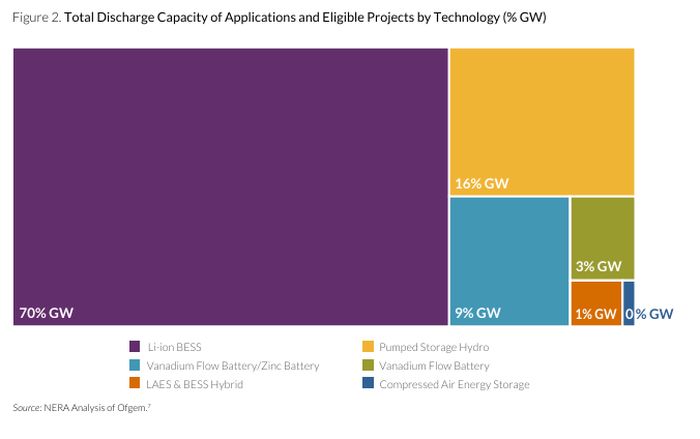
Most eligible projects are Li-ion BESS with 70 percent of eligible capacity, followed by pumped hydro (see Figure 2). Ofgem rejected all applications from iron-air, sodium sulphur, and hydrogen batteries and all but six of the 35 Track 2 applications for delivery by 2033.6 For those not involved in the decisions at project level, Ofgem’s reasons have been a black box; Ofgem has not published its decision on each application.
Project Assessment: Ofgem Adopts a Multi-Criteria Assessment
Successful projects from the eligibility assessment proceeded to the PA stage. During the PA stage, Ofgem is working with the NESO to select a list of projects that will receive a C&F award in Summer 2026. Ofgem plans to rely on a multi-criteria assessment (MCA) including an economic assessment (EA), a strategic assessment (SA), and a financial assessment (FA). Ofgem plans to publish an initial shortlist of projects in Spring 2026.
As we will describe in more detail, Ofgem’s MCA of LDES projects is opaque, which will make it difficult for project developers to reconcile and scrutinise its results. Specifically:
- The results of the MCA hinge on NESO’s simplified electricity market model, which is a black box to project developers and investors; and
- Ofgem and NESO retain high levels of discretion over each project’s outcome across assessments.
Economic Assessment: Ofgem Conducts a Cost-Benefit Analysis (CBA) to Estimate a Project’s Contribution to Socio-Economic Welfare (SEW)
Ofgem intends that the EA estimates the benefit each project will deliver to overall SEW over the regime horizon, including:8
- Monetised Impacts: Wholesale market revenues and costs; constraint management costs; contracts for difference (CfD) support scheme revenues and costs; project costs; security of supply costs; and carbon costs
- Non-Monetised Impacts: Real-time flexibility benefits; avoided renewable curtailment; natural capital, landscape, and local community; skills and supply chain; and economic growth
For the monetised impacts, NESO is using a proprietary market model to conduct a CBA that evaluates the net impact a project has on consumer and producer welfare, as well as system value. Ofgem will use the net benefit resulting the CBA to create an initial monetised ranking.9 The initial ranking will be adjusted by a project’s performance across the non-monetised impacts.
Financial Assessment: Ofgem and ARUP Assess Project Costs and Revenues to Estimate the Required Consumer Support for Each Project
In the FA, Ofgem uses submitted project costs and expected revenues to estimate required C&F payments by consumers. To avoid excessive consumer burden, Ofgem excludes projects in which it expects a high level of floor payments by consumers. The assessment essentially follows three steps:10
- Ofgem and its technical consultant ARUP assess the efficiency of cost estimates submitted by applicants and exclude costs they consider inefficient.11 Any costs excluded at this stage will also reduce the initial C&F levels (before postconstruction review) that determine project returns.
- Ofgem measures the revenue potential for each project. Ofgem considers revenues generated from (i) temporal arbitrage, (ii) alleviating network constraints, (iii) ancillary services, and (iv) the capacity market. Instead of relying on a project’s own revenue submissions, Ofgem estimates revenue components based on NESO’s market modelling and its own calculations.12
- Ofgem determines an FA score for each project based on the amount of consumer support required via floor payments.13 Projects that score below a minimum threshold and therefore require high levels of consumer support will not receive funding, while those scoring above a maximum threshold receive a higher ranking in the FA. Ofgem has not set out these thresholds in advance but will disclose them with its shortlist.
Footnotes
1. Ofgem states that this target aligns with NESO’s Future Energy Scenarios (2024). These indicate that the system requires an additional 2.7–7.7 GW of LDES by 2035. “Long Duration Electricity Storage: Technical Decision Document,” Ofgem, 11 March 2025, p. 15.
2. The battery operator Zenobe has applied to the Competition Appeal Tribunal for a review of the LDES scheme as a subsidy decision under the Subsidy Control Act 2022. Zenobe’s application argues that “the Scheme’s design risks distorting competition by enabling supported LDES projects to compete directly with unsupported short duration energy storage.” While Zenobe’s appeal is ongoing, there is a risk that the Ofgem’s September 2025 decision on the C&F framework could be quashed and that any decisions Ofgem makes on the successful applications could in turn be affected. Competition Appeal Tribunal, Case No. 1754/12/13/25, Zenobe Energy Limited v. Gas and Electricity Markets Authority, registered 22 October 2025, accessed 7 April 2026, available at https://www.catribunal.org.uk/ cases/1754121325-zenobe-energy-limited.
3. “Decision to Roll Out a Cap and Floor Regime to Near Term Electricity Interconnectors,” Ofgem, 6 August 2014, available at https://www.ofgem.gov.uk/sites/default/ files/docs/2014/08/decision_cap_and_floor_near_term_ electricity_interconnectors.pdf.
4. “Eligibility Criteria Assessment Framework for LDES Window One,” Ofgem, 8 April 2025, Appendix 2.
5. “LDES Eligibility Assessment Outcome,” Ofgem, 23 September 2025, Table 1.
6. The six Track 2 applications that Ofgem progressed to the PA stage include two out of three pumped storage hydro projects. See “LDES Eligibility Assessment Outcome,” Ofgem, Table 3.
7. Ibid.
8. “LDES Window 1 Cap and Floor Multi Criteria Assessment Framework,” Ofgem, 23 September 2025, p. 16–17.
9. Specifically, Ofgem will rank projects according to their benefit cost ratio (BCR). Ofgem calculates the BCR by dividing the calculated net benefits by a project’s costs. This allows Ofgem to normalise the SEW effects for differences in project size.
10. “LDES Window 1 Cap and Floor Multi Criteria Assessment Framework,” p. 37.
11. Ofgem and its technical consultant ARUP retain a level of discretion to exclude costs they deem inefficient in that they do not provide “appropriate, good value for money.” “Cap and Floor Cost Assessment Guidance,” Ofgem, 23 September 2025, p. 8.
12. Ofgem states that it will nonetheless use applicants’ revenue expectations for comparative and calibration purposes. “LDES Window 1 Cap and Floor Multi Criteria Assessment Framework,” p. 40.
13. To generate the FA score, Ofgem calculates the projected annual revenues (before payments to consumers) as a percentage of the project’s floor level. A score below 100 percent indicates that revenues fall below the floor, suggesting the project may require floor payments, and a score above 100 percent indicates that revenues exceed the floor, with no expected floor payments.
To read this article in full, please click here.
The content of this article is intended to provide a general guide to the subject matter. Specialist advice should be sought about your specific circumstances.
[View Source]
