The race is on for businesses to make the most of what AI can offer. The winners will hold a considerable edge over the competition. But, even given the rush to test, deploy and scale AI, there’s a long road ahead.
In late January and mid-February 2026, we surveyed 300 executives from organisations with at least £500 million in annual revenue. Of these, only 7% reported strong AI adoption across the entire organisation. This is despite nearly all executives (94%) stressing the strategic importance of AI.
This reveals a telling gap between ambition and execution: 55% admit that it has been more difficult than expected to scale AI across the organisation.
The problem is that AI is often implemented within isolated functions, without a defined organisational roadmap. At the same time, governments around the world are implementing their own AI rulebooks, creating a complex regulatory environment for businesses to negotiate.
Executives must go beyond simply developing AI models and tools to provide clarity on who owns AI, how it is to be used, and which risks are acceptable.
“What we see consistently is that organisations don’t fail on AI ambition – they stall on ownership and decision‑making," explains Jocelyn Paulley, Partner and Co-Lead of AI at Gowling WLG.
Without a clear mandate, defined risk appetite and senior accountability, AI stays stuck in pilots. The organisations that make progress are those that treat AI as an enterprise issue from day one, with legal, risk and the board aligned on how fast to move and where to draw the line.
Jocelyn Paulley, Partner and Co-Lead of AI at Gowling WLG
AI is advancing in pockets, not at scale
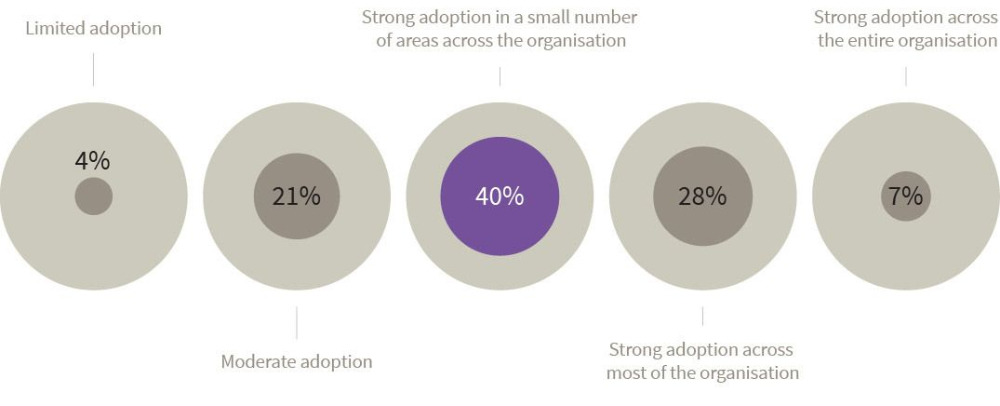
Organisations often use AI only within siloed functions. The largest proportion of executives describe their organisational AI adoption as “strong in a small number of areas”. In other words, many organisations have only scaled AI in a fragmented way, within specific functions.
40%
of executives report strong AI adoption in a small number of areas across the organisation
7%
report strong AI adoption across the entire organisation
The largest proportion of executives reports strong AI adoption in a small number of areas
Which of the following best describes the level of AI adoption within your organisation?
Why do silos persist? It’s easy for functions to experiment with different AI tools but, without clear guidelines and leadership engagement, these experiments happen in isolation, with teams selecting their own tools, data and workflows.
But when one function embeds AI effectively, it proves value and builds trust across the organisation. For example, the legal team at oil and gas multinational Shell used early adopters to accelerate engagement across the function. “The key is to have an eager group of volunteers: early adopters who try out the tool and share how they’re using it and the outcomes they’re seeing,” explains Gordon McCue, Shell’s Head of Legal Operations. “We also support teams directly with training, so they know how to integrate these tools into their day-to-day work. It then snowballs because people see the immediate benefits.”
This has seen Shell’s legal team lead the company in adoption of AI tools such as Copilot, and it’s now applying the same approach to agentic AI. “You can give a lot of advice on AI but there’s more weight to it if you are using AI in your own function,” says McCue. “You build the credibility with the business when you’re walking the talk.”
You can give a lot of advice on AI, but there's more weight to it if you're using AI in your own function.
Gordon McCue, Shell’s Head of Legal Operations.
Uneven regulation means uneven progress
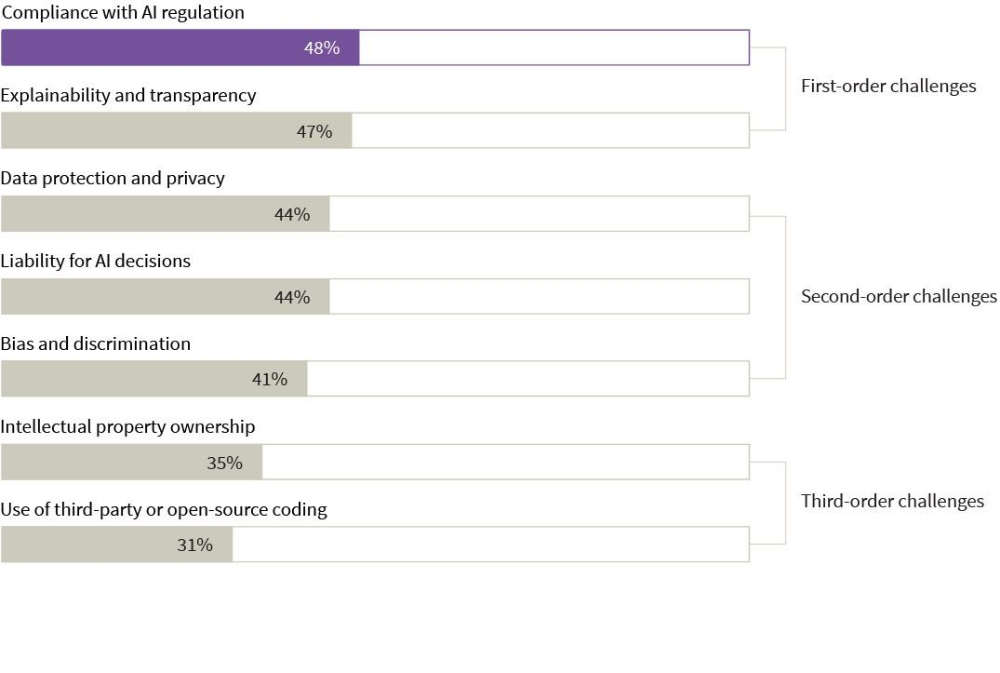
Executives identify compliance with fragmentary AI regulation as the greatest challenge to adopting and using AI. “There are 2,000-plus AI regulations globally,” says Lavonne Burke, VP Legal, Global Security & Resiliency, Digital (IT) and AI at Dell Technologies. “In 2025, 1,200 regulations were introduced in the US alone.”
This means that there is no global standard for AI deployment. As a result, AI is no longer just about building models and deploying tools. Legal design, risk classification and governance architecture are now also crucial considerations when designing an AI-driven solution.
40%
of executives rank compliance with AI regulation among their top three greatest challenges to adopting and using AI within their organisation
47%
of executives rank explainability and transparency among their top three greatest challenges to adopting and using AI within their organisation
Compliance and explainability present the greatest challenges to AI implementation
Which of the following legal and regulatory issues present the greatest challenge to adopting and using AI within your organisation?
Regulatory uncertainty is an ongoing issue. In late March 2026, for example, the European Parliament voted to delay parts of the EU AI Act, obliging executives to choose between halting progress or continuing to scale AI without full regulatory clarity.
Burke says organisations should focus on putting strong AI governance foundations in place as regulation continues to develop. “Although the regulatory landscape is still developing, organisations have a strong sense of where it’s going. The priority now is to build scalable frameworks that can adapt as rules evolve,” she explains. “In a fast-moving environment, organisations need to move forward while building compliance, governance and risk management into their approach from the outset. Flexibility matters more than trying to achieve perfect compliance in every area from day one.”
This highlights an important point: in practice, regulation is downstream of getting the operational foundations right. “Operational risk is the number one challenge, with regulatory risk a fast follower,” Burke argues. “Compliance matters, but if an AI system meets regulatory requirements yet doesn’t operate effectively, that doesn’t help. Organisations need to address issues like security, accuracy and resiliency first – otherwise they won’t have a system that’s worth deploying, let alone one that can meet regulatory standards.”
Good governance is the key to scaling AI
At its core, scaling AI is less of a technical challenge and more of a governance challenge. Without clear governance, AI initiatives stall. All executives reporting limited AI adoption and 40% of executives overall say they lack clarity over who’s responsible for AI governance.
40%
of executives say they lack clarity over who’s responsible for AI governance
67%
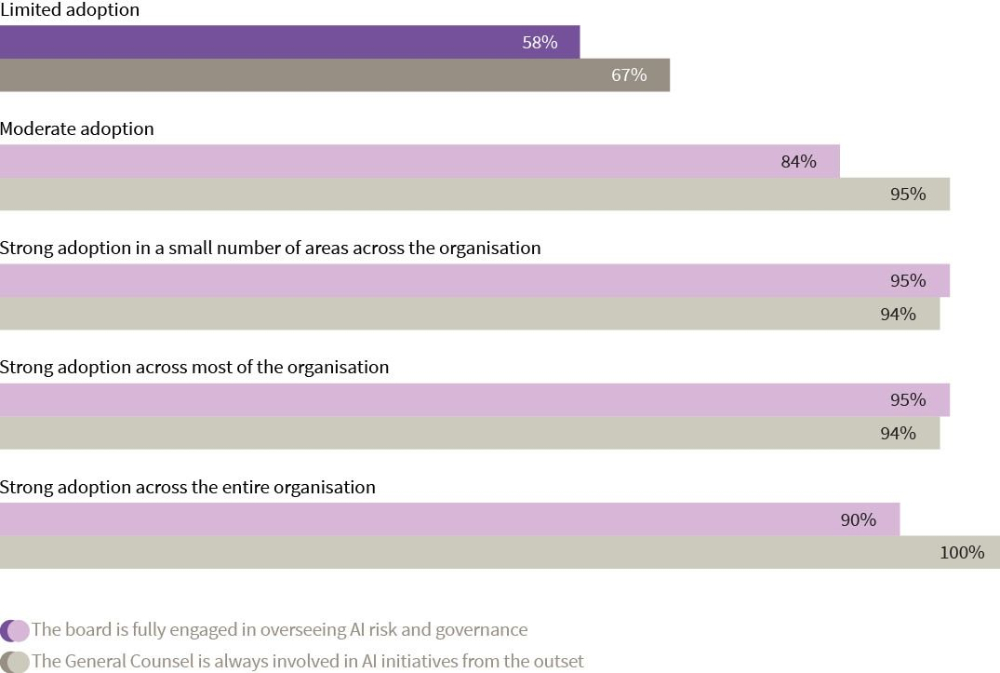
of organisations with limited AI adoption say they always involve the General Counsel (GC) in AI initiatives from the outset, compared with 94%–100% among more advanced adopters
"It’s important to identify a single individual as the ultimate decision-maker,” Burke says. “All too often, organisations are making decisions by committee, which slows down progress. Our Chief AI Officer is ultimately responsible for the totality of AI governance. While there is input from legal and other relevant stakeholders, our Chief AI Officer makes the final call on what we should and shouldn’t implement, and why. Without this single point of contact to bring all those inputs together, it’s easy to lose momentum in decision-making.”
Strategic board oversight is crucial. Organisations with limited AI adoption are less likely to say that their board is fully engaged in overseeing AI risk and governance than those that have scaled AI more widely (58%, compared with 84%–95% among more advanced adopters). This suggests that scaling AI requires active board-level oversight to set direction and define risk appetite, which ensures consistent decision-making across the organisation. Without this alignment, implementation becomes uneven and progress slows.
Within governance, the GC plays a central role in enabling AI to scale. Our survey findings reflect this. Executives who report limited AI adoption are far less likely to always involve the GC in AI initiatives from the outset than those who have scaled AI more widely (67%, compared with 94%–100% among more advanced adopters).
It’s important to identify a single individual as the ultimate decision-maker. All too often, organisations are making decisions by committee, which slows down progress
Lavonne Burke, Chief Privacy Officer & Head of AI Legal at Dell Technologies
Getting the board and GC involved boosts AI adoption
To what extent do you agree or disagree with the following statements regarding AI?
There’s a persistent myth that governance slows AI down. In reality, the opposite is true. Clear governance gives teams the confidence to scale – because they know what’s permitted, what’s off limits and who makes the final call.
Alexandra Brodie, Partner and Co-Lead of AI at Gowling WLG
Governance is the way to break out of AI silos. Organisations must establish clarity early on in terms of who’s responsible, which risks can be taken and what guardrails should be in place as AI scales. A robust governance structure enables AI to move beyond pilots while maintaining effective oversight as adoption expands.
“There’s a persistent myth that governance slows AI down,” says Alexandra Brodie, Partner and Co-Lead of AI at Gowling WLG. “In reality, the opposite is true. Clear governance gives teams the confidence to scale – because they know what’s permitted, what’s off limits and who makes the final call. The organisations moving fastest are those that embed legal and risk thinking early, rather than trying to retrofit it once AI is already embedded.”
As we have seen, AI is no longer a purely technological challenge. The businesses that succeed in freeing AI from its silos will be the ones that focus on getting the governance right.
Read the original article on GowlingWLG.com
The content of this article is intended to provide a general guide to the subject matter. Specialist advice should be sought about your specific circumstances.
[View Source]