

- within Real Estate and Construction topic(s)
- in United States
- with readers working within the Property, Securities & Investment and Law Firm industries
- within Wealth Management, Family and Matrimonial, Media, Telecoms, IT and Entertainment topic(s)
- with Senior Company Executives, HR and Inhouse Counsel
Landlords of commercial premises generally have one key overriding concern: to maintain their income stream by ensuring that their tenants pay and continue to pay all rents due under their leases. Landlords should act quickly if they see any delays in paying the full rent due, as they will stand a much better chance of maximising their return, possibly without incurring too many additional costs, if they act early.
This Guide summarises the options available to a landlord to recover rent arrears owed by a tenant and looks at the advantages and disadvantages of each. The options can be categorised into: (i) recovery against the tenant, and (ii) recovery against third parties such as guarantors, sub-tenants, former tenants and former guarantors.
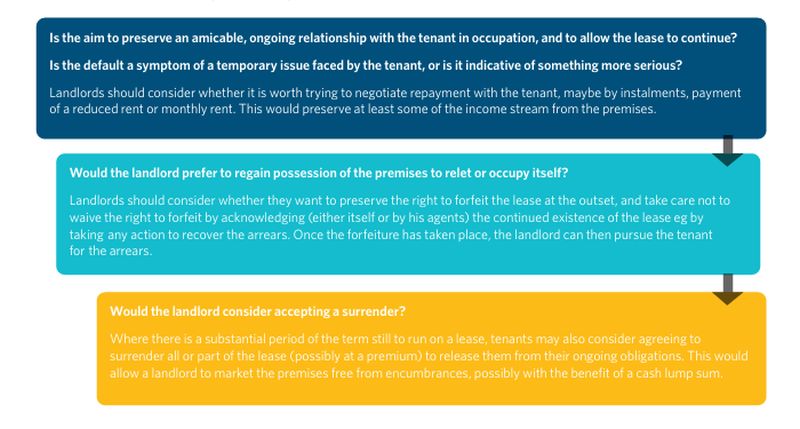
What is the landlord hoping to achieve?
Before commencing any enforcement action to recover arrears, a landlord will need to consider its longer-term strategy. What is the landlord hoping to achieve? Much will depend on the landlord's view of the tenant and the prevailing market conditions, but a landlord should also be driven by the following considerations:
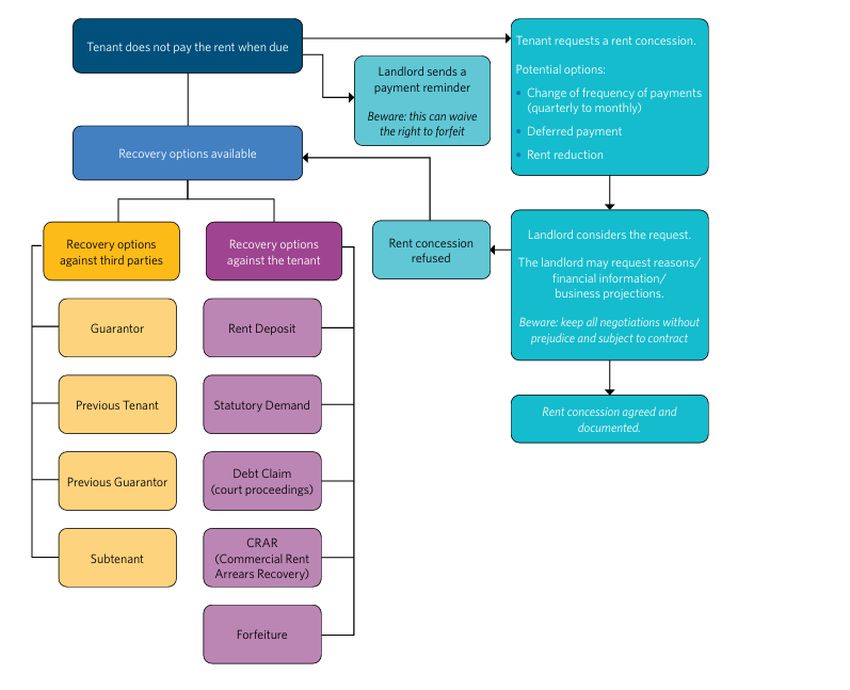
Recovery directly against the tenant
Rent deposit
If the tenant provided a rent deposit by way of security at the time of taking the lease, a landlord will generally be able to call on the deposit and draw down the outstanding monies from the account in which the deposit is held. Prior to doing so, the landlord must check the rent deposit deed to ensure that its terms allow it to be drawn upon to discharge the type of arrears (plus interest) owed and whether any formalities eg requiring that landlords give prior notice to tenants of any withdrawals, must first be satisfied. Once a withdrawal has been made, the deed will usually require the tenant to top up the deposit sum, though a tenant experiencing even short–term financial difficulties may not be in a position to do so. Failure to top up the rent deposit sum within the requisite period may then, depending on the terms of the rent deposit deed and lease, give the landlord a fresh right to forfeit the lease.
Whilst the ease of drawing down on a rent deposit deed and receiving an immediate cash sum might seem attractive, a landlord should bear in mind that, if a shortfall in the deposit sum is to follow, there will be less money available to cover any future liabilities under the lease that may be less straightforward to pursue eg damages for dilapidations, wants of repair and reinstatement obligations.
Statutory demand
A statutory demand is a written demand for payment of an undisputed debt and can be served on an individual, partnership or a company. It is not in itself a method of debt recovery, but it is a popular and effective way of putting pressure on a tenant to pay what is owed. If the sums specified in the demand are not paid within 21 days of service of the demand, the tenant is open to the very real risk that it could be (in the case of an individual) declared bankrupt or (in the case of a company) placed into liquidation.
A statutory demand can only be served if:
- the debt is liquidated, ie for a specific amount that has been fully and finally ascertained;
- the debt is undisputed; and
- the debt exceeds £750 (in the case of a company) or£5,000 (in the case of any individual).
If these criteria are not met, or if the tenant has a valid counterclaim against the landlord, the tenant may apply for the statutory demand to be set aside.
Non-payment of the sum sought in the statutory demand is treated as evidence of the tenant's "inability to pay the debt" and entitles the landlord to present a bankruptcy or winding up petition to the court. A landlord will have to consider the tenant's financial position before deciding whether this option is worth pursuing. If the tenant simply does not have any money, the landlord will have incurred costs in petitioning the insolvency, only to rank as an unsecured creditor and recover only a small percentage, if any, of the debt owed. However, where a tenant has the money, a statutory demand in itself may be sufficient to prompt payment.
Court proceedings
As an alternative to serving a statutory demand, a landlord can sue a tenant for rent arrears as a debt. Pursuing a tenant using the court system should be considered as a two–stage process:
- Issuing and serving proceedings on the tenant and pursuing the claim to judgment or settlement; and
- Enforcing the judgment or settlement so that the tenant pays what is due.
The conduct of litigation in England and Wales is governed by the requirements of the Civil Procedure Rules ("CPR"). Before proceedings are commenced, the CPR requires that the parties take reasonable and proportionate steps to identify, narrow and resolve the legal or factual issues between them. Arrears cases should be relatively straightforward, so the landlord should engage with the tenant to put forward its requirement that the rent arrears which fall due under the lease should be paid. A letter before action must be sent, which must clearly set out all relevant details relating to the type of arrears, the date(s) on which they fell due, the amounts and any interest owed (and how this has been calculated), with supporting documentation. The tenant must be allowed a reasonable time to consider this. If this does not trigger payment and the landlord issues proceedings, the parties will remain subject to the detailed procedural requirements and timeframes set out in the CPR.
Once proceedings are issued and served on the tenant, they must file an Acknowledgment of Service or a Defence. If they do not, the landlord will be able to seek judgment in default. Alternatively, in relatively straightforward arrears claims, the landlord may be able to apply for summary judgment. Summary judgment is a procedure by which the court may decide a claim at an early stage, so without a full trial or many of the procedural steps that would ordinarily lead up to trial. The aim of the procedure is to determine straightforward cases quickly, avoid long running disputes and to minimise costs.
Early judgment in either instance would resolve the matter with minimal cost and delay, subject to the landlord being able to enforce the judgment. If neither judgment in default or summary judgment is granted, the court will order directions for the conduct of the litigation through to trial, which can be time consuming and costly.
However, obtaining judgment against a tenant is only the first step. Landlords will have to take further steps to enforce any judgment against a tenant, which will only be worthwhile if the tenant has sufficient assets to make it worth pursuing. If the tenant's assets are minimal (save for his interest in the premises), the landlord should consider whether other less costly or time-consuming avenues of recovery might be more appropriate.
Various enforcement options include:
- Writs of control (High Court) and warrants of control (County Court) (bailiffs)
- Third party debt order (banks)
- Charging order (property)
- Attachment of earnings (individual)
Commercial Rent Arrears Recovery (CRAR)
CRAR was brought into force in 2014, replacing the ancient common law remedy of distress or distraint for rent arrears. It allows a commercial landlord to enter the demised premises and seize goods belonging to the tenant to the value of the arrears due, and sell them to cover the arrears and the landlord's costs.
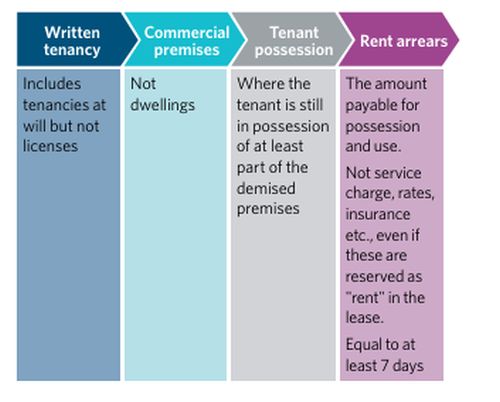
CRAR is available to landlords where at least seven days' principal rent is due under the lease (it is not available for service charge, rates, council tax, repairs, maintenance or insurance arrears even if these are reserved as rent under the lease). The landlord must engage an enforcement agent to exercise CRAR on its behalf, and the enforcement agent must give the tenant at least seven days' written notice that it will enter the demised premises to exercise CRAR, though it is possible to apply to court so that a shorter notice period is allowed to the tenant. Following service of the notice, a tenant will often enter into a "controlled goods agreement" to allow goods to remain on the premises whilst the tenant negotiates and performs a repayment agreement with the landlord. This allows the tenant to continue to trade and run its business, thus not causing it further financial difficulties. Alternatively, the goods belonging to the tenant at the premises may be seized and sold by the enforcement agent on notice to the tenant.
Landlords must consider the type and value of the goods belonging to the tenant at the premises when deciding whether CRAR is the most suitable remedy to recover arrears. CRAR places restrictions on the type and value of the equipment, stock etc that can be seized. If the landlord intends to remove goods from the premises (rather than enter into a controlled goods agreement under which the goods would remain at the premises so that they could still be used for the benefit of the tenant's business), they will have to arrange for suitable storage and insurance. Landlords should also consider whether, having entered into a controlled goods agreement, there is any possibility that the tenant might still remove its goods from the premises. In such cases, the landlord should consider the practicalities and logistics of arranging for the goods to be relocated to a suitable storage facility.
CRAR is still seen as a relatively quick, easy and cheap means of recovering principal rent arrears plus VAT and interest on these sums, particularly if the tenant settles the debt following the initial notice from the enforcement agent to avoid them seizing control of their goods.
To read this article in full, please click here.
The content of this article is intended to provide a general guide to the subject matter. Specialist advice should be sought about your specific circumstances.
[View Source]


