- within Employment and HR topic(s)
- in Asia
- in Asia
- within Technology, Wealth Management, Government and Public Sector topic(s)
- with Senior Company Executives, HR and Inhouse Counsel
- with readers working within the Technology industries
If an employer needs to employ someone in a country where it has no base, there could be all sorts of legal and administrative complications concerning, for example, the management of tax and social security withholdings. To simplify the management of these employees, businesses sometimes use what are known as 'Employers of Record'.
There is no sole definition of an Employer of Record (an EOR), but generally these organisations contract with the employee and go on record as the employer for administrative purposes (taking responsibility for all the paperwork). This can be a great help given the increasing clamour by employees to work remotely, along with a desire on the part of employers to access talent in previously untapped markets, without setting up a legal entity there. But entities that are in the business of providing labour often fall into a regulatory regime relating to 'labour leasing' (or the specific country equivalent). These are regulations governing the activity of companies that hire employees who then work for a third-party entity, outside of the scope of a genuine service agreement.
Where EORs undertake labour leasing activities (sometimes known as 'temporary work agency' arrangements) and fall under the relevant legal frameworks, strict compliance requirements can apply depending on the jurisdiction. To support with navigating the legal landscape, we have set out in a table below how countries interpret EORs in the absence of a single legal definition, together with an analysis of the rules applicable to EORs undertaking labour leasing activities (or the specific country equivalent) where they wish to enter into the business of leasing personnel. This includes the sanctions that can apply if these rules are breached. For those countries that don't necessarily have a 'labour leasing' regime, we have included key risks that EORs should note.
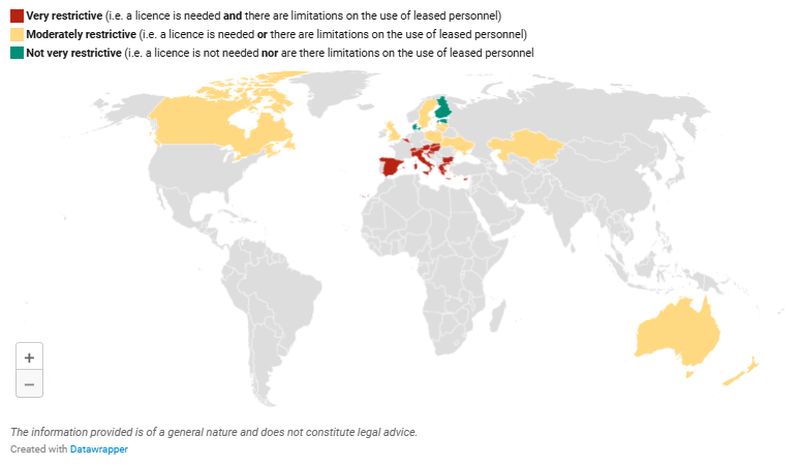
To further visualise the extent of these restrictions, we have then set out a map of the same countries, grouped according to whether the personnel leasing legislation (or the specific country equivalent) is very restrictive, moderately restrictive or not very restrictive.
*Please note, the information contained in this article is limited to employment law considerations only. Organisations should also evaluate potential tax implications when assessing the use of EORs or similar arrangements.
EORs, leasing of personnel and key compliance requirements
| Australia | |
|---|---|
| How are EOR's interpreted? | There is no formal legal definition of EORs in Australia and the terminology is not in common usage. Nevertheless, it is permissible for businesses to employ workers who work under the direction and control of a third party, in which case the formal employer would seem to be what in a European context would be described as an EOR. While there is no specific legislation regulating EORs in Australia, they could be viewed as labour-hire companies. |
| What happens if an EOR engages in labour leasing activities/ temporary work arrangements (or specific country equivalent)? | Labour-hire companies would need to be licenced as such in jurisdictions that require licencing. |
| What are the consequences or penalties for breaching the labour leasing rules (or specific country equivalent)? |
In the event the EOR was deemed to be a labour-hire company, the following penalties could apply. Civil penalties:
|
How restrictive is the legislation on leasing of personnel?
The below map seeks to visualise how restrictive the legislation on leasing of personnel is as applicable to employers of record undertaking labour leasing activities/ temporary work arrangements (or the specific country equivalent).
Key takeaways
When entering a country, EOR's should be mindful of the requirements of local legislation depending on the kind of activity they wish to perform and especially when they enter into the business of leasing of personnel.
On the other hand, it is recommended that the user companies seek counsel to review the commercial agreement with the EORs and evaluate possible risks such as claims by the EOR employees for the establishment of an employment contract with them, joint liabilities with respect to employment rights, possible sanctions, creating a permanent establishment locally and dealing with intellectual property rights. These risks could possibly be mitigated through a careful set up or, for example, by introducing indemnity clauses in the commercial contracts. Moreover, alternative set ups may be investigated such as direct employment without setting up a branch, when allowed locally.
The content of this article is intended to provide a general guide to the subject matter. Specialist advice should be sought about your specific circumstances.
[View Source]