REFERENCE: Turkish Competition Authority, Automotive Tyre Production and Distribution Investigation, Case No. 2024-6-007, Decision No. 26-20/612-242, 16 June 2026.
A. From Complaints to a Sector-Wide Investigation
The Turkish Competition Authority’s (“TCA”) investigation into automotive tyre production and distribution began with complaints submitted in early 2024. The first allegations concerned pricing and territorial practices involving a major tyre manufacturer and its dealers, while subsequent complaints raised broader concerns about the conduct of tyre manufacturers and their distribution networks. On 7 March 2024, the TCA opened a preliminary examination. Following on-site inspections and its review of the evidence collected, the TCA found the suspicions sufficiently serious and opened a full investigation on 21 November 2024 against 17 manufacturers, distributors and dealers under Article 4 of Law No. 4054 (similar to Art. 101 of the TFEU).
The scope of the case broadened considerably as the investigation progressed. The TCA examined alleged concerted practices relating to price movements, direct and indirect exchanges of competitively sensitive information, resale price maintenance, territorial and customer restrictions, discriminatory dealer practices, non-compete obligations, labour-market information exchanges and no-poach arrangements. The investigation therefore addressed horizontal coordination between competitors, vertical restraints within distribution systems and employment-related restrictions in a single sector-wide proceeding1.
Digital evidence played a central role in the investigation. WhatsApp messages and emails collected during on-site inspections referred, in general terms, to rival price increases, the timing of future price changes, sales volumes and other commercial conditions. The TCA assessed not only direct competitor contacts but also information flows through distributors. In this "hub-and-spoke" setting, a common distributor may collect future-looking pricing information from one supplier and transmit it to another rival supplier, thereby reducing uncertainty between competing manufacturers and/or suppliers.
B. Multiple Infringement Theories and Heavy Fines
The proceeding was resolved in two stages. Seven undertakings (Petlas, Üstündağ, Tatko, Prolas, Özcanlar, Kardeşler and Abdullah Özdoğan) concluded settlement procedures in November 2025, accepting liability for varying combinations of concerted price movements, resale price maintenance, territorial or customer restrictions, output-market information exchange and labour-market information exchange.
The aggregate settlement fines reached to EUR 11.6 million. Petlas, the only producer among the settling parties, accounted for approximately 80 per cent of that total with a fine of EUR 9.2 million. The remaining six settling parties—were all distributors.
The investigation continued against the remaining producer/supplier undertakings and concluded with the TCA's decision of 4 June 2026. The fines imposed were substantial: Brisa received the highest individual penalty at EUR 23.7 million; followed by Goodyear at EUR 15.6 million for concerted practices relating to price movements, , territorial and customer restrictions and labour-market information exchange and no-poach arrangements, while Michelin was only found to have violate the competition law via concerted practices on price movements. In addition to those types of violation, Hankook, Pirelli and Prometon also were fines due to the resales price maintenance. Apart from the suppliers, two distributors were fined for their participation in restrictive information exchange. The fines imposed through the contested procedure alone totalled EUR 72.9 million. Taken together, the settlement and final decisions resulted in aggregate administrative fines of EUR 84.5 million. Both the magnitude of the fines and the breadth of the conduct sanctioned render this case one of the most consequential sector-wide enforcement actions in the recent history of the Turkish Competition Authority.
The TCA nevertheless declined to uphold several allegations. It found insufficient evidence that Prometeon had participated in the concerted practice concerning price movements. It did not establish discriminatory distributor practices on the part of Brisa or Hankook. Notably, it also concluded that Brisa's non-compete obligation in the forklift-tyre market benefited from the block exemption under on motor-vehicle block exemption regulation a finding that preserves the lawfulness of that particular contractual arrangement going forward.
The TCA had previously examined tyre-sector information flows—most notably in its 2015 Tyre decision, where it considered allegations of information transmitted through common distributors but ultimately concluded that access to current, rather than future, prices was insufficient on its own to establish restrictive coordination2. Yet, 2026 decision reveals that the timing, strategic nature and onward transmission of pricing information are now firmly at the centre of the TCA's assessment framework.
C. The TCA Is Redesigning Market Conduct, Not Merely Imposing Fines
The most significant feature of the decision may be the remedies imposed under Article 9(1) of Law No. 4054. The TCA concluded that distributors had contributed to the indirect exchange of future pricing information and ordered tyre manufacturers and suppliers active in the Turkish replacement market to change the way in which they communicate prices and commercial terms.
First, every price list and every communication concerning price components including price increases, discounts, bonuses, support payments, sales conditions, financial conditions and incentive systems must contain a visible and repeated watermark identifying the specific distributor to whom it was sent. The watermark must be placed across the relevant document in a manner that is both readily identifiable and sufficiently prominent. The apparent objective is to ensure that any future onward disclosure can be traced to the distributor that originally received the document.
Second, manufacturers must stop sending price-related communications collectively to multiple distributors. Such notices must instead be delivered individually through an interface or portal that each distributor accesses using its own username and password. Companies that do not currently operate such a portal must create one and make it available to their distributors. The Board also prohibited the use of oral or written channels outside the relevant interface or portal for communicating this information. The remedy therefore extends beyond the content of communications and regulates the technological channel through which they must be delivered.
Third, agreements between manufacturers or suppliers and their distributors must prohibit distributors from disclosing future-dated price information, or information concerning future price components, to rival manufacturers, suppliers or distributors. These agreements must contain a sufficiently deterrent contractual penalty and provisions allowing the agreement to be terminated for cause. The manufacturers and suppliers concerned must document that they have implemented these obligations within three months following service of the reasoned decision. The remedies accordingly require changes to information systems, standard distribution agreements, internal approval processes and monitoring arrangements.
These measures demonstrate that the TCA increasingly views fines as only one part of effective enforcement. A closely comparable approach appeared in the recent poultry decision. In that case, alongside very high fines, the TCA required poultry manufacturers and suppliers to apply updated price lists as soon as they were announced and to discontinue the use of forward-dated price lists3. Both cases target the mechanism through which future pricing may circulate and facilitate coordination.
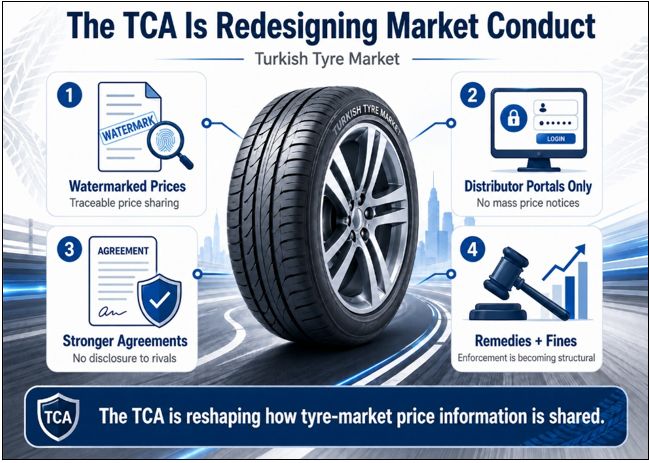
The emerging enforcement pattern is therefore remedial as well as punitive. The TCA is not limiting its intervention to findings of infringement and administrative fines. It is also redesigning communication systems, contractual arrangements and the timing of price announcements with the stated objective of preventing recurrence and restoring competitive uncertainty in the market.
D. Practical Implications for the Tyre Industry and Distribution Networks
The decision has consequences beyond the companies fined. Manufacturers and distributors should treat distributor communications as a competition-law risk area rather than a routine commercial function. Future prices, discount calendars, bonus structures, campaign timing, sales targets and anticipated commercial changes should not be shared through informal messaging groups, forwarded emails or distributor meetings in a manner that allows the information to reach competitors.
Distributor compliance programmes will also require revision. Distributors are not necessarily passive recipients where they collect one supplier's future terms and use them in negotiations with another. The decision demonstrates that the TCA may characterise distributors as the hub of an indirect information-exchange mechanism. Contractual clauses, audit rights, training programmes and disciplinary procedures should therefore address the onward transmission of supplier information. Companies should also consider technical controls that prevent downloading, forwarding or externally sharing sensitive communications, although such controls would need to be designed consistently with the specific requirements of the reasoned decision.
The labour-market findings are equally important. Several manufacturers were fined for exchanging competitively sensitive employment information and/or participating in no-poach arrangements. Human resources teams must therefore apply competition-law safeguards comparable to those used by sales and pricing teams. Company-specific data concerning salaries, future wage increases, bonuses, benefits, recruitment plans, vacancies or employee-mobility policies should not be exchanged with competitors unless the exchange pursues a clearly legitimate purpose and is supported by appropriate aggregation, historical data, independent administration and legal safeguards.
Companies should finally prepare for the operational burden of the remedies. Watermarked communications, individual distributor portals, access controls, record-retention systems, revised distributor contracts and monitoring procedures will require coordination between legal, sales, IT, compliance and human resources functions.
The TCA's broader message is clear: in concentrated sectors characterised by extensive distribution networks, competition-law enforcement may now reshape the architecture of commercial communications in addition to imposing substantial financial penalties. The tyre decision is therefore significant not only because it introduces the first sector-specific fines, but also because it provides a detailed blueprint for how the Authority expects future pricing information to be protected from direct or indirect circulation among competitors.
Footnotes
1. Please see the Turkish Competition Authority’s announcement “Investigation Concerning Undertakings Active in Automotive Tyre Production and Distribution Concluded,” dated 16 June 2026.
2. Please see the original Turkish version of the case.
3. Please see the original Turkish version of the case.
The content of this article is intended to provide a general guide to the subject matter. Specialist advice should be sought about your specific circumstances.