
The TCA's Sector Inquiry into AI: A Reflection of a Global Trend
On 7 April 2026, the Turkish Competition Authority ("TCA" or "Authority") announced the launch of a comprehensive sector inquiry into the artificial intelligence ("AI") ecosystem1. Exercising its powers under Article 27 of Act No. 4054 on the Protection of Competition2, the TCA stated that AI is no longer merely a new area of technological development but has become a tool that rewrites the rules of competition, transforms market power, and fundamentally alters economic balances. The inquiry is designed to provide a holistic assessment of how the AI ecosystem is evolving, to identify emerging competitive risks at an early stage, and to inform future policy and enforcement priorities.
This initiative reflects a global trend as competition authorities across the world have increasingly turned their attention to the competitive dynamics of AI. The UK Competition and Markets Authority ("CMA") published its initial report on AI foundation models in September 2023, followed by a detailed update in April 2024 examining the development of the AI market and emerging concerns around concentration3. The European Commission has signaled its intention to monitor AI-related competition issues closely, particularly in the context of partnerships and investments between large technology companies and AI developers4. The US Federal Trade Commission ("FTC") has similarly published reports on generative AI and competition and has initiated investigations into major AI-related partnerships and investment structures5. The TCA's sector inquiry places Türkiye squarely within this international trend, positioning the Authority as an active participant in what has become a global regulatory conversation about the competitive implications of AI.
The AI Value Chain and Foundation Models
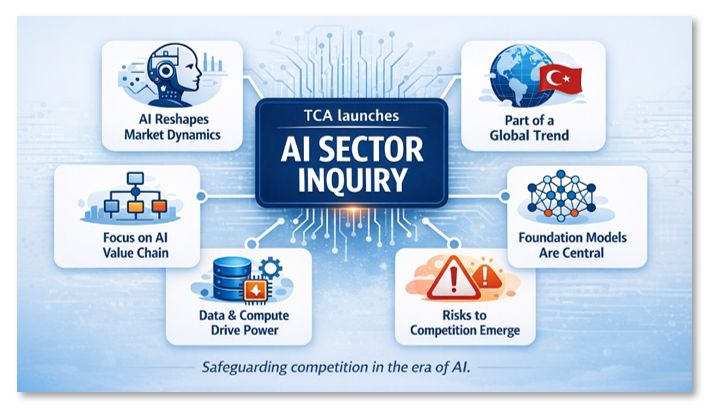
A central theme of the TCA's announcement is the multi-layered structure of the AI value chain. The Authority describes this chain as extending from infrastructure and computing capacity at the base, through model development in the middle, to applications and end-user services at the top. At each layer, different competitive dynamics are at play, and the interactions between these layers create complex interdependencies that can amplify or constrain competition. Notably, strong economies of scale, network externalities, and feedback loops operate across all three layers. The more a model is used, the more data it accumulates; the more data it accumulates, the better it performs; and the better it performs, the more users it attracts. This classic winner-take-most dynamic is further intensified by the tight vertical linkages between layers, a handful of hyperscaler cloud providers (notably Microsoft Azure, Google Cloud, etc.) control a significant share of global computing capacity, Nvidia has become the de facto standard-setter, and only a few players dominate the foundation model space. The TCA has indicated that it will analyze these interdependencies in detail, with a particular focus on the conditions of access to critical inputs at each stage of the value chain.
Foundation models occupy a central position in this analysis6. These are large-scale, general-purpose models trained on extensive datasets that can be adapted to a wide range of downstream tasks and applications. The TCA recognizes that the development of foundation models requires access to a combination of critical inputs consisting of vast quantities of training data, significant computing power, deep technical expertise, and substantial financial resources. Because access to these inputs is unevenly distributed, undertakings that secure early and intensive access are capable of establishing strong positions not only in model development but across multiple layers of the value chain. The TCA has specifically noted that such undertakings may build vertically integrated structures that enable them to consolidate their market power rapidly.
The general-purpose nature of foundation models makes these dynamics particularly consequential. Unlike traditional technologies that serve a specific function in a specific market, foundation models can be deployed across a broad range of industries and use cases. This versatility means that an undertaking with a dominant position in foundation models can project its influence into numerous downstream markets simultaneously. The TCA has highlighted that early movers in this space may be able to deepen their competitive advantages over time, creating a self-reinforcing cycle in which scale begets further scale. The risks identified include the raising of barriers to entry for new competitors, the lock-in of users into particular ecosystems, and the restriction of competitors' access to essential inputs such as training data and computing infrastructure. These concerns are not hypothetical as they mirror the types of competitive harm that competition authorities have observed in earlier generations of digital markets, from search and social media to app stores and cloud computing.
Integration of AI into Digital Platforms and Its Potential Impacts on the Competition
The TCA's announcement also places considerable emphasis on the integration of AI technologies into the existing products and services of large digital platforms. This is arguably the most immediately consequential dimension of the inquiry from an enforcement perspective. When dominant technology companies embed AI capabilities into their existing ecosystems, whether in search engines, operating systems, productivity software, cloud services, or e-commerce platforms, a range of familiar competition law concerns may arise. The TCA has specifically identified certain risks such as:
- self-preferencing (where a platform favors its own AI-powered services over those of competitors),
- exclusionary conduct (where access to the platform's user base or data is denied to rival AI providers),
- tying and bundling (where AI features are packaged with existing dominant products in ways that foreclose competition),
- access restrictions (where competitors are denied interoperability or data portability),
- the raising of switching costs (where users face increasing difficulty in migrating to alternative providers).
These practices, the TCA notes, have the potential to affect not only current market structures but also the trajectory of future competition and innovation. In other words, the Authority is signaling that its concern extends beyond static market allocation to encompass the dynamic effects of AI integration on the pace and direction of innovation.
Merger Control Implications
Another notable aspect of the TCA's announcement is its reference to recent merger and acquisition activity in the AI sector. The TCA has observed that transactions it has recently assessed demonstrate the growing significance of AI for merger control. In some cases, AI technology directly constitutes the relevant market in which the competitive assessment is conducted. In other cases, AI does not define the relevant market but nonetheless plays a critical role in the analysis; for instance, through the data advantages conferred by the transaction, the complementarities between the merging parties' activities, the impact on potential competition, or the implications for the preservation of innovation incentives.
This dual relevance of AI in merger control, as both a market in its own right and a cross-cutting analytical factor, reflects the pervasive nature of the technology and the challenges it poses for traditional competition assessment frameworks. Internationally, the unconventional investment and partnership structures in the AI space, such as the Microsoft-OpenAI, Amazon-Anthropic, and Google-Anthropic arrangements, have proven equally challenging for merger control authorities, with the CMA and the European Commission grappling with the question of whether existing merger regulations can adequately capture such structures.
The TCA's reference to merger control is also significant in the broader context of its recent reforms to the notification regime for technology undertakings. In 2022, the TCA introduced a dedicated framework for merger notifications involving technology undertakings, removing the standard local turnover threshold for transactions involving companies active in areas such as digital platforms, software, financial technologies, biotechnology, and health technologies. This framework was subsequently amended in February 2026 to introduce a specific Turkish turnover threshold for the target and to redefine the territorial nexus requirement by limiting the special regime to technology undertakings "established in Türkiye"7. The sector inquiry into AI can be seen as a complementary initiative. While the merger control reforms address the jurisdictional question of which transactions are notifiable, the sector inquiry aims to provide the substantive analytical foundation for assessing competitive dynamics in AI markets. Together, these initiatives suggest a comprehensive and coordinated approach by the TCA to the competitive challenges posed by the AI ecosystem. The TCA's earlier sector inquiry into online advertising8, which laid the analytical groundwork for its subsequent enforcement decisions, provides a telling precedent for how sector inquiries can translate into concrete enforcement outcomes.
The Enforceability Challenge: Local Representative Requirements
A dimension that deserves particular attention in the context of this inquiry is the enforceability question arising from the absence of local legal entities of major AI providers in Turkey. Leading foundation model providers such as OpenAI, Anthropic, and Mistral do not maintain incorporated subsidiaries or appointed legal representatives in Turkey. This creates a practical challenge for the Authority, as the effectiveness of information requests, the exercise of rights of defense, and the enforcement of administrative fines all depend on the existence of an identifiable and reachable legal person within the jurisdiction. Without such a counterpart, even the most sophisticated analytical findings risk remaining practically unenforceable. International practice increasingly addresses this gap through mandatory local representative requirements. Türkiye itself imposed such an obligation on social network providers through the 2020 amendments to Act No. 5651. At the European level, the Digital Services Act, the Digital Markets Act, and the recently adopted AI Act all require non-EU providers to appoint a legal representative within the Union9. Should the TCA's sector inquiry report flag this regulatory lacuna and recommend concrete legislative action, its output could prove valuable not only for competition policy but for the broader digital regulatory architecture in Türkiye.
The Broader Regulatory Landscape
Importantly, the sector inquiry should not be read in isolation. The Turkish Grand National Assembly's AI Research Commission published a comprehensive report outlining a roadmap for Türkiye's AI policy, ethical framework, employment implications, and regulatory needs10. The report emphasizes the need to strengthen the national AI strategy and to adopt a risk-based regulatory approach and position Türkiye as an active actor in the global AI governance conversation.
In this regard, it can be derived that a multi-regulator architecture is emerging in which the Personal Data Protection Authority addresses data governance, the Information and Communication Technologies Authority covers the telecommunications dimension, while the TCA assumes responsibility for market structure and barriers to entry. The sector inquiry thus forms one piece of a broader regulatory construction effort, and its findings are likely to interact with and inform the parallel initiatives of these other bodies.
Scope of the Inquiry and Policy Rationale
In terms of its stated objectives, the TCA has indicated that the sector inquiry will cover a wide range of themes. These include the structural evolution of the AI ecosystem with reference to foundation models, the relationships between different layers of the value chain, the conditions governing access to critical inputs such as data and computing power, the interactions between large technology incumbents and innovative startups, and the effects of data concentration and computing capacity on competition. A Turkey-specific dimension of particular interest may be the extent of the public and private sector's dependence on foreign cloud providers for computing capacity, and the bargaining asymmetries this dependence may create. Equally relevant is the question of access to high-quality Turkish-language training data, where the scarcity of suitable datasets and the contractual terms governing their use by model developers could prove decisive for the development of the local AI ecosystem.
The TCA has articulated a clear policy rationale for the inquiry. The stated objective is to detect structural trends and potential anticompetitive risks at an early stage, and to use the findings to inform policy development and the design of intervention tools aimed at preserving competitive market structures. This language suggests that the TCA views the inquiry not merely as an information-gathering exercise but as a foundation for potential future action, whether in the form of enforcement proceedings, regulatory recommendations, or advocacy initiatives. The OECD has similarly encouraged competition authorities to adopt proactive approaches to AI markets, noting that the speed of technological change in AI may outpace traditional enforcement timelines and that early intervention may be necessary to prevent the entrenchment of dominant positions11.
For undertakings operating in the Turkish market, whether they are large technology platforms integrating AI into their existing services, AI-focused startups developing foundation models or applications, cloud infrastructure providers, data intermediaries, or companies in adjacent sectors that rely on AI-powered tools, the sector inquiry carries significant implications. While a sector inquiry does not, by itself, constitute an enforcement action or impose any obligations on market participants, it represents a systematic effort by the TCA to map the competitive landscape and identify areas of concern. The findings may inform future investigations, guide the Authority's enforcement priorities, and potentially lead to recommendations for regulatory or legislative action. Market participants would be well advised to monitor the progress of the inquiry closely, to engage constructively with any information requests issued by the TCA, and to review their commercial practices in light of the competitive concerns identified in the announcement.
Conclusion
In conclusion, the TCA's decision to launch a sector inquiry into the AI ecosystem represents a significant and timely initiative. It reflects a sophisticated understanding of the competitive dynamics at play in AI markets and a willingness to engage proactively with the challenges they present. By adopting a holistic, value-chain-wide approach, the TCA aims to identify structural risks before they become entrenched, to ensure that the benefits of AI innovation are not captured by a small number of dominant players, and to preserve the conditions for effective competition and continued innovation. The true test, however, will lie not only in the analytical quality of the inquiry's findings but in the enforceability of the policy recommendations that follow, particularly with respect to cross-border AI providers that currently lack a legal footprint in Turkey. The inquiry is likely to be an important reference point for competition policy in Türkiye's digital markets for years to come.
Footnotes
1.Turkish Competition Authority, Press Release dated 7 April 2026, available at: https://www.rekabet.gov.tr/tr/Guncel/yapay-zekaya-rekabet-kurumu-sektor-incel-d21eee058332f11193f70050568585c9.
2.Article 27 of Act No. 4054 on the Protection of Competition empowers the Turkish Competition Board to conduct sector inquiries in markets where conditions of competition are prevented, distorted, or restricted, or where there are signs of such effects.
3.CMA, AI Foundation Models: Initial Report (September 2023), available at: https://www.gov.uk/government/publications/ai-foundation-models-initial-report; CMA, AI Foundation Models: Update Paper (April 2024), available at: https://www.gov.uk/government/publications/ai-foundation-models-update-paper.
4.European Commission, Communication on Artificial Intelligence (January 2024), available at: https://digital-strategy.ec.europa.eu/en/policies/european-approach-artificial-intelligence; see also the joint statement by the European competition authorities on competition in virtual worlds and generative AI (2024), available at: https://www.ftc.gov/news-events/news/press-releases/2024/07/ftc-doj-international-enforcers-issue-joint-statement-ai-competition-issues.
5.US Federal Trade Commission, Staff Report on AI Partnerships & Investments Study (2025), available at: https://www.ftc.gov/news-events/news/press-releases/2025/01/ftc-issues-staff-report-ai-partnerships-investments-study; see also the FTC's investigation into major AI partnerships and investments, available at: https://www.ftc.gov/news-events/news/press-releases/2024/01/ftc-launches-inquiry-generative-ai-investments-partnerships.
6.The concept of "foundation models" was popularized by Stanford University's Center for Research on Foundation Models. See: https://crfm.stanford.edu/report.html?. These models are characterized by their training on broad datasets and their adaptability to a wide range of downstream tasks.
7.For a comprehensive overview of the TCA's approach to technology undertakings in merger control, see B. Yüksel, Z. Şengören Özcan, C. Peker, "Technology Undertaking Exemption Revisited: Recent Amendments Redefine Tech Merger Notifications in Turkey," Concurrences (2026), available at: https://www.mondaq.com/turkey/contracts-and-commercial-law/1751400/technology-undertaking-exemption-revisited-recent-amendments-redefine-tech-merger-notifications-in-turkey.
8.See, e.g., the TCA's Sector Inquiry Report on Online Advertising (2023), which laid the analytical groundwork for subsequent enforcement decisions concerning Google. Available at: cevrimici-reklamcilik-on-raporu-20231009170548088.pdf.
9.See, e.g., Law No. 5651 (as amended in 2020) imposing local representative obligations on social network providers; EU Digital Services Act, Art. 13; EU Digital Markets Act, Art. 4(2); EU AI Act, Art. 22 (requiring providers of high-risk AI systems and general-purpose AI models to appoint an authorised representative in the EU).
10.TBMM Yapay Zekâ Araştırma Komisyonu Raporu (2025). See also: https://cdn.tbmm.gov.tr/KKBSPublicFile/D28/Y1/T10/DosyaKomisyonRaporunuVerdi/9f0e7abf-41f6-4133-ab3d-4879113f7f9f.pdf.
11.OECD, Artificial Intelligence, Data and Competition, DAF/COMP(2024)1, available at: https://www.oecd.org/competition/artificial-intelligence-data-and-competition.htm.
The content of this article is intended to provide a general guide to the subject matter. Specialist advice should be sought about your specific circumstances.

