
TRADEMARKS
Trademarks in Thailand are governed primarily by the Trademark Act 1991, as amended by Trademark Act (No. 2) 2000 and Trademark Act (No. 3) 2016. The Department of Intellectual Property (DIP), Ministry of Commerce, administers trademark registration and maintenance.
Types of marks
The law protects:
- Trademarks;
- Service marks;
- Certification marks;
- Collective marks; and
- Trademark and service mark licenses.
Thailand follows the Nice Classification system for goods and services.
Registration requirements
A trademark may be registered if:
- It is distinctive;
- It is not prohibited under the Trademark Act; and
- It is not identical or confusingly similar to an existing
registered mark.
Distinctiveness can be established through stylized words, invented terms, devices, shapes, colours or sounds. Marks that reference royal insignia, official emblems, flags or are contrary to public order or morality are prohibited.
International protection
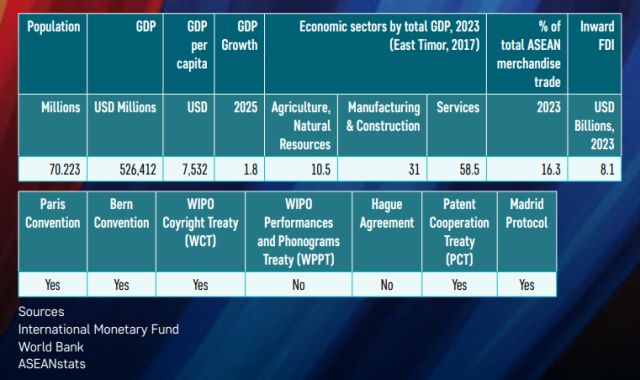
Thailand acceded to the Madrid Protocol on August 7, 2017, enabling trademark owners to file a single international application designating Thailand or other member states.
Application process
Applications must:
- Be filed in Thai language with specimens of the mark;
- Include class of goods/services;
- Be submitted by the proprietor or authorized agent with a local address; and
- Attach translations for non-Thai documents.
Both single-class and multi-class applications are accepted. Priority rights under international conventions can be claimed within six months of the first foreign filing.
Fast-track examination
Two expedited programmes allow issuance of a first office action within six months (or four months for stricter conditions) at no extra cost. Conditions include limits on goods/services and compliance with DIP's description manual.
Businesses seeking urgent protection should consider Thailand's fasttrack examination programmes. These programmes can reduce the time for a first office action to as little as four months if strict conditions are met, such as e-filing and limiting goods or services. For companies planning regional expansion, the Madrid Protocol offers a cost-effective route to secure protection in multiple jurisdictions through a single application. When selecting marks, applicants should avoid descriptive terms and prohibited elements, as these are common grounds for refusal. Early clearance searches and careful attention to distinctiveness requirements can prevent delays and objections.
Term and renewal
A registered trademark is valid for 10 years from the filing date and renewable for successive 10-year periods. Renewal applications can be filed within three months before expiry or within six months after expiry (with surcharge). A fasttrack renewal process introduced in 2021 allows completion within 45 minutes for qualifying applications.
Owners of well-known marks should note that while Thailand abolished the formal recordation system in 2015, prior recordation can still influence examination of new applications. Businesses expanding into Thailand should also leverage priority rights under international conventions by filing within six months of the first foreign application. This strategy helps secure early protection and avoid conflicts with competing applications.
Licensing
Trademark licenses must:
- Be in writing;
- Identify goods/services and quality control provisions; and
- Be registered with the DIP.
Unregistered licenses are not recognized for defending against non-use cancellation actions.
Enforcement
Trademark infringement can be addressed through civil and criminal actions. Remedies include:
- Preliminary search and seizure orders,
- Injunctions to cease infringement;
- Criminal penalties: up to B400,000 (US$12,200) fine and four years' imprisonment for forgery; up to B200,000 (US$6,100) fine and two years' imprisonment for imitation; and
- Civil damages under the Civil and Commercial Code.
Thailand's Intellectual Property and International Trade Court (IP&IT Court) has exclusive jurisdiction over trademark disputes. For more details on IP enforcement in Thailand, please see the enforcement section later in this chapter.
PATENTS
Patents in Thailand are governed by the Patent Act 1979, as amended by Patent Act (No. 2) 1992 and Patent Act (No. 3) 1999. The DIP administers patent registration.
Types of patents
Thailand provides protection for:
- Invention patents
- Petty patents
- Design patents (industrial designs)
Pharmaceutical products or processes are patentable if they do not involve methods of diagnosing or treating diseases. Naturally occurring microorganisms and their components, animals, plants and extracts are excluded. Excluded subject matter includes scientific or mathematical theories, methods for diagnosis or treatment and inventions contrary to public order or morality.
Computer programs are not patentable, although inventions involving computer programs or AI-related processes may qualify if they meet patentability criteria.
Patentability criteria
To be patentable, an invention must be:
- New;
- Involve an inventive step; and
- Capable of industrial application.
Petty patents protect inventions that are new and industrially applicable but lack an inventive step. Design patents protect new product designs capable of industrial production.
Application routes
Patent rights can be obtained through:
- National filing under the Patent Act;
- International filing under the Patent Cooperation Treaty (PCT); or
- Filing under the Paris Convention.
Thailand is a member of the PCT and the Paris Convention. PCT applications must enter the national phase in Thailand to obtain domestic protection. Priority rights under the Paris Convention allow filing in Thailand within 12 months for inventions and six months for designs from the first foreign filing date.
Choosing the right filing route is important in developing a patent strategy. The PCT national phase is often preferred for inventions with global potential, while the Paris Convention route may suit applicants targeting fewer jurisdictions. Accurate Thai translations of specifications and claims are essential to avoid examination delays. Applicants should also monitor priority deadlines closely – 12 months for inventions and six months for designs – to preserve rights. For incremental innovations, petty patents provide a practical option with shorter timelines and less stringent requirements and also serve as valuable enforcement tools when other patent rights are unavailable.
To view the full article, click here.
The content of this article is intended to provide a general guide to the subject matter. Specialist advice should be sought about your specific circumstances.
[View Source]