

FOREWARD
Nigeria’s mining sector entered what seems to be a critical inflection point in 2025, with the Federal Government intensifying efforts to position the sector as a credible contributor to growing its non-oil revenues. The year witnessed improved policy implementation and more assertive regulatory enforcement. While the sector largely remains exploration driven, we saw increased investment activity in value addition and downstream processing, particularly in lithium and industrial minerals, reflecting a response to the Government’s vision for a shift away from raw mineral exports toward domestic beneficiation. Subnational governments continued to emerge as active participants in the sector, with states such as Bauchi, Kaduna, Kebbi and Nasarawa taking steps to advance exploration initiatives and improve access to capital.
The sector’s trajectory in 2026 will depend on the government’s ability to sustain reform momentum, especially if it is able to address long-standing structural constraints, particularly in security, infrastructure, and geological data availability.
In this annual roundup of The Conduit, which we launched as our monthly newsletter in 2025 to track developments across the sector, we consolidate our insights into a comprehensive review. We discuss regulatory developments, notable transactions and projects across the mining value chain, and the key challenges that constrained performance during the year. We conclude with an outlook that assesses anticipated regulatory implementation and the market trends that are likely to shape the sector in 2026.
We hope that this publication provides context, clarity and insights for investors, operators and policymakers engaging with Nigeria’s evolving mining and metals landscape.
1. Market Dynamics
The market dynamics for Nigeria's mining sector in 2025 were shaped by continued volatility alongside a deliberate push for a transition from raw extraction to a more strategic, value- added industry. Although the mining industry commenced the year poorly across some critical segments, the latter part of the year recorded a sharp rebound reflecting drastic improvement, amidst regulatory reforms and increased attention towards the growth of the industry.
1.1 Growth Rates Across Key Sectors
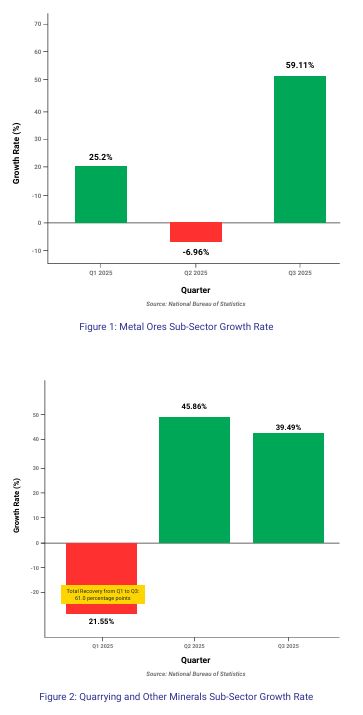
According to data from the National Bureau of Statistics, the metal ores sub-sector displayed the most pronounced volatility, recording a year-on-year real growth of 25.20% in Q1 2025,1 contracting sharply to -6.96% in Q2 2025,2 and rebounding strongly to 59.11% in Q3 2025.3
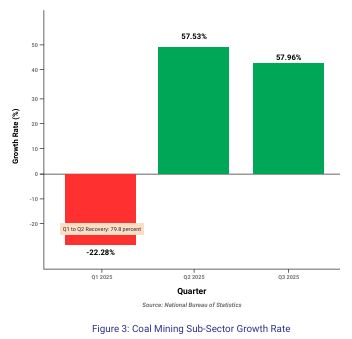
Concurrently, the quarrying and other minerals sub- sector also recorded significant fluctuations declining by -21.55% in Q1 2025, before expanding by 45.86% in Q2 2025 and 39.49% in Q3 2025.
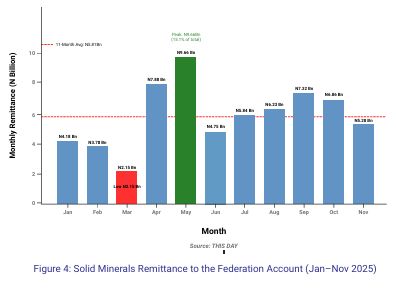
The Coal mining sector followed a similar trajectory. Output declined by -22.28% in Q1, but reversed sharply in subsequent quarters, recording strong real growth of 57.53% in Q2 and 57.96% in Q3.
Government revenue from the mining sector in 2025 mirrored the volatility observed in the overall sector performance. Cumulative remittances to the Federation Account totalled N63.92bn between January and November,4 with full-year remittances projected to exceed N70bn.5 This represents a sharp increase from approximately N38bn recorded in the prior year, reflecting in part the increase in annual service fees for mineral titles and other statutory charges, as well as stricter regulatory enforcement of payment obligations.
Overall, the pattern of contraction, recovery and expansion observed across the mining sub-sectors, together with government collections, points to increasing extraction activity and a stabilizing effect driven by governmental intervention. Even though the mining sector remains a relatively small contributor to the broader economy, greater policy interventions led by the Ministry of Solid Minerals Development (MSMD), signals a growing national priority to unlock and maximise mineral wealth.6
1.2 Emerging and New Discoveries
2025 also saw several discoveries announced by subnational actors. In March 2025, Kebbi State reported the identification of 5 additional mineral deposits raising the state's total identified minerals to over 30 minerals.7 The new discoveries include limestone, iron ore, bauxite, coal, and kaolin. Similarly, Kaduna State announced a multi-metallic discovery in Gidan Waya, Jemaa Local Government Area, with preliminary results indicating inferred quantities of gold, lithium, copper, and nickel, alongside inferred resources of 97MT of enriched tantalum and niobium ore bodies. These announcements underscore the breath of Nigeria's mineral potential and point to an expansion of exploration activity at the subnational level.
Footnotes
1https://microdata.nigerianstat.gov.ng/index.php/catalog/147/download/1258/Q1_2025_GDP%20Report.pdf
2 https://microdata.nigerianstat.gov.ng/index.php/catalog/147/download/1287/Q2%202025%20GDP.zip
3 https://microdata.nigerianstat.gov.ng/index.php/catalog/147/download/1317/GDP_Report_Q32025.zip
Click here to view the full report.
The content of this article is intended to provide a general guide to the subject matter. Specialist advice should be sought about your specific circumstances.
