

Explore the latest New Zealand AML/CFT reforms, including DIA supervision, updated compliance guidance and stronger regulatory expectations. Learn the key impacts, governance requirements and practical actions organisations should take to strengthen compliance readiness.
Download the Reporting Entity Reform Readiness Checklist
From 1 July 2026, sole supervision of Anti-Money Laundering and Countering Financing of Terrorism (AML/CFT) in New Zealand passes to the Department of Internal Affairs (DIA). The DIA has published 23 new and updated guidance documents to support the transition, following two further guidance notes issued in June to accompany the AML/CFT law reforms outlined below.
The changes reinforce a more risk-based approach to compliance, clarify supervisory expectations, and provide additional regulatory relief in some areas. Reporting Entities (REs) will need to demonstrate compliance with the new requirements and show that both the reforms and guidance have been embedded into their AML/CFT Programme, policies, processes, governance arrangements and control framework. This overview highlights key considerations to help REs address those requirements.
AML/CFT Reforms: intended to strengthen supervision, simplify compliance and improve certainty
Three phases have made up the AML/CFT Reform Programme to date:
- the Statutes Amendment Act 2025
- the AML/CFT Amendment Act 2026
- the AML/CFT (Supervisor, Levy and Other Matters) Amendment Act 2026.
These reforms aim to introduce greater effectiveness, regulatory relief and stronger certainty, spanning the following themes:
Regulate more effectively:
DIA becomes the single supervisor with expanded powers to:
- Publicly censure reported non-compliance
- Issue rules, guidance and exemptions
- Exercise stronger investigation powers
- Deliver a National Strategy and work programme, funded by an annual levy from the REs.
What you need to consider
- Monitor more frequent DIA announcements and updates
- Brief Senior Management on key changes and business impacts
- Strengthen regulatory response plans to prepare for greater DIA scrutiny and investigative activity.
Comply more efficiently:
- Induce risk-based settings for :
- Reduced Trust verification
- Politically Exposed Person (PEP) identification
- Address verification where a risk is identified.
- Extending PTR filing from 10 to 20 working days.
- Extending SAR filing for law firms from 3 to 5 working days.
What you need to consider
- Balance change with complexity
- Update ML/TF risk assessments and AML/CFT programmes for new risk settings and reporting timeframes.
Strengthen the framework:
- Use the regulator’s risk view: DIA and FIU risk assessments must be considered when preparing AML/CFT risk assessments
- Produce records quickly: urgent requests require immediate response, with a 20-working-day backstop where no timeframe is set
- Expect tougher enforcement: core AML/CFT failures increase exposure to fines and potential criminal penalties.
What you need to consider
- Refresh your risk assessment methodology to incorporate DIA and FIU risk assessments
- Strengthen regulatory response processes
- Notify your Board & senior leadership of their accountabilities.
Still to come:
The final Omnibus AML/CFT Amendment Bill (late 2026) is expected to close out the reform programme, targeting simpler compliance, FATF alignment and stronger law enforcement powers.
DIA Guidance Updates: Impact Assessment
AML/CFT Reforms in New Zealand are in force and organisations now need to move from awareness to action. As implementation efforts accelerate, it is critical to understand where the most significant obligations, expectations and risk considerations have shifted.
While the headline changes are now widely understood, the practical impact on governance, compliance and operational processes will vary across organisations.
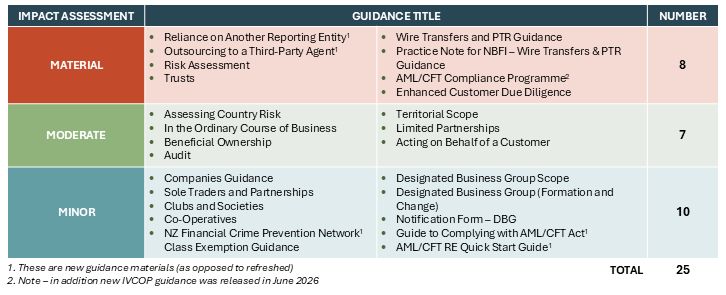
The assessment below considers how the 25 new and updated DIA guidance documents may impact REs:
Reporting Entity Reform Readiness Checklist
Reporting entities should now be reviewing whether both the reforms and the updated guidance have been appropriately reflected in their AML/CFT programmes, policies, procedures and governance arrangements.
Our AML/CFT specialists have prepared a reporting entity reform readiness checklist to help organisations assess where they are, identify gaps and prioritise action against the new reforms and DIA guidance.
The content of this article is intended to provide a general guide to the subject matter. Specialist advice should be sought about your specific circumstances.
[View Source]
