

Summary
- In-house teams under budget pressure usually respond by insourcing work and renegotiating external rates, and both tactics reach their limit quickly.
- The alternative is to define a legal core: the small set of activities that advance the organisation’s strategy, match the team’s capabilities, and use business knowledge only an in-house lawyer holds.
- A cascade strategy carries that core from the organisational strategy down through the legal strategy, the areas of focus, a measure for each, and the value delivered.
- The measure is what changes the conversation, because it states legal work in a number the executive already tracks rather than as a cost line.
- Executive buy-in is the step that frees capacity, since an executive who accepts the core will redirect peripheral work away from the legal team.
Tips for Businesses
Start by writing down your organisation’s top three objectives in the executive’s own words, not in legal language. Then ask which legal activities move those objectives and which your team is uniquely placed to do. Pick three, attach a measure to each, and take that to your executive sponsor before the next budget round. Our Legal Transformation team can help you build the case.
Every in-house team hears the same instruction: do more with less. The usual responses are to pull work back in-house and to push external firms on rates, and both run out of road quickly. The teams that escape the squeeze change the question. Instead of defending a budget, they show the executive how a small number of legal activities move the objectives the business already measures. That requires defining a legal core, the handful of activities that advance the organisation’s strategy and that your team is better placed to do than anyone else, and then abandoning the argument about cost altogether. In this two-part series, we explore how your in-house team can maximise its impact by focusing on value-creation.
Finding the ‘Core’ of the Business
The best organisations become successful through focussing on what is important. When Warren Buffett and Bill Gates first became close friends, Bill was at Warren’s house for dinner. Warren’s father asked them to separately and silently write down one word that had most impacted their success. On that piece of card, they both wrote down the same word; focus.
While focusing on core activities can bring incredible value, many in-house teams are disconnected from the core focus of their business. A survey from the FindLaw Corporate Counsel Centre found that just 45% of in-house lawyers believe that their legal department’s priorities aligned with those of the chief executive. 11% said there was ‘no correlation’ between the two. So, how can your in-house team tackle this lack of alignment?
What is the ‘Legal Core’?
Navigating the challenge to do more with less must begin with re-aligning the focus of your in-house team with the activities that deliver the most value to the business as a whole. To do this, Australia’s largest in-house teams have first defined the core activities that align with the critical objectives of the business. Then, these teams sharpened their focus to deliver these core objectives.
Discovering ‘core’ activities for your in-house team begins with asking which particular legal activities:
- advance the strategic objectives of the organisation;
- align with the core capabilities of your in-house team; and
- best leverage the in-depth business knowledge and understanding of your in-house team.
The key to defining these activities is first to understand the objectives of the organisation. Then, establish which of these objectives can be advanced with the ‘unique selling propositions’ (or USPs) of your in-house team. These USPs may include the:
- proximity of the business;
- commercial understanding of the legal team; and
- specialist legal capability.
A helpful exercise for in-house teams is to ask themselves:
‘If our in-house function could only do three things to support our organisation’s mission and strategy, what would they be?’
To implement the ‘legal core’, your in-house team can use a cascade strategy. This strategy will derive specific legal activities from overarching objectives. Beginning with the objectives of the business, this tool translates the goals of your in-house team into quantifiable value for the business.
For example, let’s put this principle into practice with a retail business ‘A-Star Company’. This business’ key objective is to out-compete other retailers by reducing the cost of products and decreasing the time it takes to acquire new stores.
Set out below is a hypothetical example of how the cascade strategy would work. Here, it could be used by the retailer’s in-house team to implement legal activities that will advance the retailer’s mission.
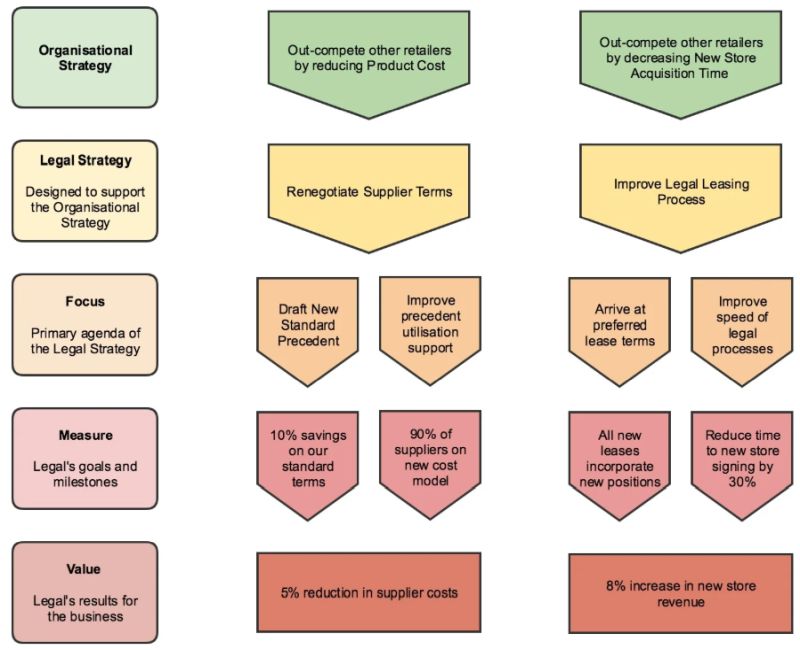
What it All Means:
- the organisational strategy is the macro-level strategy that is the primary aim of the business;
- the legal strategy is the macro-level strategy of the in-house legal team, which is aligned with – and nestled within – the broader aim of the business. Identifying this legal strategy begins with an in-house team asking how they can add to, or support, the organisational strategy;
- focus refers to the in-house team’s set of primary goals that support the legal strategy;
- the measure concerns the specific, measurable outcomes for each area of focus; and
- value refers to the tangible outcome of the in-house team working to support the overall organisational strategy.
A Worked Cascade for A-Star Company
The diagram above sets out the cascade, but the logic is worth stating in words. Take A-Star Company. Its organisational strategy is to out-compete rival retailers by lowering the cost of products and shortening the time it takes to open a new store. The legal strategy that nests inside it is to remove legal friction from procurement and site acquisition. That legal strategy produces two areas of focus: supplier contracting and property. Each area of focus needs a measure the business already recognises. For supplier contracting, the measure might be the average turnaround on a supplier agreement, moving from twenty-one days to seven. For property, it might be the average time to negotiate a lease, moving from twelve weeks to six. The value falls out of the measure: the buying team reaches lower-cost suppliers sooner, and more stores trade sooner. Notice what the cascade does. It converts a legal activity into a number the chief financial officer already tracks, which is what makes the conversation about value rather than cost. Build your own version before you take it to the executive. Our General Counsel Toolkit sets out the supporting material.
The Importance of Gaining Executive Buy-In
Within our experiences working with in-house teams, we have seen that achieving support for strategies from key executives within the company is essential. Known as gaining executive buy-in, this is an important component in aligning the activities of the in-house team with the ‘legal core’.
In-house teams who implement a strategy focusing on their ‘legal core’ have been able to better articulate their value beyond simply saving their spend. In doing so, key executives have bought into the strategies. By narrowing the focus of your in-house team to high-value outcomes and gaining business approval, executives often redirect in-house resources to ‘non-core’ activities, called peripherals. This will be further explored in Part 2 of this series.
Key Takeaways
The pressure to do more with less is prevalent within some of Australia’s largest in-house teams. Re-focusing the objectives of your in-house team to align with the business’ core goals could assist in navigating the business’ aims. Shifting the focus to value creation rather than saving money will begin with your in-house team asking themselves which particular legal activities:
- advance the strategic objectives of the organisation;
- align with the core capabilities of your in-house team; and
- best leverage the in-depth business knowledge and understanding of your in-house team.
Once these ‘core’ objectives are identified, you can properly implement them through the ‘cascade strategy’. You should also ensure the buy-in of key executives with the business. The focus of the in-house team can then turn to manage their excess (or ‘peripheral’) tasks. We delve into this challenge in Part 2 of this series.
If you have any questions about how your in-house legal team can better meet business aims, LegalVision provides ongoing legal support for all businesses through our fixed-fee legal membership. Our experienced Legal Transformation lawyers help businesses manage contracts, employment law, disputes, intellectual property, and more, with unlimited access to specialist lawyers for a fixed monthly fee. To learn more about LegalVision’s legal membership, visit our membership page.
Frequently Asked Questions
What does “do more with less” mean for an in-house legal team?
It usually means the executive has cut or frozen the legal budget while the volume of work keeps rising. Most teams respond by insourcing work and renegotiating external rates. Both help, but neither changes how the business values the legal function.
What is an in-house team’s legal core?
It is the small set of legal activities that advance the organisation’s strategic objectives, match your team’s capabilities, and draw on the business knowledge only an in-house team holds. A useful test is to ask what three things your function would do if it could do nothing else.
How does the cascade strategy work?
It runs from the organisational strategy down to the legal strategy, then to areas of focus, then to a measure for each, then to the value delivered. Each level derives from the one above it, so every legal activity traces back to a business objective.
Why does executive buy-in matter?
Because the legal core only works if the executive accepts it. Once they do, they stop treating every legal task as equally important and start redirecting peripheral work away from your team, which is what frees the capacity the core needs.
The content of this article is intended to provide a general guide to the subject matter. Specialist advice should be sought about your specific circumstances.
[View Source]