

01 Executive summary
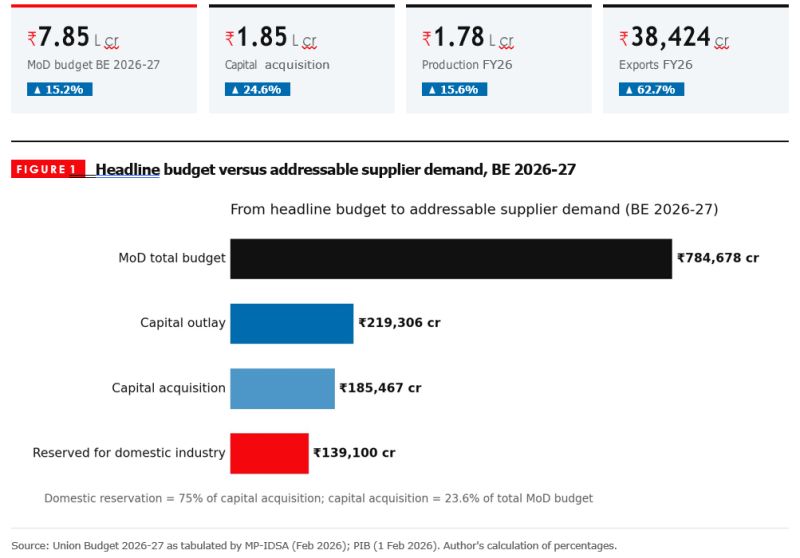
India's defence market is larger on paper than in practice. The FY2026-27 Ministry of Defence budget of ₹7.85 lakh crore contains only ₹1.85 lakh crore of capital acquisition, of which ₹1.39 lakh crore is reserved for Indian industry. Against that, the Defence Acquisition Council cleared about ₹7.6 lakh crore of proposals in four meetings between February and September 2026. The gap between approvals and annual spending is the central fact for any supplier, investor or foreign OEM.
Findings
- Read the budget in Pensions (21.8%), pay and maintenance are not supplier markets. Capital acquisition is 23.6% of the MoD budget; the domestic-industry reservation is 17.7% of it.
- Approvals far exceed AoNs of about ₹7.6 lakh crore in 2026 alone, on top of ₹6.73 lakh crore across 55 proposals in FY2025-26, compare with ₹1.85 lakh crore of annual capital acquisition. Conversion speed is the investment variable.
- The rulebook is mid-change. DAP 2020 governs live procurement; a draft DAP 2026 (released 10-11 February 2026) would raise indigenous content in the top category from 50% to 60%, define indigenous design, add technology-readiness-level routes and two-stage trials, and drop No notified final text was found by 30 September 2026. The Defence Procurement Manual 2025, covering about ₹1 lakh crore a year of revenue procurement, took effect on 1 November 2025.
- Demand is tilting to aircraft, sensors and weapons. FY27 capital heads for aircraft and aero engines (+31.1%) and other equipment (+30.3%) grow about 30%; the naval fleet head grows 2.6%.
- Production is state-led; exports jumped on state DPSUs and other PSUs made about 76% of FY26 output. DPSU exports rose 151% to ₹21,071 crore while private exports rose 14% to ₹17,353 crore.
- Supplier gaps are engines, marine turbines, RF electronics and Roughly half of the 33,000 items offered on SRIJAN remain unindigenised; Tejas Mk1A deliveries wait on imported engines.
- Foreign capital has not followed the Cumulative FDI in defence industries was only $32.29 million between April 2000 and March 2026; DPIIT confirmed on 31 August 2026 that it is consulting on easing norms.
- Internal security is a separate, growing market. The seven CAPFs are budgeted ₹1,16,789 crore in FY27 and Home Ministry capital outlay is ₹21,272 crore, up 84% from FY2024-25.
What this means, by reader
|
Reader |
Main implication |
First action |
|
Indian manufacturers and MSMEs |
Spares, components and sub-tier supply to DPSUs are the funded, lower-risk entry points (SRIJAN, sixth Positive Indigenisation List) |
Register on SRIJAN and DPSU vendor lists; map product to open list items |
|
Startups |
iDEX has 676 innovators and 551 contracts; draft DAP 2026 promises five years of assured orders for Make and iDEX projects, but it is not yet in force |
Target counter-UAS, loitering and autonomy challenges; keep IP clean |
|
Foreign OEMs |
Design ownership and Indian IP access are becoming the test; licensed build alone may not qualify for the top category |
Structure JV or ToT with Indian design content; watch FDI easing |
|
Investors |
Order books are large (HAL ₹2.54 lakh crore) but conversion and working capital are the constraint |
Track AoN-to-contract time, receivables and engine supply, not headline AoNs |
|
Advisers and counsel |
Five instruments changed in 12 months: DPM 2025, draft DAP 2026, Security Manual 2025, FDI consultation, sixth PIL |
Maintain a live regime tracker per transaction |
Click here to read the full report.
The content of this article is intended to provide a general guide to the subject matter. Specialist advice should be sought about your specific circumstances.

