

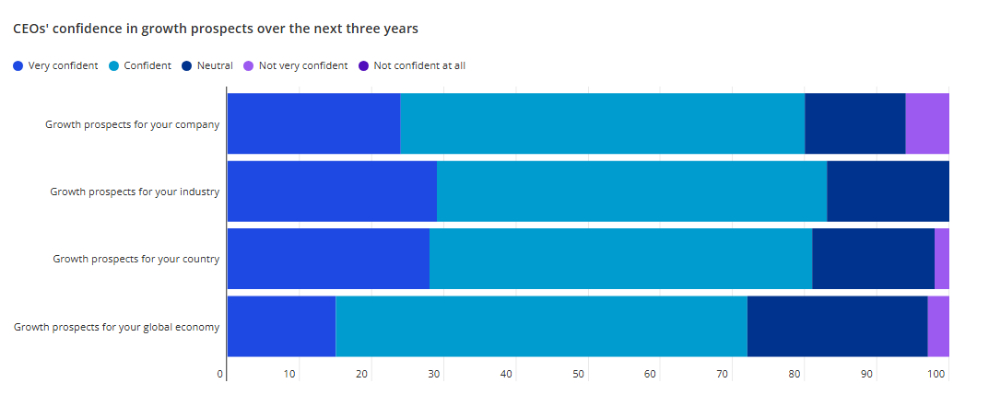
Optimism has turned to confidence. Asset Managers and Private Equity leaders are increasingly bullish about the prospects for their company and the wider industry. Nearly a quarter expect outsized earnings over the next three years. Expect deployments to skyrocket and disposals to follow as valuation gaps narrow and managers start to focus on executing strategic M&A.
Value creation will continue to be high on the Asset Management agenda, driven by investments into digitalisation and AI. Sector CEOs are clear on how AI will create competitive advantages for their funds, their organisations and their portfolio companies. The vast majority are confident they have the skills and capabilities to turn these investments into tangible value uplift. Cybersecurity will remain a top concern, with AI creating both risks and opportunities.
Maximising value will require Asset Managers and Private Equity leaders to adjust their organisational skills and capabilities. Recognising the continued fierce competition for top talent, CEOs are taking proactive steps to equip themselves with the skills needed to continue driving exceptional value for investors. People are being upskilled, workplace models are being updated and new partnerships are being formed to drive AI adoption and retraining.
Sustainability has become part of the value equation, with sector leaders saying they are increasingly focused on understanding — and unlocking — the financial value of their ESG initiatives. That means both assessing the cost and value of their sustainability investments and ensuring they are reporting on the right metrics to meet the expectations of their investors and regulators.
As this report illustrates, Asset Management and Private Equity leaders expect 2026 to deliver increasing confidence and outsized growth. Our CEO Outlook explains why.
Asset Management and Private Equity CEO Outlook
Explore how leaders in the sector are navigating industry challenges and shaping their strategies for long-term success.
approaches. This report focuses on 110 asset management and private equity CEOs. All respondents oversee companies with annual revenues over US$500M; a third have more than US$10B in annual revenue. The survey covers 11 key markets and 12 industry sectors.
Key findings
Closing the valuation gap and prioritising strategic M&A will be essential for asset managers seeking to deliver stronger outcomes and long-term value for clients in a rapidly evolving market.
Vivian Chui
Head of Securities & Asset Management, Hong Kong SAR
KPMG China
Quantifying value creation and aligning sustainability with financial outcomes will help asset managers and private equity leaders achieve resilience and drive returns as the industry embraces new opportunities.
Darren Bowdern
Head of Asset Management Tax, ASPAC / Head of Alternative Investments, Hong Kong SAR
KPMG China
Private equity leaders should prioritise strategic M&A and AI-powered innovation to drive scale, enhance value creation, and deliver long-term outcomes for investors in a competitive market.
Louis Ng
Co-Head of Private Equity
KPMG China
Why download the report?
By downloading the 2025 Asset Management and Private Equity CEO Outlook report, you will:
- Discover why 83% of Asset Management and Private Equity CEOs are confident in the growth of the industry.
- Uncover why 90% have clarity on how AI will benefit their organisation.
- Examine why 75% think their organisation can keep pace with the speed of AI development.
- Find out why 61% are prioritising compliance and reporting standards to meet investor expectations.
- Understand why 72% will use AI for climate risk modelling and scenario planning.
Explore the full report to gain a deeper understanding of the trends, perspectives, and emerging themes shaping the future of Asset Management and Private Equity.
The content of this article is intended to provide a general guide to the subject matter. Specialist advice should be sought about your specific circumstances.


