

Emerging technologies and government focus on security will drive new entrants and consolidation in the sector, but the realities of procurement remain a political and commercial challenge
US Secretary of State and National Security Advisor Marco Rubio struck a conciliatory tone during his speech at the Munich Security Conference in February, though the underlying message for European leaders was the same: the continent’s defence capacity must meet the challenge of a new global environment.
Europe has responded with spending promises, pledges to remove red tape holding back defence procurement, and overtures towards greater coordination on security strategy.
The Ukraine war and a changing relationship with the US has given European governments a sense of urgency. Further conflicts and tensions elsewhere have globalised the trend. World-wide defence spending grew from US$ 2.48 trillion in 2024 to US$ 2.63 trillion in 2025, with Europe increasing spending by 12.6% year on year (to US$ 563 billion) and Asia by 5.7% (to US$ 573 billion), according to the International Institute for Strategic Studies.
Will increased defence spending drive dealmaking?
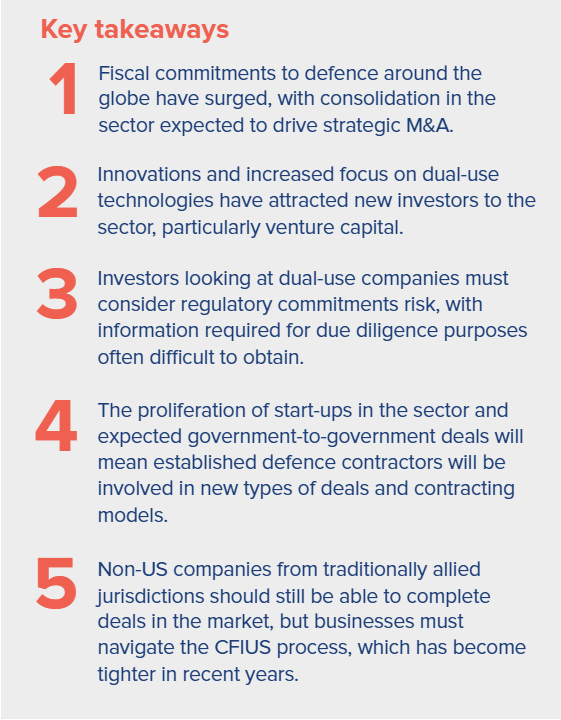
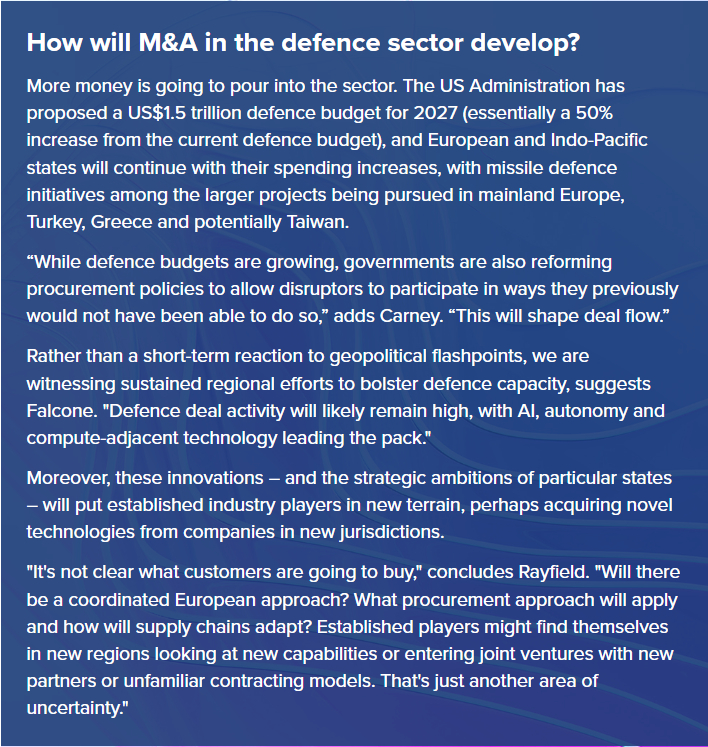
While observers have raised concerns about the speed and focus of rearmament in regions where it is thought to be needed, global increases in defence spending have driven consolidation in the sector.
"There's been an uptick in dual-use and defence-related work," says Sönke Becker, head of HSF Kramer's corporate practice in Germany and manufacturing and industrials sector team. "If we look at Germany, we can definitely expect consolidation. Now is the time for making your business bigger and getting closer to the German government. That trend will continue for the foreseeable future."
Arms manufacturer Rheinmetall is among those who have set ambitious targets, eyeing sales of €50 billion by 2030, an approximate fivefold increase on its 2025 revenues. The group is also exploring an array of new technologies and platforms, notably acquiring shipyard group Lürssen's naval division in September last year and forging a joint venture with ICEYE in November, Rheinmetall ICEYE Space Solutions. Armin Pappberger, CEO, aims to develop Rheinmetall into an integrated technology group, providing integrated network solutions “from sensor to effector”.
While governments have made significant investments in conventional weapons, such as tanks and traditional aircraft, new systems such as drones, modern satellites, and assets underpinned by AI and quantum technology have become central to defence strategy. As a result, established defence contractors may find themselves acquiring nascent companies such as technology-driven start-ups in unfamiliar jurisdictions.
"Even the players that have been there and done it all themselves might find themselves in a different environment," says London-based corporate partner Stephen Rayfield. "No one knows with certainty what's coming next. With governments looking for new solutions and security partnerships, customers and contractors might not just be dealing with their existing supply chains."
No one knows with certainty what's coming next. With governments looking for new solutions and security partnerships, customers and contractors might not just be dealing with their existing supply chains
Stephen Rayfield
Partner, London
Are new investors being attracted to the sector?
The prevailing military doctrine of the last 50 years has prioritised power and precision over mass, informing the focus on expensive defence platforms such as missile systems, submarines and aircraft carriers.
However, recent developments in AI and autonomous systems, combined with new commercially available technologies which can be manufactured cheaply such as drones, has seen military experts coin a new euphemism – 'precise mass'. These innovations have attracted a new profile of investor and removed some of the reticence that has traditionally characterised investment into the sector.
"A variety of investors are coming in," notes London-based M&A partner Siddhartha Shukla, whose deals work focuses on defence. "Banks and private equity houses which previously abandoned or did not have a defence desk have put that defence desk back. That's driven by deployment of cash into the sector and opportunities."
The transition has been particularly fast in Germany, according to Becker: "Prior to 2022, Germany was a largely pacifist country. It was somewhat of a challenge to invest in defence assets. That has dramatically changed. There is no reticence now to get close to the defence sector, and that very much includes venture capital."
Acquirers from more traditional US ally and partner nations, such as the Five Eyes nations, Germany, France, Japan and others, can have an easier time getting clearance without significant mitigation remedies, at least compared to investors from ‘countries of concern’ to the US Government
Joseph Falcone
Partner, New York
Will there be more government-to-government dealmaking?
Aligning defence strategies between states is notoriously thorny, with government-to-government projects often stymied by sovereignty and cost concerns. But as governments look to recast their supply chains and defence partnerships, there is likely to be a trend towards more collaboration, according to Shukla.
"We expect there will be a trend towards more government-to-government dealmaking. People are coming together faster. For example, the Canadians are saying let’s build a coalition. We expect deals at that level, or deals driven by geopolitical imperatives.”
“The AUKUS pact, which is a technology sharing agreement between the United States, the United Kingdom and Australia is a prime example of this,” adds Nick Carney, head of HSF Kramer's infrastructure and defence practice in Australia.
But such deals require collaboration between states and must be downstream of their strategic priorities. In Europe these priorities remain somewhat unclear and the continent has been dogged by issues with duplication and a lack of interoperability between its defence systems. Meanwhile, many established assets remain underpinned by generic platforms sourced from the US and it is still uncertain how much Europe intends to decouple from the American supply chain. As Rayfield points out, "the US supply chain is reliable, they'll sell it to you, you just need to buy it."
Can non-US companies still do deals in the US market?
US defence contractors have supplied traditional partners and allies around the world for decades, with states in the Middle East, Europe and Asia among their largest customers. But these ties work both ways: non-US companies are also deeply entwined with the country's defence sector.
The US foreign direct investment regulator, the Committee on Foreign Investment in the United States (CFIUS) applies close scrutiny to investments into the defence sector for their potential US national security impacts, with the US Government identifying the need for a resilient defence supply chain that can reliably produce and provide security-related products.
However, certain non-US companies may find the market more accessible, says New York- and Washington DC-based partner Joe Falcone, whose practice focuses on advising clients on and representing them before CFIUS.
"Acquirers from more traditional US ally and partner nations, such as the Five Eyes nations, Germany, France, Japan and others, can have an easier time getting clearance without significant mitigation remedies, at least compared to investors from ‘countries of concern’ to the US Government. Moreover, the path to CFIUS clearance for new deals may be a bit easier for non-US companies already doing business in the US in defence, since presumably you've already been vetted on some level."
One caveat, however, is that there is no limit on CFIUS jurisdiction – it never expires. "The Trump Administration recently ordered divestment of a Chinese acquisition of a US company that appears to have provided services to the US government and military," warns Falcone. "But they did so five years after the closing of the deal, which was never filed to CFIUS."
This serves as a reminder that any non-US investments in the US defence sector should be (pre-)assessed for their potential national security and CFIUS implications, as CFIUS can call in any non-notified sensitive transaction, even years after completion – and in the defence sector, governments always have other levers to pull as a customer.
The content of this article is intended to provide a general guide to the subject matter. Specialist advice should be sought about your specific circumstances.
[View Source]


