

Requesting priority is a powerful tool that allows for the establishment of an earlier claim date on the basis of an earlier filed application (the “earlier application”). Under subsection 73(3) of the Patent Rules, to request priority for a later filed Canadian application (the “later application”) on the basis of the earlier application, the later application has to be filed within the 12-month priority period starting from the filing date of the earlier application. When multiple priorities are requested, the priority period is 12 months from the earliest filing date of the earlier applications.
Subject to subsection 73(1) of the Patent Rules, the priority request itself can be made (in the petition or a separate document) before the end of the 16-month period starting from the earliest filing date of the earlier applications, or within four months from the filing date of the regular Canadian application, whichever is later. If early publication is requested before either of these dates, the priority request must be made on or before the date of early-publication approval.
The same date for requesting priority is applied to a Patent Cooperation Treaty (PCT) application entering national phase in Canada (where the filing date is the PCT filing date), unless said date is before the national phase entry date, in which case the deadline for priority request is the national phase entry date. To request priority for a PCT application under Article 8 of the PCT at the international stage, the PCT application and the priority request itself must be submitted to the receiving office (which is the Canadian Intellectual Property Office (CIPO) or the International Bureau (IB) for Canadian applicants) within the 12-month priority period starting from the filing date of the earlier application (or the earliest filing date of the earlier applications).
Under the Patent Rules, CIPO has introduced mechanisms for the “restoration of priority.” As the name suggests, a valid request for the restoration of priority allows a later application to claim priority to an earlier application that was filed more than 12 months before the later application was filed. In other words, under certain conditions (described in more detail below), a later application may be filed with a priority claim to an earlier application after the expiry of the 12-month priority period of the earlier application.
In Canada, restoration of priority can be classified into three categories, depending on the type of the application to which the request pertains:
- Restoration of priority for a regular Canadian application.
- Restoration of priority for a PCT application entering national phase in Canada.
- Restoration of priority for a PCT application filed with CIPO as the receiving office (international stage).
Restoration of priority for a regular Canadian application
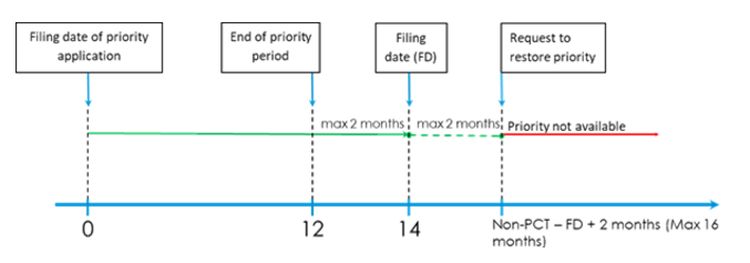
Subject to subsection 28.4 (6) of the Patent Act, restoration of priority is available only for a regular Canadian application filed within two months after the expiry of the 12-month priority period (i.e., within 14 months from the filing date of the earlier application).
Subject to subsection 77(1) of the Patent Rules, the request for the restoration of priority (the request itself) must be submitted within two months of the filing date of the regular Canadian application.
As an example, assuming an earlier application was filed on March 1, 2024. The 12-month priority period for the earlier application would expire on March 1, 2025. In order for a regular Canadian application to be eligible for the restoration of priority on the basis of the earlier application filed on March 1, 2024, the regular Canadian application must be filed on or before May 1, 2025. Assuming the regular Canadian application is filed on April 2, 2025, then the request for the restoration of priority must be made on or before June 2, 2025.
As such, the maximum period for which a request for the restoration of priority can be made is 16 months after the filing date of the earlier application (i.e., where the regular Canadian application is filed two months after the expiry of the 12-month priority period and the request for the restoration of priority is submitted two months after the filing date of the regular Canadian application).
The Manual of Patent Office Practice (MOPOP) provides a diagram for explaining the timeline of the restoration of priority, which is reproduced below for reference.
A valid request must be submitted to the Commissioner under subsection 28.4(6) of the Patent Act. In particular, the request must contain:
- A valid request for priority including:
- A request for priority in the petition or in a separate document.
- The filing date and the name of the country or office of filing of the earlier application.
- A statement that the failure to file the regular Canadian application within 12 months after the filing date of the earlier application was unintentional.
No government fee is required for this request.
Restoration of priority for a PCT application entering national phase in Canada
Restoration of priority is available for PCT national phase applications with CIPO acting as the designated office. We note that, while the World Intellectual Property Organization (WIPO) appears to list Canada as ineligible for the restoration of priority when acting as the designated office for national phase entry (Restoration of the right of priority by receiving offices and designated offices), this appears to be outdated as the Patent Act and Rules do allow for restoration of priority for PCT applications entering national phase in Canada.
Subject to subsection 28.4 (6) of the Patent Act, restoration of priority is available only for a PCT application filed within two months after the expiry of the 12-month priority period (i.e., 14 months from the filing date of the earlier application).
Subject to subsection 77(1) of the Patent Rules, the request for the restoration of priority (the request itself) must be submitted within one month after the date of national phase entry.
For example, again assuming an earlier application was filed on March 1, 2024. The 12-month priority period for the earlier application would expire on March 1, 2025. In order for a PCT national phase application to be eligible for the restoration of priority on the basis of the earlier application filed on March 1, 2024, the PCT application must be filed on or before May 1, 2025. Assuming the PCT application is filed on April 2, 2025, and entered national phase on September 1, 2026 (the 30-month deadline), then the request for the restoration of priority must be made on or before October 1, 2026.
A valid request must be submitted to the Commissioner under subsection 28.4(6) of the Patent Act. In particular, the request must contain:
- A valid request for priority including:
- A request for priority in the petition or in a separate document.
- The filing date and the name of the country or office of filing of the earlier application.
- A statement that the failure to file the PCT application within 12 months after the filing date of the earlier application was unintentional.
No government fee is required for this request.
Restoration of priority for a PCT application filed with CIPO as the receiving office
While there is no specific provision under the Patent Act or Rules pertaining to the restoration of priority for a PCT application during the international phase, the WIPO indicates that CIPO, when acting as the receiving office, do accept requests for restoration of priority (Restoration of the right of priority by receiving offices and designated offices).
CIPO has not provided any specific guidelines for restoring priority for a PCT application during the international phase where CIPO is the receiving office, with the only guidelines provided by WIPO.
Subject to Rule 26bis.3 of the Regulations under the PCT, restoration of priority is available only for a PCT application filed within two months after the expiry of the 12-month priority period (i.e., 14 months from the filing date of the earlier application). Further, the request for the restoration of priority (the request itself) must also be submitted within two months after the expiry of the 12-month priority period (i.e., 14 months from the filing date of the earlier application). Note that the PCT application must also have at least one valid priority claim.
For example, assuming an earlier application was filed on March 1, 2024. The 12-month priority period for the earlier application would expire on March 1, 2025. In order for a PCT application (during the international phase) to be eligible for the restoration of priority on the basis of the earlier application filed on March 1, 2024, the PCT application must be filed on or before May 1, 2025, and the request for the restoration of priority must also be made on or before May 1, 2025.
A valid request can be submitted using Box VI of the PCT request form indicating the claims which restoration of priority is requested (5.064 of Introduction to the International Phase). Alternatively, a letter separate from the request form can be used. A valid request should contain:
- A statement of reasons for the failure to file the international application within the priority period. The statement of reasons should be submitted as a separate document even if the request is submitted via the request form.
Subject to Rule 26bis.3 of the Regulations under the PCT, the statement of reasons should indicate the reasons for the failure to file the PCT application within the priority period and should contain all the relevant facts and circumstances to allow the receiving Office (i.e. CIPO/the Commissioner) to determine that the failure to file the international application within the priority period occurred was unintentional, or in spite of due care required by the circumstances having been taken.
WIPO lists CIPO as an receiving office that could apply both due care and unintentional criteria for the restoration of priority (Restoration of the right of priority by receiving offices and designated offices). WIPO also states that, if a receiving office wishes, “it may apply both criteria for restoration and leave the choice to the applicant as to which criterion is sought to be applied in a specific case” (5.065 of Introduction to the International Phase). Under the same guidelines, CIPO may choose to apply, upon request of the applicant, first the “due care” criterion and then, if CIPO finds that that criterion is not complied with, the “unintentionality” criterion.
As CIPO appears to apply the unintentional criterion for regular Canadian applications and PCT national phase applications, it would be reasonable to assume that CIPO would likely accept a restoration of priority at the international phase if the request includes a statement that the failure to file the PCT application within 12 months after the filing date of the priority application was unintentional.
We note that a successful restoration of priority at the international stage is not necessarily binding in all designated offices (Rule 49ter of Regulations under the PCT). For example, an application where priority has been restored at the international stage based on the unintentional criterion may not have the restored priority recognized by a designated office that permits the restoration of priority based on the unintentional criterion.
WIPO has also indicated that no government fee from CIPO is required for this request, which appears to be consistent with regular Canadian applications and PCT national phase applications.
“Unintentional” and “due care” standard
We note that CIPO has not provided an official guideline as to what constitute to an “unintentional” failure. The same requirement is applied for international applications entering Canada past the 30-month deadline. We can only assume that the requirement is less strict than the “due care” standard in Canada. Currently, the “due care” standard is applied with respect to certain failures such as failure to pay maintenance fee or failure to request for examination in some circumstances.
The “due care” standard requires the applicant to have taken all measures that a reasonably prudent patent holder would have taken—given the set of circumstances related to the failure—to avoid the failure, and for the failure to have occurred despite having taken those measures (see, section 27.03 of MOPOP). CIPO publishes a list of all of past decisions regarding “due care” (see, Determinations related to due care), and at the time of writing, only 54 out of the 380 cases was determined to have met the “due care” standard.
However, it would appear that, at least for the moment, only a statement that the failure was “unintentional” is required and that the applicant does not need to provide any justification or reasons for the failure. This is largely consistent with the PCT standard, which states that “[f]or the “unintentionality” criterion, a statement indicating that the failure to comply with the priority period was not deliberate may be sufficient” (Chapter VII,166F of PCT Receiving Office Guidelines).
In the case of restoring priority for a PCT application during the international phase where the applicant would like the “due care” criterion to apply, WIPO guidelines suggest that to fulfil the “due care” criterion, the statement of reasons should describe in detail the facts and circumstances that led to the late filing and any remedial or alternative steps taken to attempt a timely filing of the international application. At this time, CIPO has not published any guidelines regarding the “due care” standard specifically for restoring priority for a PCT application during the international phase.
Priority deemed restored
For a PCT application entering national phase in Canada where priority has been successfully restored during the international phase, the priority for the PCT national phase application is deemed restored (valid) under section 162 of the Patent Rules.
Similarly, divisional applications filed on the basis of a parent application where the priority has been successfully restored are also deemed to have the priority restored (i.e., valid priority) under section 78 of the Patent Rules.
Other considerations
Although CIPO does not explicitly require the applicant to provide reasonings for the “unintentional” failure, applicants should still ensure that they have valid justifications for failing to file the application in time.
Even if a PCT application failed to have its priority restored at the international stage, applicants can still have the opportunity to restore the right of priority during national phase in Canada (Rule 49ter.1 (e) of the Regulations under the PCT) under the more lenient “unintentional” requirement.
For an applicant wishing to enter multiple jurisdictions, it could be beneficial to restore priority at the international stage considering that many designated offices accept the restoration of priority at the international stage.
If Canada is acting as the receiving office, an applicant may find it easier to satisfy the “unintentionality” criterion rather than the “due care” criterion when seeking to restore priority for a PCT application at the international stage. While recent case law on “due care” is directed to failure to pay maintenance fees beyond the prescribed time, (Taillefer v Canada (Attorney General) - 2024 FC 259, affirmed in 2025 FCA 28), nevertheless, it may be an indication of the difficulty for the applicant to meet the “due care” criterion for restoring priority. However, an applicant should note that certain other designating offices may not accept priorities restored based on “unintentionality” criterion at the international stage.
Conclusion
The Patent Rules allows for restoration of priority under a number of different mechanisms for applications filed after the expiry of the 12-month priority period. This can result in significant benefits including eliminating self-anticipation and limiting the references that are citable during prosecution. As the request itself is relatively simple and that that there is no government fee associated with the request, restoration of priority can be a powerful tool to take advantage of in Canada. However, restoration of priority for a PCT application at the international stage may be more difficult considering that many patent offices require the “due care” criterion.
Read the original article on GowlingWLG.com
The content of this article is intended to provide a general guide to the subject matter. Specialist advice should be sought about your specific circumstances.
[View Source]
