Download a PDF copy of this Blog here.
For businesses importing goods into Canada, the transaction value method (“TVM”) is the most commonly applicable method for determining the value for duty (“VFD”) under the Customs Act. However, for Canadian subsidiaries of foreign businesses, disputes often arise with the Canada Border Services Agency (“CBSA”) over VFD-related issues such as (1) the relevant “sale for export”, (2) purchaser in Canada status, and (3) inclusion of various design costs.
In a recent decision, the Canadian International Trade Tribunal (“CITT”) found that a Canadian subsidiary of a US business qualified to use the TVM and that certain design costs for unsuccessful models of imported goods do NOT need to be included in the VFD.
We review that decision below.
Maggie Sottero – Facts
In Maggie Sottero (Canada) Ltd., AP-2020-013, a US-based wedding dress company (“US Parent”) sold gowns in Canada through its wholly owned Canadian subsidiary (“MSC”). MSC arranged for custom pre-ordered and stock inventory gowns (the “Pre-Orders” and “Stock Inventory” – collectively the “Gowns”) to be imported from foreign manufacturers (“Manufacturers”). Gowns were then sold to a third-party distributor operating in Canada (“Distributor”).
The typical transactions were structured as follows:
- Retail customers placed orders with the Distributor
- Distributor placed orders with MSC, which placed orders with Manufacturers
- Manufacturers shipped the Gowns to Distributor’s premises, where MSC leased space for its inventory, and invoices were made out to MSC
- Under a service agreement, Distributor’s staff managed MSC’s inventory and scanned Gowns out of inventory once sold to Distributor
- MSC was managed by employees of US Parent, which also paid MSC’s invoices
Following an audit, CBSA took the position that MSC did not qualify to use the TVM under s. 48 of the Customs Act. It argued that title to the Gowns passed immediately to the Distributor on import, making the relevant “sale for export” between the US Parent and the Distributor. CBSA also claimed certain “non-design costs” and costs for unsuccessful designs should be added to the VFD for imported Stock Inventory gowns. MSC appealed to the CITT.
CITT Decision
On the issue of whether MSC qualified to use the TVM, the CITT considered the entire context of the transactions, including the contractual agreement between MSC and Distributor. It found that MSC held title to the goods on importation, making the relevant “sale for export” between MSC and the Manufacturers. In reaching that conclusion, the CITT distinguished the case of Landmark Trade Services, AP-2019-002 (which we wrote about here ), where an intermediary merely paid duties on behalf of the true “importers”. In the present case, the CITT also found that MSC had a permanent establishment at Distributor’s premises, allowing it to use the TVM.
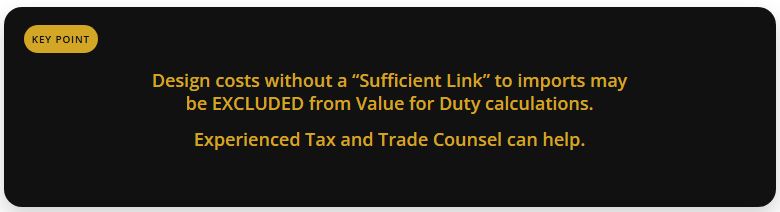
On the issue of design costs, the CITT found that only costs relating to successful models (i.e., reaching at least the prototype stage) were required to be included in the VFD. Costs relating to abandoned designs and “non-design costs”, such as the management portion of the head designer’s salary, were excluded because they lacked a “sufficient link” with the production of the Stock Inventory.
Takeaways
The Maggie Sottero decision is a reminder that an importer’s commercial structure can directly affect the VFD of its imports. It also suggests that design costs lacking a “sufficient link” to the production of imported goods may be excluded from VFD.
For help with a CBSA valuation audit, please click here .
The content of this article is intended to provide a general guide to the subject matter. Specialist advice should be sought about your specific circumstances.
[View Source]