

The Australian Securities and Investments Commission (ASIC) has published updated guidance in relation to businesses offering products and services which are, or relate to, digital assets. ASIC's Information Sheet 225 - Digital Assets: Financial Products and Services sets out how certain products and services in relation to digital assets are regulated under the existing Australian financial services laws.
Digital Assets - Financial Products and Services
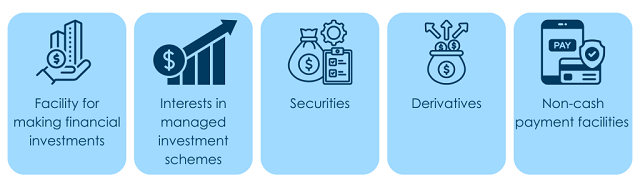
ASIC's eighteen (18) worked examples are grouped into the following five (5) categories:
- facility for making financial investments - for example, a digital asset platform that enables users to contribute funds or tokens for the purposes of assisting in development of the exchange.
- interests in managed investment schemes - for example, where users contribute tokens or funds to invest in a range of bank deposits and that is managed by an entity for the purposes of generating a share in profits.
- securities (shares, options, debentures) - for example, , providing ownership interests, voting rights and entitlements to dividends.
- derivatives - for example:
- a digital asset that derives its value from the price or performance of another asset; or
- a digital asset that represents another crypto-asset on a different blockchain and derives its value from the underlying asset, with a right to redeem the wrapped token for the original asset.
- non-cash payment facilities - for example:
- a digital asset that derives its value from the price or performance of another asset; or
- a digital asset that represents another crypto-asset on a different blockchain and derives its value from the underlying asset, with a right to redeem the wrapped token for the original asset.
Entities may also be providing custodial or depository services, which are determined by how assets are held and the terms of the arrangement. For example, an entity controlling the private keys related to an address on a public blockchain is likely to be considered as providing custodial or depository services.
The examples listed above illustrate some ways in which a digital asset may be classified into one of the five categories.
ASIC has reiterated that each digital asset needs to be assessed individually, considering the rights and benefits attached to the digital asset and the arrangements in place. This includes assessing the way in which products will be offered and used by clients. The rights and benefits can be derived from:
- a digital asset's terms and conditions, or "white paper", that is generally issued by an entity that makes an offer or sale of the digital asset;
- how the digital asset is marketed to clients;
- correspondence with clients; and
- other documentation setting out the legal rights, benefits and arrangements in relation to the digital asset.
Rights and benefits can evolve over time such as with changes to product features or use of the digital asset. Therefore, licensees will need to consider whether these changes impact the legal status and financial product identification of a digital asset.
Assessing Organisational Competence for purposes of digital asset Australian Financial Services Licences (AFSLs)
Licensees that engage in activities in relation to digital assets should reassess their compliance with the ongoing organisational competence obligation under section 912A(1)(e) of the Corporations Act 2001 (Cth).
In assessing organisational competence, ASIC will consider the knowledge and skills of each nominated Responsible Manager. Compliance with this obligation will also depend upon the nature, scale and complexity of the business, the capacity of each Responsible Manager and the financial products and services provided.
ASIC expects that a minimum of two (2) Responsible Managers are appointed, for example:
- one Responsible Manager overseeing the regulatory aspects of the business (regulated experience); and
- the other Responsible Manager overseeing the operational business decisions regarding digital assets (unregulated digital asset experience).
ASIC anticipates the Responsible Manager base will expand as more individuals obtain relevant knowledge, skills and experience in the digital asset space.
ASIC's No Action Position
ASIC has issued a class no action position to provide businesses dealing in digital assets time to transition and apply for an AFSL. The relief is conditional upon entities:
- having commenced providing the relevant services on or before 31 December 2025;
- being registered as a foreign company in Australia and appointing a local agent by 30 June 2026 (applicable to foreign entities only);
- having lodged an application for an AFSL by 30 June 2026; and
- becoming or remaining a member of the Australian Financial Complaints Authority prior to lodging an AFSL application with ASIC (if dealing with retail clients). If already a member, the entity must remain as one until at least 1 year after the day the entity ceases to provide financial services to retail clients.
The no action position continues until either of the following occurs earlier:
- the licence application is withdrawn;
- ASIC refuses to grant or receive the AFSL application/variation; or
- the licence/variation is approved.
The no action position is not applicable to certain activities including crypto lending, non-cash payment facilities (other than stablecoins) or derivatives (other than wrapped tokens) in relation to digital assets.
What should licensees do?
Licensees will need to assess whether digital assets and related arrangements trigger a variation to their existing AFSL. Consideration of the rights and benefits attached to the digital asset will provide further insights as to what authorisations are appropriate.
If entities are operating without an AFSL or acting in a way that may require an AFSL, ASIC will require the entity to substantiate why a licence is not required.
Background
In December 2024, ASIC released Consultation Paper 381 seeking feedback on proposed updates to Information Sheet 225. Following consultation, ASIC made updates to provide specific guidance on assessing whether a digital asset is regulated, the licensing authorisations that may be required and ASIC's expectations on licensees dealing with digital assets.
Further Reading
- Updates to Info 225 - Digital Assets - Financial Products and Services
- Regulatory Guide 121 - Doing financial services business in Australia
- Information Sheet 225 - Digital Assets: Financial Products and Services
- ASIC class no-action letter for digital asset businesses
- Updated ASIC guidance supports digital asset innovation and boosts investor protection
The content of this article is intended to provide a general guide to the subject matter. Specialist advice should be sought about your specific circumstances.
