

Key Takeaways
The Competition and Consumer Amendment (Unfair Trading Practices) Bill 2026 (Cth), released by the Federal Government this month will amend the Australian Consumer Law to prohibit a range of unfair trading practices in the digital economy (Digital Economy Bill).1 This draft legislation follows regulatory consultations and inquiries to improve consumer protections from unfair trading practices, including Treasury's 2024 consultations on whether to introduce a general prohibition on unfair trading2 and the ACCC's 2025 Digital Platforms Services Inquiry. If passed, the new prohibitions will operate from July 2027 and in addition to existing prohibitions on misleading and deceptive conduct.
Organisations should be aware that:
- The Digital Economy Bill signals a renewed regulatory focus on the digital economy for 2026-2027, particularly manipulative and false retail tactics that impact consumer decision-making and undermine trust, the sale of dangerous goods online, and practices that lessen competition in digital markets. ACCC Chair Gina Cass-Gottlieb recently identified enforcement of consumer protections in digital markets as a key priority for 2026-2027.3
- The Digital Economy Bill will strengthen consumer protections
with targeted reforms on certain practices, including:
- conduct that unreasonably manipulates consumers or distorts the environment consumers make decisions in;
- unfair subscription practices;
- processes that create barriers to cancellations; and
- pricing where fees are hidden or added through purchase stages.4
- The new unfair trading provisions are primarily directed to protecting consumers, rather than small businesses. Any industry where the ACCC has already raised concerns about consumers being misled should consider themselves in the spotlight: online retailers and marketplaces,5 gyms, meal delivery services, telecommunications products, airlines, travel agents, short term accommodation platforms, beauty treatment services, content subscription providers (streaming services) and software-as-a-service providers.6
- If the Digital Economy Bill passes, businesses will have a year or less to consider whether any of their websites, apps and consumer interfaces require redesign. Additional staff training and reviews of existing marketing and disclosures will be needed to ensure that transaction-based charges are adequately disclosed.
- Subscription agreements may require amendment to provide the required information, upfront and periodically during the subscription, about pricing, fees, renewal details, and cancellation methods.
Three Digital Practices Targeted by the Digital Economy Bill
Introducing a General Prohibition on manipulation and choice distortion
The Digital Economy Bill establishes a general prohibition of trading practices towards consumers that result in consumers incurring financial loss or obtaining unsuitable goods and services, prohibiting conduct that:
- does or is likely to unreasonably manipulate consumers or unreasonably distort the environment in which the consumer makes, or is likely to make, a decision; and
- causes or is likely to cause detriment to the consumer (whether financial or otherwise).7
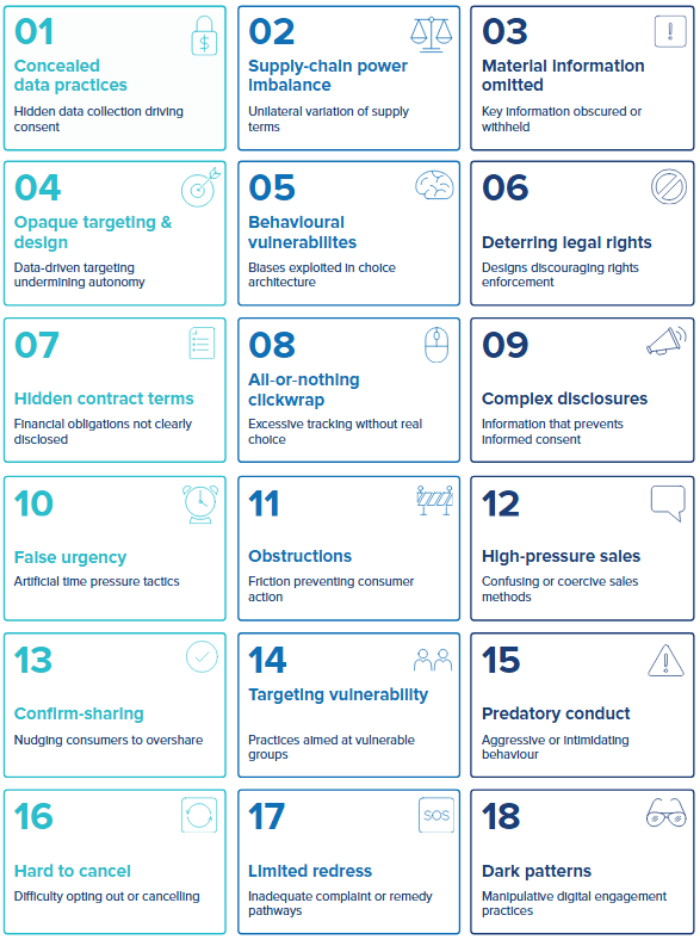
The general prohibition is intended to bridge the gap between unfair trading practices that fall outside the scope of consumer law protection and those that are already covered by consumer law protection. The Digital Economy Bill primarily targets 'dark patterns' (e.g. design elements in consumer-facing digital interfaces such as websites and apps) and other psychological tactics used in online commerce transactions that unreasonably manipulate consumers. The Government considers that these tactics "are typically aimed at benefitting the person supplying or offering to supply the relevant goods or services by nudging or pressuring consumers into unintended actions, often without the consumer's full awareness."8
The Digital Economy Bill contains examples of tactics that will be prohibited in the digital economy, including interfering with a customer's ability to exercise legal rights or seek remedies, failing to disclose material information or disclosure in a complex or ineffective way, and creating an environment that places unreasonable pressure on or obstructs consumer decision-making.9 Further, the Treasury has historically expressed concern about 'dark patterns', countdown timers or low stock notifications that create a heightened sense of urgency, 'confirm-shaming' that makes consumers feel bad about a choice, and obstructive tactics that force consumers into a particular action without alternatives.10
We consider the Digital Economy Bill will likely target the following tactics.11
New Subscription Trap Regime
The Digital Economy Bill proposes a specific regime to ensure consumers can make informed decisions about certain subscriptions and that barriers are removed for consumers to cancel subscriptions. The proposed regime will require subscription contracts to:
- disclose a statement to consumers with information about the contract. Disclosure must occur before entry into a subscription contract, but additional disclosures may be required depending on the type of subscription contract. For example, disclosure must also occur while the contract is in effect for indefinite term subscription contracts. Information that must be disclosed includes required payments, the contract term, contract renewal, required notice before termination, and how consumers can terminate;
- notify subscribers of additional information during the subscription for indefinite term subscription contracts, fixed term subscription contracts, and free trial or promotional period subscription contracts. For example, for free trial or promotional period subscriptions, this includes the date the discount period ends, the date the consumer must end the contract before payment is incurred, the period after the discount period ends, and amounts the consumer will incur after that period; and
- provide a way for the consumer to terminate the contract. This must be easy to find, straightforward, and require reasonably necessary steps to end the contract. For example, allowing online termination methods where the contract is entered into online.12
In certain circumstances, the information must be comprehensible, audible, unambiguous, and disclosed in a reasonable time before a consumer can agree to enter the contract, or in a legible, prominent and unambiguous way and in close proximity to where the consumer can agree to enter the contract.
Strengthening Drip-Pricing Rules
The Digital Economy Bill will strengthen the existing ACL protections against "drip-pricing", which is "when a price is advertised at the beginning of an online purchase, but extra fees and charges (e.g. booking and service fees) are gradually added during the purchase process."13 This amendment supports consumer awareness of transaction-based charges throughout their purchase and empowers them to make informed decisions about whether to continue.
The amendments will require that a 'base price' be accompanied by a disclosure of any additional transaction-based charge, or the method for calculating that charge. A transaction-based charge is any charge that would be paid by the consumer on a 'per transaction' basis, but excludes a payment surcharge, tax, duty, fee, levy or charge imposed on the organisation. The organisation would need to disclose the following:
| The amount of the transaction based charge or the method for calculating the transaction based charge. | It must be clear that the amount is a per transaction charge. | Whether the transaction based charge will or may apply to the supply. | Whether or not the base price disclosed includes the transaction based charge. |
Consequences of non-compliance
Contraventions of the proposed unfair trading prohibition, subscription trap regime and drip pricing protections may attract large civil penalties consistent with the existing maximum penalty under the ACL, being the greater of $50 million, 3 times the value of the benefit gained, or 30% of the organisation's adjusted turnover for the breach period if the value cannot be determined.14
A pecuniary penalty may also be imposed for a contravention of any of these unfair trading practices.
Footnotes
1 See the draft Digital Economy Bill here: https://storage.googleapis.com/files-au-treasury/treasury/p/prj3ab7a24aa75262e9da14e/page/c2026_739506_exposure_draft.pdf
2 The Treasury Consultation Regulation Impact Statement, Protecting Consumers from Unfair Trading Practices, available at: https://treasury.gov.au/sites/default/files/2023-08/c2023-430458-cris1.pdf
3 ACCC Media Release, Manipulative conduct in the digital economy, pricing claims and competition in essential services among ACCC priorities for year ahead, available at: https://www.accc.gov.au/media-release/manipulative-conduct-in-the-digital-economy-pricing-claims-and-competition-in-essential-services-among-accc-priorities-for-year-ahead?utm_source=ACCC+media+alerts&utm_campaign=e43b60093c-EMAIL_CAMPAIGN_2026_02_19_02_36&utm_medium=email&utm_term=0_0b94b1dddb-e43b60093c-97416180
4 The Treasury, Unfair Trading Practices – Exposure Draft, available at: https://consult.treasury.gov.au/c2026-739506
5 The Treasury, Decision Regulation Impact Statement: Protecting Consumers from Unfair Trading Practices (December 2025), available at: https://treasury.gov.au/sites/default/files/2025-12/p2025-723145-dris-unfair-trading-practices.pdf
6 The Treasury lists meal delivery services as an example given they may contain complex menus and pre-selected checkboxes that re sult in consumers making business-favoured choices.
7 Section 28B Unfair trading practices towards consumers, proposed by the Digital Economy Bill available here: https://storage.googleapis.com/files-au-treasury/treasury/p/prj3ab7a24aa75262e9da14e/page/c2026_739506_exposure_draft.pdf
8 Parliament of the Commonwealth of Australia, Exposure Draft Explanatory Materials for the Competition and Consumer Amendment (Unfair Trading Practices) Bill 2026, available at: https://storage.googleapis.com/files-au-treasury/treasury/p/prj3ab7a24aa75262e9da14e/page/c2026_739506_explanatory_memorandum.pdf
9 Section 28B(5) of the Digital Economy Bill. See also Parliament of the Commonwealth of Australia, Exposure Draft Explanatory Materials for the Competition and Consumer Amendment (Unfair Trading Practices) Bill 2026, available at: https://storage.googleapis.com/files-au-treasury/treasury/p/prj3ab7a24aa75262e9da14e/page/c2026_739506_explanatory_memorandum.pdf
10 The Treasury, Decision Regulation Impact Statement: Protecting Consumers from Unfair Trading Practices (December 2025), available at: https://treasury.gov.au/sites/default/files/2025-12/p2025-723145-dris-unfair-trading-practices.pdf
11 The Treasury, Consultation Regulation Impact Statement, Protecting Consumers from Unfair Trading Practices, available at: https://treasury.gov.au/sites/default/files/2023-08/c2023-430458-cris1.pdf
12 Section 48B Statement and information that must be disclosed when offering goods or services under a subscription contract, proposed by the Digital Economy Bill available here: https://storage.googleapis.com/files-au-treasury/treasury/p/prj3ab7a24aa75262e9da14e/page/c2026_739506_exposure_draft.pdf
13 ACCC , Price Displays, available at: https://www.accc.gov.au/consumers/pricing/price-displays
14 Section 1.71 and 1.96 of the Parliament of the Commonwealth of Australia, Exposure Draft Explanatory Materials for the Competition and Consumer Amendment (Unfair Trading Practices) Bill 2026, available at: https://storage.googleapis.com/files-au-treasury/treasury/p/prj3ab7a24aa75262e9da14e/page/c2026_739506_explanatory_memorandum.pdf; see also sections 224 and 225 of the ACL, available at: https://www.legislation.gov.au/C2004A00109/latest/text/4
The content of this article is intended to provide a general guide to the subject matter. Specialist advice should be sought about your specific circumstances.


