

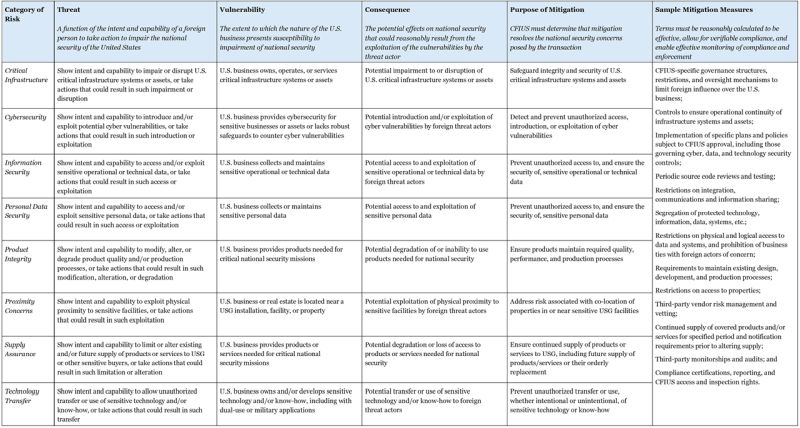
On July 29, 2026, the U.S. Department of the Treasury (“Treasury”), as Chair of the Committee on Foreign Investment in the United States (“CFIUS” or the “Committee”), published new guidance for the public in the form of a CFIUS Risk Matrix. The Matrix identifies eight categories of common national security risks often identified during the CFIUS process (i.e., critical infrastructure, cybersecurity, information security, personal data security, product integrity, proximity concerns, supply assurance and technology transfer), as well as an explanation of the vulnerabilities that can arise with respect to foreign ownership in businesses with such risks. In addition, the Matrix also sets out the purpose of mitigation for each category and provides a list of sample mitigation terms frequently used in mitigation agreements. The Matrix is replicated in the attached Appendix.
The Matrix is a notable development for dealmakers and their advisors as it provides structured insight into and memorializes for the public many of the national security considerations relating to national security risk and the potential for mitigation that are often advised by CFIUS practitioners. It also provides a baseline understanding of common mitigation terms that may arise when parties are considering a CFIUS filing. This guidance should prove particularly useful as parties consider and weigh potential mitigation that might arise in the CFIUS context, and will allow buyers, sellers, and their counsel to align on what terms are typical for certain categories of transactions. This should also facilitate earlier and more informed discussions between buyers and sellers regarding potential CFIUS conditions and may help parties more efficiently negotiate CFIUS-related provisions in transaction documentation.
Contemporaneously with the issuance of the Matrix, CFIUS has also implemented a new portal through which transaction parties can submit questions about CFIUS and provide information about their transactions to engage with the Committee early in the process. This tool is intended to help parties better understand CFIUS processes and filing options—including the distinction between short-form declarations and full notices—and to support more efficient reviews. Early engagement with CFIUS has long been considered a best practice by experienced practitioners, and the formalization of this portal should encourage broader use of pre-filing consultations across the deal community.
These developments represent a significant step to enhance the accessibility of the CFIUS process. As Treasury Secretary Bessent noted, the Administration is “significantly upgrading CFIUS’s customer service, making it easier for companies, investors, and their counsel to find the information they need, understand our processes, and facilitate greater foreign investment in the United States.” We encourage clients and deal teams to review the new risk Matrix and mitigation guidance, and to consider how these resources may inform CFIUS-related risk assessments, transaction structuring, and mitigation negotiations on pending and future transactions.
APPENDIX
CFIUS Risk Matrix – Categories of National Security Risk and Sample Mitigation Measures
Source: CFIUS.gov (July 2026).
The content of this article is intended to provide a general guide to the subject matter. Specialist advice should be sought about your specific circumstances.
[View Source]





