

- within Consumer Protection and Real Estate and Construction topic(s)
Welcome to Edition 43 of P2N0 covering the drive to avoid, reduce and remove greenhouse gas (GHG) emissions to progress to net-zero GHG emissions (NZE).
P2N0 covers significant news items globally, reporting on them in short form, focusing on policy settings and legal and regulatory matters, and project developments and trends. P2N0 does not cover news items about M&A activity or that are negative.
This Edition 43 covers significant news items from March 1, 2026, to March 31, 2026.
Access all previous editions of P2N0 at bakerbotts.com.
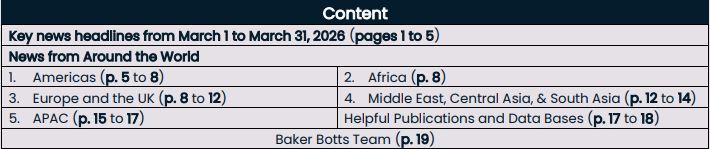
KEY ITEMS ARISING FROM MARCH 1, 2026, TO MARCH 31, 2026
- Iran War:
While this Edition 43 of P2N0 does not go into detail on the Iran War and its implications. On a daily basis there has been (and continues to be) considerable coverage of the implications of the Iran War, and given the changeability of events, we are not best placed to cover.
The International Energy Agency (IEA) has covered consistently the key facts on the Iran War (including arising from events in the Strait of Hormuz) and the implications it has for oil and gas markets. Also, on March 12, 2026, the IEA published its Oil Market Report – March 2026 (OMR). (The OMR is a monthly publication from the IEA. For the time being, we will include it in each edition of P2N0.)
On April 9, 2026, the good folk at Wood McKenzie published a graph Power Market Impact from Iran War.
In due course, we may cover any shorter to medium term impacts of the Iran war. In the context of the disruption caused to energy markets, directly and indirectly, there has been considerable analysis (some helpful, some not) about the resulting cost of the disruption compared to the cost of the development and deployment of renewable electrical energy sources.
On March 11, 2026, the UK Climate Change Committee (CCC) published Supplementary analysis of the Seventh Carbon Budget. While a number of headlines emerged extrapolating from the findings of the UK CCC, in the context of the immediate disruption of the supply of hydrocarbons from the Gulf Region, the headline from the work of the UK CCC resonated:
“Under a range of assumptions, the benefit of Net Zero consistently outweighs the costs. While achieving Net Zero requires investment, for every £1 spent there will be a £2 to £4 in benefits. A decarbonised UK will provide greater energy security and be cheaper to operate and maintain than the system that we have today. The cost of wasted energy would be halved.”
And then the real headline grabber by reference to the increased costs that resulted from the conflict in Ukraine:
Many have reported, and overstated, the meaning of this analysis, particularly the impact on the costs of electrical energy of the reduced availability of natural gas in 2022, that impact being a function of many factors, including the mechanism for setting electrical energy prices. This said, it might be expected that a broader theme will emerge distinct from cost and price in and of themselves, i.e., the theme of energy security and the benefits of what may be slightly higher prices over time, but the avoidance or mitigation of price shocks.
- S&P Global CERAWeek 2026:
During March 23 to 27, 2026, CERAWeek 2026 was held in Houston, Texas. The theme for CERAWeek 2026 was Convergence and Competition: Energy, Technology and Geopolitics.
The key outcomes and takeaways reported from CERAWeek 2026 have been recognised as follows:
- Natural Gas and Liquefied Natural Gas is now regarded as foundational to energy security globally. From 2016 to 2020, natural gas and LNG were regarded as a transitional fuel. Since 2022 there have been a number of dynamics and events that have placed natural gas and LNG squarely as a key long-term fuel, essential for energy security and as a means of powering the development of AI capacity globally. The good folk at williams.com, published Top 5 Takeaways from CERAWeek 2026 with a particularly clear focus on the dynamics across the natural gas and LNG industry; and
- Globally, increased investment in energy infrastructure is needed, critically, to ensure transmission system integrity and stability, as increased demand for electrical energy requires increased dispatch and increased dispatch from intermittent generation capacity across transmission systems. The augmentation, development and expansion of transmission systems will be an increasing focus in the United States and across the European Union. It would seem also that carbon capture and storage (CCS) is seen as a means of responding to the increased use of natural gas and LNG while at the same time addressing the emission of CO2. It is expected that the increased use of natural gas will breathe life into this CCS sector.
On April 1, 2026, the good folk at S&P Global published Takeaways and Key Insights from S&P Global’s CERAWeek Event.
For the author, affordability, security and sustainability across energy chains remains a focus of all governments, with affordability and security having come into stark focus since the start of March 2026: prices at the bowser and shortage of liquid fuel stocks have forced governments to act.
- Increasing focus on LNG and GHG emissions: Among other things, in the energy sector the Iran War has focused attention on hydrocarbon production and security. One of the key narratives continues to be the increased demand for LNG, with that narrative becoming more nuanced, recognizing that LNG is a long-term source of fuel and feedstock. During March 2026, the good folk at Shell plc published their LNG Portfolio – Strategic Spotlight / March 2026.
While the publication is framed in this context of the business of Shell, it provides a helpful and (if we may say so) balanced analysis on long-term demand and near-term outlook. Also, the publication considers the “hot topics” of financial and carbon resilience. The publication is excellent.
Picking up on carbon resilience, Shell plc has reported on its GHG emissions, Scope 1, 2 and 3 Emissions.

As reported, Shell plc reported 1.1 billion metric tonnes of CO2-e emissions during 2025, with Scope 3 emissions (including from the combustion of fuels produced by Shell). The net carbon intensity is 71 grams of CO2-e per megajoule of energy production on combustion of fuels.
For corporations that produce hydrocarbon fuels, it is not unusual for its Scope 3 Emissions to exceed 80% of their total Scope 1, 2 and 3 Emissions.
- Ember report spot on: On March 20, 2026, the good folk at Ember reported that during 2025 814 GW of photovoltaic solar and wind capacity was installed globally. This is a new record for annual installation and indicates that these established technologies are continuing to drive progress to net-zero.
It helps to reflect on the role of photovoltaic solar over these past decade:
- in 2015, there was around 230 GW of installed PV capacity providing a little less than 1% of electrical energy globally;
- by 2020, this had increased to 760 GW and around 3% of global electrical energy demand; and
- by 2025, there was 2,919 GW and around 10% of electrical energy demand globally.
If the current rates of installation continue through 2030, there may be 9,000 GW of installed capacity, providing up to 20% of electrical energy demand globally.
- Energy Technology Perspectives 2026: On March 26, 2026, the IEA publishedEnergy Technology Perspectives 2026. The publication does not hide its key finding “under a bushel”: “Strengthening supply chains can improve resilience and reduce economic security risks for key energy infrastructure”. To reach this key finding, the publication considers demand side for energy technologies and supply side, and the key dynamics in each. This publication (the 20th in the IEA series) appears to place particular emphasis on the “faults and failings” in supply chains for energy technology. Sitting beneath the key finding are the following key observations:
- Despite headwinds for each energy technology supply chain, the chains and associated fuel supply are expanding rapidly;
- There is measurable means of progress across each energy technology supply chain, with each energy technology supply at different stages of development;
- The energy technology supply chains, manufacturing and trade, are showing signs of resilience to changes in industrial and trade policy;
- The concentration of manufacturing capacity and trade in the clean energy technology sector remains a source of actual and prospective market and trade vulnerability;
- Policy settings need to be cognisant of the need for industrial competitiveness, both for energy technological development and supply security.
The publication is excellent.
It is suggested that the publication is read at the same time as re-reading Electricity 2026, Analysis and forecast to 2030: On February 6, 2026, the IEA published Electricity 2026, Analysis and forecast to 2030. By way of reminder, Electricity 2026, Analysis and forecast to 2030 anticipates that demand for electrical energy globally will increase strongly to 2030, with annual average demand to increase by around 3.5% a year. The IEA emphasises the theme of the Age of Electricity in the publication.
The key points made in the Executive Summary of the publication are as follows:
- Emerging economies continue to drive demand growth, and will account for around 60% of the increase in demand through 2030, including to respond to increased electrification and increased population growth and urbanisation;
- Demand for electrical energy is increasing, indeed it is accelerating in developed economies, after 15 years of stagnation in increased demand;
- By 2030, it is forecasted that half of the world’s demand for electrical energy will be matched by nuclear and renewable energy capacity;
- Electrical energy output from nuclear energy generation capacity set a record in 2025, and output is expected to continue to increase through 2030, for the most part with the increase to come from emerging economies;
- While the generation of electrical energy from coal-fired power generation will continue to fall as a percentage of output, through 2030 it will remain the largest source of electrical energy generation;
- Through 2030, for the most part the increased demand for electrical energy is expected to be met by the development of increased renewables, natural gas and nuclear power generation capacity;
- With the increased demand for electrical energy and the increased development of generation to match it, the need for investment in grid infrastructure augmentation and development has come into ever sharper focus; and
- The development of BESS capacity provides a significant source of short-term system flexibility.
Looking beyond 2030, IEA anticipates that GHG emissions from the generation of electrical energy will plateau at around 13.5 giga-tonnes of CO2-e.
- World Nuclear Association publishes inaugural World Nuclear Outlook Report: On March 13, 2026, the World Nuclear Outlook Report was published by the World Nuclear Association.
For those active in the nuclear power sector, the report provides a helpful summary, and for those new to the sector, the report is well worth a read. The report is framed by reference to from “the here and now” to 2050. In this context, the report identifies factors driving the development of the nuclear power sector, being the same as those driving the electrical energy sector generally, including electrification of activities, increasing population and increased urbanization, and increased demand from increased digitalisation, including AI.
- Financing the ASEAN Power Grid: On March 10, 2026, the IEA published Financing the ASEAN Power Grid. The idea of an ASEAN power grid (APG) is not new. In fact, it has been the subject of discussion for decades. The publication provides a sense that the idea is developing into a reality, and that it is needed: since 1990 demand for electrical energy across ASEAN has increased nine-fold, and the rate of growth is estimated to continue at a rate of 3 to 4% a year through 2040.
The publication makes the following key observations:
- Interconnectors are critical to the development of the APG;
- A regional trade in electrical energy will deliver an affordable, reliable and secure energy transition;
- The regional trade is nascent currently;
- Currently there is strong momentum for the development of the APG;
- USD 27 billion of investment in interconnector capacity is needed by 2040 to realise the ambitions of the APG, and while the nature of investment in interconnectors is not straight-forward this level of investment and development is possible; and
- This said, the scale and size of the investment required is challenging for current business and financing models.
To view the full pdf, click here.
The content of this article is intended to provide a general guide to the subject matter. Specialist advice should be sought about your specific circumstances.
[View Source]