

- in United States
- within Law Department Performance and Corporate/Commercial Law topic(s)
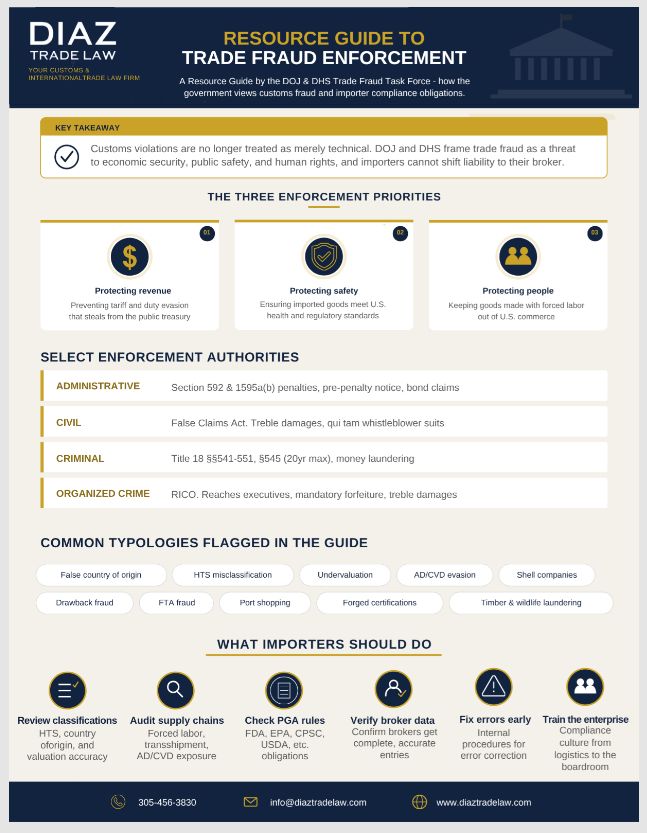
The U.S. Department of Justice (DOJ) and Department of Homeland Security (DHS) have released a new 31-page Resource Guide to Trade Fraud Enforcement, providing one of the clearest public statements yet on how the federal government views customs fraud, enforcement priorities, and importer compliance obligations. The guide was developed by the Trade Fraud Task Force, a partnership that includes DOJ’s National Fraud Enforcement Division, Homeland Security Investigations (HSI), U.S. Customs and Border Protection (CBP), and other federal agencies.
While much of the guide summarizes existing laws and enforcement authorities, its significance lies in the government’s messaging. It makes clear that customs violations are no longer viewed as merely technical or administrative issues. Instead, DOJ and DHS repeatedly characterize trade fraud as a threat to economic security, national security, public safety, and human rights, signaling that aggressive enforcement will continue across multiple agencies.
Combatting Trade Fraud Is a Priority for the Federal Government
One of the report’s primary themes is that trade fraud extends far beyond the underpayment of duties. According to the guide, fraudulent import practices undermine domestic manufacturers, deprive the government of tariff revenue, allow dangerous or non-compliant goods into the United States, and can fund criminal organizations or foreign adversaries. The agencies also emphasize that trade fraud creates an unfair competitive advantage for companies willing to circumvent customs laws while placing compliant businesses at a disadvantage.
The guide identifies three overarching enforcement priorities:
- Protecting government revenue by preventing tariff and duty evasion;
- Protecting public health and safety by ensuring imported goods comply with U.S. regulatory requirements; and
- Protecting human rights by preventing goods produced with forced labor from entering U.S. commerce.
The Guide Highlights Broad Civil and Criminal Enforcement Tools
Rather than focusing solely on CBP administrative penalties, the report outlines the extensive legal authorities available to federal investigators and prosecutors.
These include:
- CBP penalties under Section 592 and Section 1595a;
- The False Claims Act;
- Criminal customs fraud statutes;
- Smuggling offenses;
- Money laundering statutes;
- RICO;
- Securities law violations; and
- Various health and safety statutes applicable to imported products.
The guide also emphasizes that criminal exposure is not limited to the importer. Downstream parties including purchasers, distributors, resellers, and others who knowingly facilitate illegally imported merchandise may also face liability under federal law.
Forced Labor Remains a Major Enforcement Priority
The report dedicates an entire chapter to forced labor enforcement, underscoring that DHS and DOJ continue to prioritize imports linked to forced labor under Section 307 of the Tariff Act and the Uyghur Forced Labor Prevention Act (UFLPA).
The guide reviews:
- Withhold Release Orders (WROs)
- Findings
- The UFLPA rebuttable presumption
- The Forced Labor Enforcement Task Force (FLETF)
- The UFLPA Entity List
- High-priority enforcement sectors
The agencies make clear that importers should conduct extensive due diligence regarding supply chains, particularly where goods or raw materials may originate from high-risk regions or entities.
Common Trade Fraud Schemes
The final portion of the report discusses many of the trade fraud patterns investigators continue to encounter, including:
- False country of origin declarations
- HTS misclassification
- Undervaluation
- AD/CVD evasion
- Manifest fraud
- Shell company schemes
- Customs broker fraud
- Free Trade Agreement fraud
- Drawback fraud
- Port shopping
- FDA prior notice evasion
- False product safety certifications
- Illegal timber and wildlife imports
- Importation of adulterated drugs and medical devices
What Importers Should Do
The guide reinforces a longstanding principle of customs law: the Importer of Record bears the ultimate responsibility for ensuring the accuracy of customs entries. Although much of the guide summarizes existing law, it serves as a clear roadmap for how federal agencies are approaching trade enforcement. Importers should use this opportunity to evaluate their customs compliance programs before problems arise.
Companies should consider:
- Reviewing HTS classifications, country of origin determinations, and customs valuation methodologies.
- Conducting supply chain due diligence to identify risks involving forced labor, transshipment, AD/CVD exposure, and supplier compliance.
- Confirming that customs brokers receive complete and accurate information for each entry.
- Establishing internal procedures for identifying and correcting customs errors through appropriate post-entry mechanisms when necessary.
- Reviewing compliance obligations with Partner Government Agencies such as FDA, EPA, CPSC, USDA, and others whose requirements may apply to imported products.
- Ensuring executives, compliance personnel, procurement teams, and logistics staff understand that customs compliance is an enterprise-wide responsibility—not simply a customs broker function.
The content of this article is intended to provide a general guide to the subject matter. Specialist advice should be sought about your specific circumstances.
[View Source]