

- in United States
- within Law Department Performance and Corporate/Commercial Law topic(s)
KEY TAKEAWAYS
- CBP has certified roughly $71.06 billion in IEEPA refunds and cleared 18.1 million entries through CAPE — but the headline number hides who is being left out.
- 4.36 million entries failed CAPE’s entry-level checks. If your entry is finally liquidated beyond CBP’s 90-day reliquidation window, CAPE will not refund it, and the government is fighting to keep it that way on appeal.
- Phase 2 (reconciliation-flagged entries) went live June 29, 2026. Finally, liquidated entries remain in dispute at the Federal Circuit (No. 26-1898).
- The government’s stated position: no refund on finally-liquidated entries unless the importer filed suit at the CIT. Filing preserves your standing while the appeal plays out; it is not a guarantee of recovery.
- Three fixable failure reasons: importer/filer mismatch, entry-number errors, and CSV template misalignment are costing importers refunds they are otherwise entitled to.
A $71 Billion Headline That Hides Who Isn’t Getting Paid
On July 1, 2026, CBP filed its latest status declaration in Euro-Notions Florida, Inc. v. United States (CIT No. 25-00595) — the lead case now governing how IEEPA duty refunds are administered through CBP’s Consolidated Administration and Processing of Entries (CAPE) platform. The numbers are large. As of June 29, 2026, CBP reported that CAPE declarations had cleared file validation covering 18.1 million entries, that 15.92 million of those had been liquidated or reliquidated without IEEPA duties, and that roughly $71.06 billion in refunds (duties plus interest) had been certified and sent to Treasury for disbursement.
That is the story most trade outlets are running. It is not the story that matters to importers who paid IEEPA duties and have not yet seen a dollar back. Buried in the same filing: 4.36 million entries failed CAPE’s entry-level validations — and a subset of those failures is structural, not a data glitch you can fix by resubmitting.
What Importers Should Do: Triage Your Rejections, Then Protect What CAPE Can’t Reach
Step 1 — Sort every rejected entry into ‘fixable’ or ‘outside CAPE’
CBP identified the primary reasons CAPE declarations fail. There are ordinary data or formatting errors you can correct and resubmit. The others are substantive — and one of them, the 90-day reliquidation bar, cannot be solved inside CAPE at all. Use this triage before you refile anything:
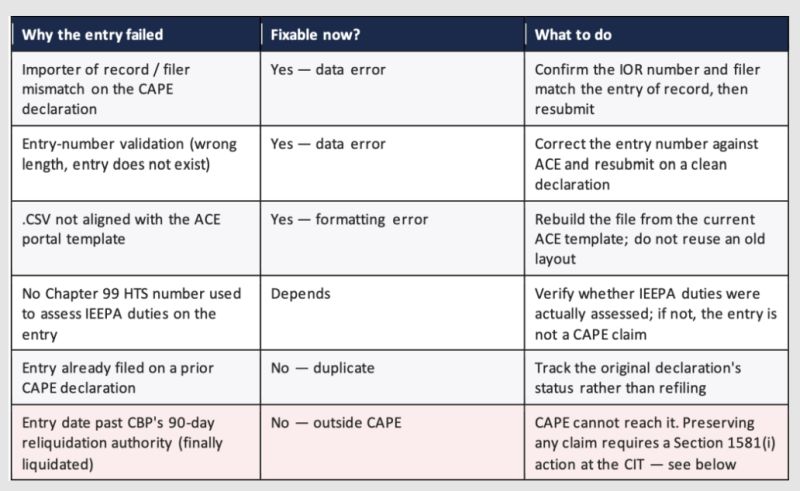
Note the separate operational trap CBP flagged: as of June 29, 8,384 certified refunds had not been transmitted to Treasury solely because the importer of record — or its authorized CBP Form 4811 designee — never provided Automated Clearing House banking information. If you filed a clean declaration and still see nothing, confirm your ACH details are recorded in ACE before assuming a processing delay.
Step 2 — Understand what Phase 2 changed on June 29
On June 29, 2026, CBP deployed new CAPE functionality allowing importers and brokers to include entries flagged for reconciliation that are unliquidated (or liquidated within the preceding 80 days) but for which no Reconciliation Entry (Entry Type 09) has been filed. CBP reported that 1.6 million reconciliation-flagged entries had been successfully filed in CAPE as of June 30. If you defer duties through reconciliation, this phase is your on-ramp — but it does not extend to entries that were finally liquidated long ago.
Step 3 — If your entries are finally liquidated, CAPE is the wrong door
This is the point most importers miss. If your entry liquidated beyond CBP’s 90-day reliquidation authority — which includes the millions of informal entries where liquidation occurred at or near the time of entry — CAPE will reject it, and no amount of resubmitting changes that. The court itself flagged this population as its central unresolved concern.
The government’s position, now on appeal to the Court of Appeals for the Federal Circuit (No. 26-1898, filed June 2, 2026), is that it will refund finally-liquidated entries only to importers who filed suit at the CIT. Whether that position survives appeal is unresolved. What is clear today: an importer with an active Section 1581(i) action is inside the group the government concedes it must address; an importer without one is betting on a ruling that has not come.
OUR RECOMMENDATION:
If you paid IEEPA duties on entries that have finally liquidated and you have not filed at the CIT, file a Section 1581(i) action now to preserve your standing while the Federal Circuit appeal is pending. Filing preserves your position; it is not a guarantee of recovery, and the appeal could narrow eligibility. For fixable rejections, correct and resubmit before the phases close. Waiting is the one strategy with no upside.
Know Which Bucket You’re In — Today
Within one review of your entry data, you should be able to place every IEEPA entry into one of three buckets:
- Refund in progress — cleared CAPE, liquidated without IEEPA duties, ACH on file. Confirm disbursement; no further action.
- Fixable rejection — failed on IOR/filer mismatch, entry-number error, or CSV formatting. Correct against ACE and resubmit before the relevant phase closes.
- Outside CAPE — finally liquidated beyond the 90-day window. CAPE cannot help; preserving any claim means litigating at the CIT while the appeal is decided.
The importers who recover the most will not be the ones who filed the earliest CAPE declaration. They will be the ones who correctly identified which of their entries CAPE was never going to reach — and acted on them separately, before the appeal foreclosed the option.
The content of this article is intended to provide a general guide to the subject matter. Specialist advice should be sought about your specific circumstances.
[View Source]