

- with readers working within the Property industries
- with Senior Company Executives, HR and Finance and Tax Executives
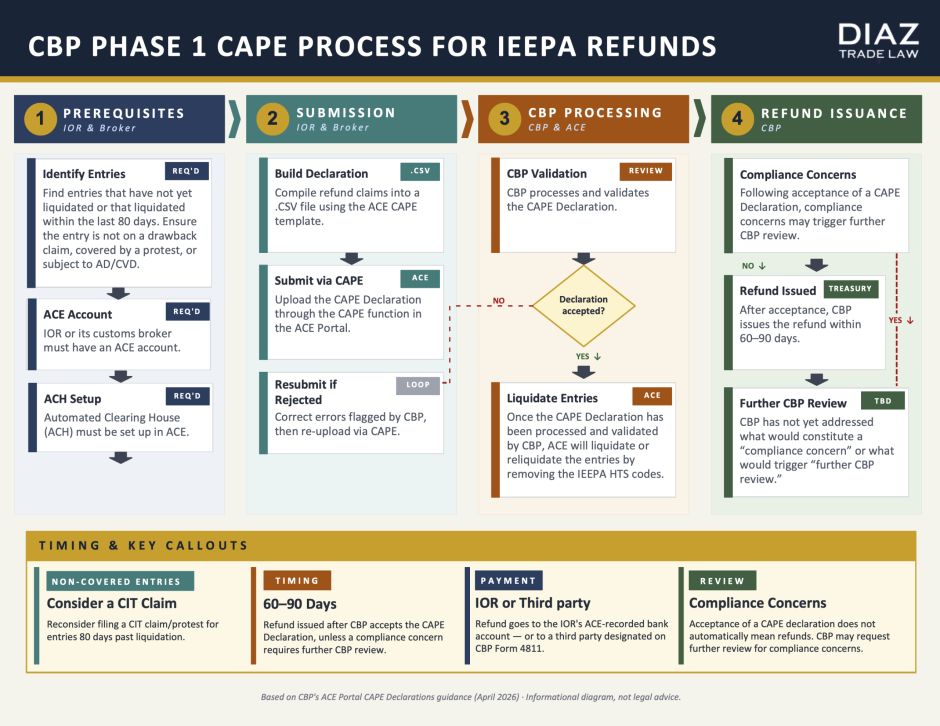
On April 20, 2026, CBP launched Phase 1 of the Consolidated Administration and Processing of Entries (CAPE). Importers of record (IORs) and licensed customs brokers may now file CAPE Declarations through ACE.
Tariff Refund Process
CBP has specified the actions required for requesting refunds:
- The Importer of Record (IOR) or its customs broker must have an ACE account.
- ACH must be set up in ACE (using a U.S. bank account).
- The IOR or its customs broker must submit the request for refund (CAPE Declaration) via CAPE in the ACE system.
The CAPE Declaration must be submitted as a .CSV file in ACE along with the following certification:
“I attest to the best of my knowledge and belief that: (1) the country of origin, entry type, Harmonized Tariff Schedule of the United States (HTSUS) classification(s), and valuation for each entry number is true and correct; and (2) the goods were not entered in violation of any applicable United States law, order, or rule. I understand that if I make or cause others to make material false statements or omissions to CBP, including in connection with a request for tariff reimbursement, I may be subject to criminal prosecution and civil liability, including but not limited to under 18 U.S.C. §§ 1001, 542, 545, 19 USC § 1592, and 31 U.S.C. § 3729(a).”
Once the CAPE Declaration has been processed and validated by CBP, ACE will liquidate or reliquidate the entries by removing the IEEPA HTS codes. Refunds will be issued directly to the IOR’s bank account recorded in ACE or to a party the IOR has designated to receive refunds on its behalf via CBP Form 4811. Lastly, after the CAPE Declaration is accepted by CBP, refunds will be issued within 60 to 90 days, “unless a compliance concern requires further CBP review.”
CBP has not addressed what would constitute a “compliance concern” or what would trigger “further CBP review.”
What Importers Should Do:
In preparing for IEEPA refunds, we recommend that importers take the following steps:
- File a lawsuit at the U.S. Court of International Trade. While the CIT Orders purportedly apply to litigants and non-litigants alike, this position will likely be appealed, and resolution could take months.
- If not already created, create an ACE importer account immediately (and ensure Diaz Trade Law has access as a consultant on your ACE account)
- If you have an ACE account but you haven’t connected in the past 45 days, call ACE Support immediately to reactivate your account
- Sign up for the ACH Refund section inside the ACE portal using your U.S. bank account (when future refunds are issued, CBP has advised they will only be issued electronically via ACH)
- Prepare an ACE report covering all entries with IEEPA duties and review and incorporate the liquidation dates
- For Phase I refund requests, Prepare a CAPE Declaration consisting of a .CSV (comma-separated values) file containing only entry numbers, and only entry numbers 1) for which IEEPA duties were paid, and 2) that are unliquidated or liquidated less than 80 days prior to the date the Declaration will be submitted.
Importers seeking assistance should contact Diaz Trade Law TODAY. We can help you navigate CAPE, prepare required filings, and position your refund request for prompt processing.
The content of this article is intended to provide a general guide to the subject matter. Specialist advice should be sought about your specific circumstances.
[View Source]