

The Snowbird’s Dilemma, Revisited
Earlier this year, we explored how a New York couple’s move to Florida fell short in the eyes of the New York Tax Appeals Tribunal, resulting in approximately $60,000 in additional New York income taxes (read earlier advisory here). A recent Connecticut Supreme Court decision demonstrates how much higher the stakes can become when the tax at issue is estate tax. Although the two cases arose in different tax contexts, they reinforce the same planning lesson: formal declarations of domicile carry limited weight when they are inconsistent with an individual’s actual pattern of living.
Key Takeaways:
- A Connecticut Supreme Court decision lowered the burden of proof for challenging an estate tax domicile determination.
- Formal steps like obtaining a driver’s license, registering to vote, and filing a declaration of domicile carry limited weight if contradicted by where and how an individual actually lives.
- The strongest protection is a consistent, well-documented factual record – built before a controversy arises.
In Daniels v. Commissioner of Revenue Services, 354 Conn. 768 (2026), the Connecticut Supreme Court considered the domicile of Jack Anderson, a successful businessman who died in Florida in 2015. During his lifetime, as detailed here, Anderson divided his time among Connecticut, Florida, and Arizona. He took many of the formal steps commonly recommended to establish Florida domicile, including obtaining a Florida driver’s license, registering to vote in Florida, and executing a declaration of domicile.
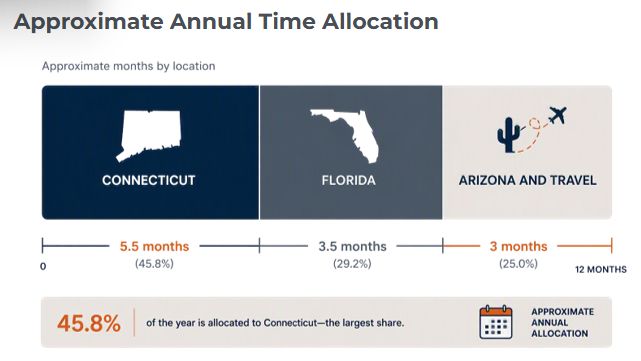
Approximate Annual Time Allocation
The Connecticut Department of Revenue Services (DRS) determined that Anderson remained domiciled in Greenwich, Connecticut, at the time of his death and issued a final determination that his estate owed $13,198,544.60 in Connecticut estate taxes.
At trial, the court dismissed Anderson’s Florida driver’s license, voter registration, and declaration of domicile as “one-time, administrative tasks accomplished with little more than an afternoon’s or a day’s effort.” It focused instead on where Anderson actually lived: he spent approximately five and one-half months each year in Connecticut, compared with roughly three and one-half months in Florida, and lived a “full and complete life” in Connecticut during those months. The trial court upheld DRS’s determination.
One-time, administrative tasks accomplished with little more than an afternoon’s or a day’s effort.
— Connecticut Superior Court, describing Anderson’s Florida driver’s license, voter registration, and declaration of domicile
What the Connecticut Supreme Court Decided
On appeal, the Connecticut Supreme Court reversed on procedural grounds. Under Conn. Gen. Stat. § 12-391(h)(1), the estate need only prove by a preponderance of the evidence — that is, that a proposition is more likely than not to be true — that Anderson was not domiciled in Connecticut. The trial court had applied the more demanding clear-and-convincing-evidence standard. The Supreme Court did not determine that Anderson was domiciled in Florida; it remanded for a new trial under the correct standard.
A Procedural Win, but a Continuing Factual Challenge
The reduced burden of proof is important: an estate challenging a Connecticut domicile determination no longer must satisfy the more demanding clear-and-convincing-evidence standard. But a lower burden of proof will be most helpful when the evidence presents a genuinely close question. It will not eliminate inconsistencies between an individual’s stated intentions and the manner in which that individual actually lived.
For individuals who maintain substantial connections to more than one state, the strongest protection remains creating and maintaining a consistent factual record before a controversy arises. Domicile should not be treated as a collection of forms completed at the time of a move. It is established through the cumulative pattern of an individual’s life.
Building a Defensible Domicile Record
Effective domicile planning requires an individual both to establish meaningful connections with the new state and to reduce significant connections with the former state. The following considerations can help support a claimed change of domicile.
1. Complete the Formal Steps, but Do Not Stop There. A declaration of domicile, driver’s license, voter registration, homestead exemption, and updated mailing address can provide an important foundation. As Daniels illustrates, however, a court may give those actions limited weight if they are contradicted by where and how the individual actually lives. The documented record should consistently reflect the intended domicile, but the individual’s daily life must support the same conclusion.
2. Maintain Reliable Day-Count Records. The amount of time spent in each state can become particularly significant when an individual’s personal, residential, and social connections are otherwise closely balanced. Individuals with homes in multiple states should maintain contemporaneous records of their locations and travel. Calendars, travel records, credit card statements, toll and transportation records, and information from mobile devices may help corroborate those records. Reconstructing a travel history after an audit begins is generally more difficult than maintaining reliable documentation as travel occurs. Day counts should also be reviewed under the rules of each potentially relevant state because domicile and statutory residency are related but distinct concepts.
3. Both “Leave” and “Land”. Building connections with a new state is only half of a domicile change. An individual should also examine the connections that remain in the former state. Continuing club memberships, board positions, civic or religious affiliations, business activities, medical relationships, or other personal commitments in the former state may undermine the position that it has been abandoned as the individual’s permanent home. By contrast, establishing comparable relationships in the new state helps demonstrate that the individual has not merely acquired another residence, but has moved the center of personal life there.
4. Move the Center of Gravity. Domicile is determined by the complete pattern of an individual’s life. Relevant considerations may include the locations of:
- Family and close personal relationships;
- Physicians and other health care providers;
- Clubs, civic organizations, and places of worship;
- Business and professional activities;
- Charitable involvement;
- Family celebrations and holiday gatherings;
- Vehicles, pets, artwork, and other significant personal property;
- Financial advisors, banking relationships, and safe deposit boxes; and
- The residence treated and used as the individual’s principal home.
No single factor necessarily determines domicile. Together, however, these facts should tell a coherent story about the place the individual regards as a permanent home.
5. Coordinate Legal, Tax, and Financial Records. Inconsistencies among legal and financial documents can weaken an otherwise supportable domicile position. Individuals who have changed domicile should review their:
- Wills and revocable trusts;
- Powers of attorney and health care documents;
- Federal and state income tax returns;
- Property and casualty insurance policies;
- Life insurance and annuity records;
- Financial and brokerage accounts;
- Business agreements and governance records;
- Real estate records; and
- Beneficiary designations.
These materials should be reviewed not only for addresses, but also for declarations concerning residence or domicile and references to the laws of a particular state.
Estate planning documents may also require substantive revision if the new state’s laws differ from those of the former domicile. A change of domicile therefore provides an appropriate occasion for a broader estate plan review.
6. Consider the Significance and Use of Each Residence. Maintaining multiple substantial residences can make the domicile analysis more difficult, particularly when the homes are similarly equipped and used. The analysis may consider the relative size and value of each property, how each residence is furnished, where valuable or sentimental items are kept, which residence hosts family and social events, and how the individual uses each property throughout the year. Owning an impressive home in the new state does not necessarily establish domicile if the residence in the former state continues to function as the center of the individual’s personal and family life.
7. Review the Record Periodically. A domicile plan should be revisited as circumstances change. Health needs, family relationships, business responsibilities, travel patterns, and the use of different residences may evolve over time. An individual who established a well-supported domicile several years ago may gradually develop new connections that complicate the analysis. Periodic reviews can identify those inconsistencies before they become relevant in an audit or estate tax proceeding.
The Broader Planning Lesson
Daniels is favorable to taxpayers and estates because it confirms that the ordinary preponderance of the evidence standard applies when challenging a Connecticut estate tax domicile determination. It is not, however, a substitute for careful planning. A lower evidentiary standard may change how a close case is decided. It does not transform a contradictory factual record into a consistent one. The central lesson of Daniels is therefore the same lesson raised by the earlier New York “snowbird” decision: paperwork establishes intent, but conduct provides the evidence. Individuals seeking to change domicile should ensure that their legal documents, tax filings, personal relationships, activities, property, and allocation of time collectively support the state they intend to make their permanent home.
The content of this article is intended to provide a general guide to the subject matter. Specialist advice should be sought about your specific circumstances.
[View Source]
