

- within Consumer Protection topic(s)
- within Government and Public Sector topic(s)
Sazerac sells Fireball Cinnamon Whisky and Parrot Bay Rum. Sazerac also sells Fireball and Parrot Bay branded malt beverages in similar packaging. Some consumers sued Sazerac under New York law, alleging, essentially, that the packaging of these malt beverage drinks misled them into believing that they were actually buying the distilled spirits versions of the products.
Sazerac moved to dismiss, arguing, among other things, that the plaintiffs had failed to plausibly allege that consumers would be misled by the labeling of its Fireball and Parrot Bay branded malt beverage products. The court denied the motion, allowing the case to proceed. Here's why.
To survive a motion to dismiss for false advertising in New York, plaintiffs must "plausibly allege that a significant portion of the general consuming public or of targeted consumers, acting reasonably in the circumstances, could be misled."
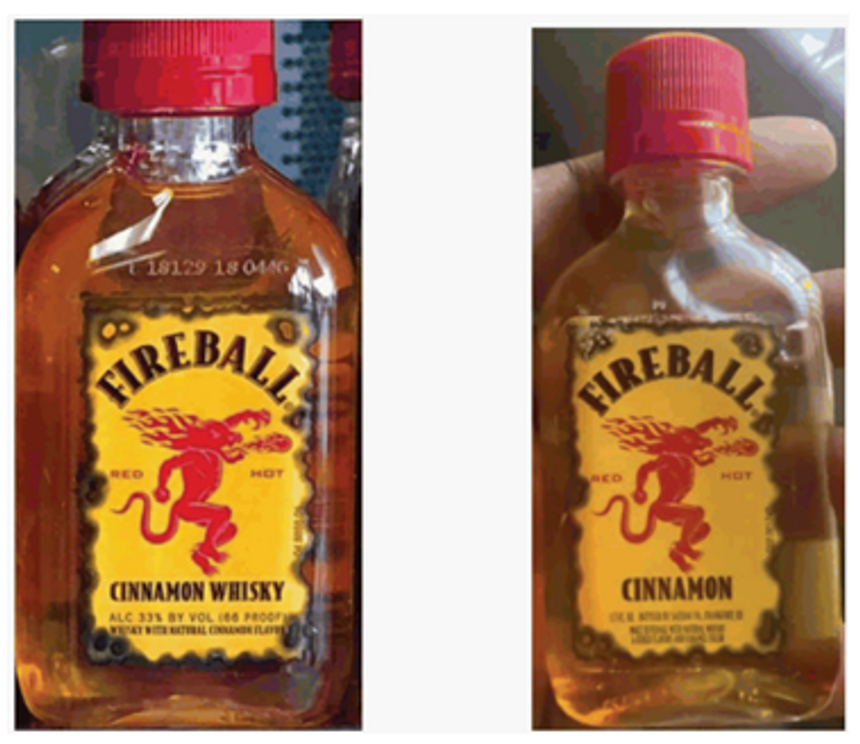
Here, the plaintiffs alleged that Sazerac packaging is misleading because the malt beverage version of the product is sold in packaging that is nearly identical to the distilled spirits version.
Considering the allegations regarding Fireball, the court agreed that the labels are "nearly identical." The court explained, "they reflect the same charred edges with the exact same burn patterns and burn marks, and the labels are also identical colors." The court further wrote, "Both labels prominently place the mark 'FIREBALL' at the top in large font and bold, black text, under which a large, red, fire-headed demon – spewing what can only be characterized as a fireball – can be found between the words 'RED' and 'HOT' in smaller red font." The court also gave great weight to the fact that Fireball whiskey is "one of the most popular drinks to down – particularly in shot form" and that consumers may not even realize that Sazerac sells a malt beverage version of the product. And, looking at the allegations regarding Parrot Bay, the court same to similar conclusions.
Sazerac argued that its malt beverage labeling isn't misleading because the labels don't assert that they contain distilled spirits – and, in fact, they explicitly state that they are malt beverages. The court didn't buy this argument, however, writing, "in the context of the Fireball Malt and Parrot Bay Malt labels themselves, the 'Malt Beverage" disclosures are printed in very small font and are certainly overshadowed by the elements of the label that mirror the Fireball Whisky and Parrot Bay Rum labels."
Ultimately, then, the court held that the plaintiffs' allegations were sufficient to survive a motion to dismiss.
While this case is still at its early stages, and there's no telling how it will be resolved, the facts here do certainly raise some interesting issues for advertisers to consider. First, when you're creating line extensions of your products that offer different benefits, it's very important to be clear about what those are. Second, when the line extensions look very similar to the original, you may have additional hurdles in clearly conveying what those differences are. And, finally, it's highly unlikely that some fine print is going to cure any potential consumer confusion.
Pizzaro v. Sazerac, 2024 WL 4290647 (S.D.N.Y. 2024).
The content of this article is intended to provide a general guide to the subject matter. Specialist advice should be sought about your specific circumstances.
