

The Federal Trade Commission (“FTC” or “Commission”) closed its investigation of IonQ, Inc.’s (“IonQ”) acquisition of SkyWater Technology, Inc. (“SkyWater”) and permitted the transaction to proceed after the Commission’s two sitting members were divided over whether the transaction warranted a negotiated behavioral consent order.1 SkyWater is an American semiconductor foundry serving IonQ and several of IonQ’s rivals in the race to develop the first fault-tolerant quantum computer.
The IonQ/SkyWater statements of Chairman Andrew Ferguson and Commissioner Mark Meador are detailed accounts of how each Commissioner analyzes vertical transactions and their claimed benefits, and, in Chairman Ferguson’s case, the circumstances in which competitive concerns might appropriately be resolved through behavioral relief. (Commissioner Meador, having found no sufficient competitive concern, did not reach the merits of the proposed order.) Parties planning vertical transactions, particularly transactions in the defense and national-security sectors, should study both.
Staff identified two familiar vertical theories of harm; the commissioners divided over whether relief was justified
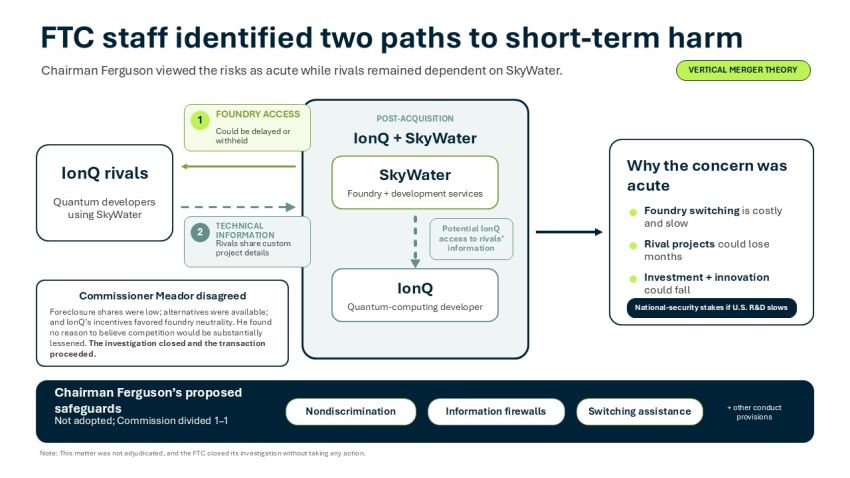
Commission staff identified the two canonical vertical concerns: (i) that IonQ, post-acquisition, would have the ability and incentive to limit rivals' access to SkyWater's foundry services, including through delay (switching foundries is expensive, time-consuming, and constrained by industry capacity that is slow to expand), and (ii) that IonQ would gain access to rivals' competitively sensitive technical information housed within SkyWater.2
Chairman Ferguson concluded that these risks, significant in the short term but low in the long term as newly funded domestic foundries come online, warranted a consent order containing, among other items, non-discrimination rules, information firewalls, switching assistance, and a prior-notice requirement for future foundry acquisitions.3 In doing so, the Chairman acknowledged his previously expressed skepticism of behavioral remedies in merger cases,4 but reasoned that a categorical refusal to consider negotiated behavioral relief would leave the Commission with “no choice at all” as the only options would be inaction or difficult litigation, given (1) the government's recent litigation record in vertical-merger matters (with losses in AT&T/Time Warner, UnitedHealth/Change, Microsoft/Activision, and Tempur Sealy/Mattress Firm) and (2) courts' willingness to credit merging parties' unilateral behavioral commitments as evidence of the absence of competitive harm.
Commissioner Meador did not agree. He concluded that the record did not supply reason to believe the acquisition may substantially lessen competition. The foreclosure shares at issue were a small fraction of the 50% share, above which the 2023 Merger Guidelines generally infer that a firm has, or is approaching, monopoly power in the related product, and below the 30–40% levels that courts have ordinarily regarded as concerning in analogous exclusive-dealing cases.5 Although the Guidelines recognize that lower shares may still support liability where the related product is particularly important to its trading partners, Commissioner Meador found no such circumstances here: SkyWater is not a “must have” input, and IonQ's incentives favor maintaining SkyWater as a neutral, multi-customer foundry.
The procedural posture was somewhat uncommon. The closure of the investigation reflected a divided Commission, not a determination that the transaction raised no concerns. Staff investigated the transaction during the Hart-Scott-Rodino waiting period, identified the competitive concerns, and negotiated with the parties a proposed decision and order embodying the behavioral commitments Chairman Ferguson favored. However, given the unusual circumstance of having only two commissioners, a majority did not agree to adopt the order, and both members agreed that a suit to enjoin the transaction would be an imprudent use of the agency's resources. With no majority for an order, and litigation off the table, the Commission terminated its investigation and allowed the transaction to close.6
The commissioners used familiar vertical-merger tools but disagreed about the evidence and the case for intervention
Neither statement is an outlier, and the division is not a contest between competing frameworks. Both Commissioners worked with the analytical categories collected in Section 2.5 of the 2023 Merger Guidelines: ability, incentive, competitive effects, and access to competitively sensitive information.7
Chairman Ferguson's analysis resembles the ability, incentive, and effects framework articulated in the now-withdrawn 2020 Vertical Merger Guidelines and reflected, in somewhat different form, in the 2023 Merger Guidelines. It also echoes the Commission's historical enforcement practice, most directly Northrop Grumman/Orbital ATK, in which the Commission resolved the same paired theories (input foreclosure and access to rivals' competitively sensitive information) in a defense supply chain through a consent order combining non-discrimination and firewall provisions.8
Commissioner Meador placed greater weight on the quantitative evidence, but his analysis was not merely arithmetic: he also weighed the available alternatives, SkyWater's competitive significance, the costs and duration of switching, the federal government's expanding investment in fabrication capacity, and IonQ's incentives.
The Commissioners largely agreed on the relevant analytical categories; they disagreed about the weight of the evidence and the threshold for intervention. Chairman Ferguson emphasized the potentially acute consequences of even temporary foreclosure in an innovation race; Commissioner Meador emphasized the limited foreclosure shares, the available alternative suppliers, the temporary nature of any risk, and expanding public investment.9
Both commissioners considered transaction benefits, although chairman Ferguson articulated the broader efficiencies framework
Chairman Ferguson began from the premise that vertical integration commonly benefits competition and consumers, through (1) reduced transaction costs and coordinated timelines across business units, (2) elimination of double marginalization, and (3) improved innovation incentives, because the integrated firm captures the full return on innovation at either level of the supply chain.10 Commissioner Meador did not adopt that general catalogue, but he too considered the transaction's claimed benefits, noting IonQ's representation that closer collaboration with its manufacturing partner would accelerate development, and he concluded, based on the structure and trajectory of the industry, that the transaction is likely procompetitive or, at worst, competitively neutral.11 That posture is a meaningful signal. The 2023 Merger Guidelines expressly subject the elimination of double marginalization to the Guidelines' Section 3.3 rebuttal framework, including its merger-specificity requirements. The IonQ/SkyWater statements give the benefits of vertical integration greater prominence than their placement in the 2023 Merger Guidelines might suggest, consistent with the approach of the now-withdrawn 2020 Vertical Merger Guidelines and the Commission's pre-2021 practice.12 Merging parties should not treat the efficiencies case as an afterthought.
Parties to vertical transactions (particularly in defense, critical technology, and other national-security-adjacent sectors) should evaluate their transactions under both Commissioners' approaches, and should substantiate claimed efficiencies with documentary care. They should also consider whether the behavioral architecture the Commission nearly adopted (non-discrimination commitments, information firewalls, switching assistance, and other provisions) belongs in transaction planning.
The IonQ/SkyWater statements disclose, with unusual clarity, how the Commission's members think about vertical mergers, vertical efficiencies, and vertical remedies. Together with the recent abandonment of TransDigm Group's proposed acquisition of Stellant Systems, a contrasting horizontal matter in which the Department of Justice announced it would sue to block a deal that would have left the U.S. military with a single source for radar-system components used in the Aegis Combat System and the F-16,13 the statements show the agencies' continued attention to transactions affecting the defense industrial base. National-security considerations did not supply a predictable thumb on the scale: in IonQ/SkyWater, they magnified both the potential consequences of foreclosure and the potential costs of preventing beneficial integration.
Counsel should read the statements closely.
View the FTC Staff’s Two Theories of Short Term Harm here.
References
1. Statement of Chairman Andrew N. Ferguson, In the Matter of IonQ, Inc./SkyWater Technology, Inc., Matter No. 2610061 (July 31, 2026) (“Ferguson Statement”); Statement of Commissioner Mark R. Meador, In the Matter of IonQ, Inc. and SkyWater Technology, Inc., Matter No. 2610061 (July 31, 2026) (“Meador Statement”).
2. Ferguson Statement at 4; Meador Statement at 1.
3. Ferguson Statement at 8–9.
4. See Statement of Chairman Andrew N. Ferguson, Joined by Comm'r Melissa Holyoak and Comm'r Mark R. Meador, In the Matter of Synopsys, Inc./Ansys, Inc., Matter No. 2410059, at 8 (May 28, 2025).
5. Meador Statement at 3–4 (citing Fed. Trade Comm'n & U.S. Dept. of Just., Merger Guidelines § 2.5.A.2 & n.30 (2023), and collecting cases, including United States v. Philadelphia Nat'l Bank, 374 U.S. 321, 364–66 (1963)); cf. Ford Motor Co. v. United States, 405 U.S. 562, 567–68 (1972) (approximately 10% foreclosure could suffice given high downstream concentration and entry barriers).
6. Ferguson Statement at 1, 9 (noting that a majority of the Commission did not agree to adopt the proposed order); Meador Statement at 7.
7. Merger Guidelines § 2.5 (2023); see Ferguson Statement at 4; Meador Statement at 1–2.
8. U.S. Dept. of Just. & Fed. Trade Comm'n, Vertical Merger Guidelines (2020); Fed. Trade Comm'n, Commentary on Vertical Merger Enforcement (2020), both withdrawn by the Commission in 2021; the Vertical Merger Guidelines were later designated inactive by the Department of Justice. On Northrop Grumman/Orbital ATK, see Press Release, Fed. Trade Comm'n, FTC Imposes Conditions on Northrop Grumman's Acquisition of Solid Rocket Motor Supplier Orbital ATK, Inc. (June 2018) (describing the foreclosure and information-access concerns and the order's non-discrimination and firewall provisions).
9. Compare Ferguson Statement at 3–9, with Meador Statement at 1–7.
10. Ferguson Statement at 3.
11. Meador Statement at 1, 7.
12. Compare Merger Guidelines §§ 2.5 n.31, 3.3 (2023), with Vertical Merger Guidelines § 6 (2020), and Commentary on Vertical Merger Enforcement § 6 (2020) (describing the elimination of double marginalization as “among the most common procompetitive effect claims”).
13. Press Release, U.S. Dept. of Justice, TransDigm Abandons Proposed Acquisition of Stellant Systems in Response to Justice Department's Decision to Block Transaction (July 13, 2026).
The content of this article is intended to provide a general guide to the subject matter. Specialist advice should be sought about your specific circumstances.
[View Source]
