

(August 13, 2026) - Mary Helen Wimberly of Axinn LLP explains that statements of interest by the Antitrust Division can provide insights into DOJ enforcement priorities, and she offers strategic takeaways in areas such as risk management and agency engagement.
During the second Trump Administration, the Antitrust Division of the U.S. Department of Justice (DOJ) has filed 21 statements of interest (https://bit.ly/4zgKVz2). These filings can be good predictors of future enforcement activity.
Companies can use statements of interest to assess areas potentially requiring a refreshed risk assessment. And parties currently in litigation should evaluate the potential for DOJ involvement and the wisdom of outreach to the agency.
(Mostly) steady stream of statements of interest
The second Trump Administration has embraced the statement of interest, which is a discretionary filing before a trial court in litigation to which DOJ is not a party, similar to an amicus brief before an appellate court.
In a March 2026 speech (https://bit.ly/4go93Iq) at George Washington Law School, then Acting Assistant Attorney General (AAG) Omeed Assefi touted the antitrust discretionary-filing program as having "been incredibly active and successful," including when DOJ "broke a record" by filing "three different statements of interest in a single day."
These filings proceed apace following Acting AAG Assefi's departure from DOJ, with Associate Attorney General Stanley Woodward appearing on the signature block for the last three antitrust statements. DOJ thus continues the expanded use of discretionary filings that began (https://bit.ly/4q9rCUb) during the first Trump Administration.
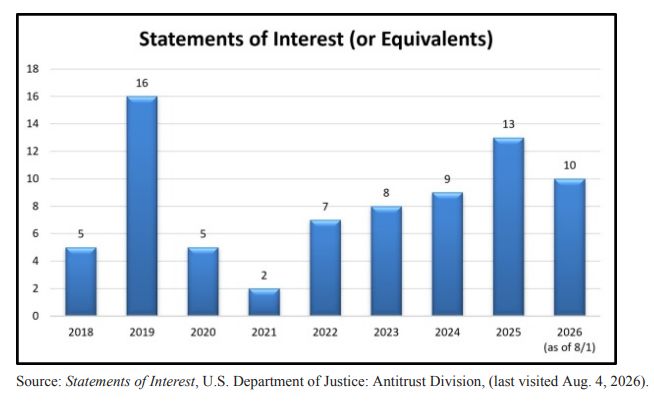
Except for a dip during the first year of the Biden Administration before political leadership was confirmed, DOJ has filed at least five statements of interest every year since 2018. The chart below shows the number of unique statements of interest (https://bit.ly/3TQMy6d) that DOJ has filed each year (excluding reply briefs and counting identical filings in related cases as a single brief).
Why statements of interest?
Statements of interest provide an avenue for DOJ to advocate to courts in a manner that demands fewer resources than enforcement. They also allow the Antitrust Division to avoid some of the intra-Department hurdles that apply to appellate amicus briefs, which require Solicitor General approval. The Antitrust Division can have greater leeway within the Department to decide when it will file statements of interest, in what cases, and on what issues.
Statements of interest also provide a source of work for the Antitrust Division's Appellate Section. Section attorneys have signed or co-authored 16 of the last 21 statements. With the number of appellate filings at a historic low for the Antitrust Division, the Appellate Section appears to be taking an active role in identifying opportunities for statements of interest.
Triggers for a statement of interest
There are at least four reasons why DOJ might file a statement of interest.
1. Securing favorable law in advance of enforcement. DOJ may file statements on a recently untested legal theory before pursuing its own enforcement action on a similar theory.
For example, in 2019, DOJ filed multiple statements of interest on the applicability of the per se rule to labor non-compete ("no-poach") agreements, including filing a statement (https://bit.ly/4qgHm80) in a case before seeking to intervene (https:// bit.ly/4g4A5Dr) in that same case.
DOJ then indicted its first criminal labor non-compete case (https://bit.ly/4g4AiXf) in 2021. The author, formerly a member of the Antitrust Division's Appellate Section at DOJ, was involved in developing some of these statements.
DOJ does not announce such a motivation for filing, but the statement of interest can include hints. A filing arguing a novel or long dormant legal theory, or emphasizing that the usual standards apply in an unusual context or in an industry in which DOJ has not recently been active, can sometimes preview that related enforcement activity is on the horizon.
2. Private litigation in parallel with ongoing enforcement. DOJ now appears to favor filing statements of interest in parallel private litigation related to its ongoing enforcement actions.
For example, in recent years, DOJ has filed statements in private litigation challenging algorithmic pricing (https:// bit.ly/45Uj7CY) and benchmarking services (https://bit.ly/4gpazdf), while maintaining its own civil enforcement actions against some of the same companies (https://bit.ly/4xx595E) for allegedly the same practices (https://bit.ly/4xqwPJq). The author's firm is involved in defending interested parties in this litigation and related matters.
These filings represent a departure from historical practice. Traditionally, an ongoing DOJ investigation or litigation would weigh against DOJ filing in a parallel private matter, absent invitation from the Court or a need to explain the relationship between the private and DOJ actions.
3. Protecting legal sensitivities. DOJ tends to file statements of interest in cases involving issues that implicate DOJ's enforcement power, particularly the reach of the antitrust laws. DOJ often demonstrates sensitivity to arguments implicating the scope of the per se rule, which is the rule under which DOJ has brought the vast majority of its antitrust criminal prosecutions.
Recent examples include cases where the defense argued that a challenged restraint is "hybrid" in nature and therefore not subject to per se condemnation. Indeed, a single citation to DOJ's 2023 4th U.S. Circuit Court of Appeals loss on that ground, United States v. Brewbaker, can prompt a statement of interest (https://bit.ly/4wVYVg0).
During the second Trump Administration, DOJ has filed four statements of this nature. The author's firm is involved in defending interested parties in this litigation and related matters.
Another frequent area of DOJ interest, with four filed statements, is information exchange (https://bit.ly/4wYv9ao). Cases involving immunities, exceptions, or exemptions from the antitrust law are also a common target (most frequently, the Noerr Pennington doctrine: https://bit.ly/4cBPIBd), as are cases involving the appropriate scope of antitrust remedies (https:// bit.ly/4wjmUo0).
4. Leadership Interests. DOJ also has filed statements concerning subjects of particular interest to political leadership, regardless of the prospect of future enforcement action. This can include filings that convey a broader policy message.
One example is the joint DOJ and Federal Trade Commission statement of interest (https://bit.ly/4qfto6i) in Texas' lawsuit against institutional asset managers concerning their purported "ESG agenda." DOJ's press release (https://bit.ly/4qftzP0) announcing the filing expressly linked the statement of interest to the President's executive orders regarding energy and the domestic production of coal.
When the leadership interest in a topic tends to align more closely with defense than prosecution, discretionary filings are a particularly attractive means to try to shape the law. During the first Trump Administration, for example, DOJ filed statements of interest (https://bit.ly/4i01b0X) arguing that a patent holder's unilateral breach of "fair, reasonable, and nondiscriminatory" commitments made during standard-setting processes is not, standing alone, an antitrust violation.
The second Trump Administration appears again focused on the overlap between intellectual property and antitrust law, filing statements reflecting similar skepticism (https://bit.ly/4g4k6Fc) of antitrust claims based on normal standards development and setting processes. It has leaned even more aggressively into patent cases, sometimes with plaintiff-friendly views, tackling patent-specific legal issues such as disclosure requirements (https://bit.ly/45VOg92) and infringement remedies (https:// bit.ly/3UsaA7G).
Strategic takeaways
Companies and their counsel should treat statements of interest as insights into DOJ enforcement priorities, and those in private antitrust litigation should account for the possibility of a DOJ filing.
1. Risk management. DOJ's statements of interest provide hints about the issues and industries of current DOJ concern. Particularly where DOJ files a statement of interest involving an industry or practice that has not recently been the subject of an enforcement action, that filing can be a signal of investigations soon to come.
Companies in such industries, or using comparable practices, should use the signal as cause to take a renewed look at the strength of their internal compliance training and programs. And they should assess the extent to which any analogous practices should be reconsidered or modified, or, where appropriate, the procompetitive justifications for the analogous practices confirmed and documented.
2. Agency engagement. Parties already in litigation should evaluate whether affirmative outreach to the agency regarding potential DOJ participation would be in their best interest. Parties should consider DOJ's likely position in the case as well as the judge's likely receptivity to a DOJ filing.
For the former consideration, DOJ speeches and filings in other matters are good predictors, and statements by the Administration more broadly can provide policy- or industry-related advocacy hooks. For the latter consideration, the judge's recent experiences with DOJ in litigation can be a useful guide.
If DOJ is likely an ally, counsel should consider agency outreach to request a favorable statement of interest, keeping in mind that DOJ often will reach out to opposing counsel in such circumstances before deciding.
If DOJ is likely opposed, silence may be the best policy, unless the likelihood of DOJ's filing and the judge's receptivity are sufficiently high, in which case counsel should consider whether outreach with advocacy as to why DOJ should not participate could potentially avoid the filing.
3. Responding to a statement of interest. If DOJ files a statement of interest, counsel must decide how, if at all, to respond. Potential responses include procedural opposition to DOJ's filing, substantive explanation why a party should prevail under DOJ's view of applicable law, and/or argument why DOJ's position is incorrect.
Often when DOJ files a statement of interest, the court takes DOJ's views into account, so a response of some kind can be warranted when a party is opposed to DOJ's expressed position. In such circumstances, DOJ's filings in past cases can be a rich source of more favorable agency views.
DOJ has been enforcing the antitrust laws for over 100 years, and even though the text of those laws has remained relatively constant, DOJ's interpretation sometimes has not. In the end, whether and how to respond should account for the judge before which the matter is pending, the procedural posture of the case, and the strength of the potential response.
The article was first published in Reuters Westlaw on August 13, 2026.
The content of this article is intended to provide a general guide to the subject matter. Specialist advice should be sought about your specific circumstances.
[View Source]