The publication of Law No. 7578 in the Official Gazette on May 1, 2026, marks the official dawn of a highly structured Turkey digital game regulation ecosystem. By introducing sweeping amendments to Law No. 5651 (the fundamental internet governance law), Turkish legislators have formally brought digital games, developers, distributors, and online stores under strict regulatory oversight for the first time.
For international studios and distribution networks, compliance is no longer a passive checklist but an immediate operational necessity. This guide breaks down the core legal definitions, age-rating mandates, local representation duties, and severe financial penalties introduced by this historic paradigm shift in Turkish digital law.
Introduction
The Law No. 7578 in the Official Gazette dated 1 May 2026 and numbered 32240, made significant amendments for the Law No. 5651 on the Regulation of Publications on the Internet and Combating Crimes Committed by Means of Such Publications. The present article will highlight all new concepts and scope of the new legal change and the significance of the critical revision. The Official Gazette is available via here.
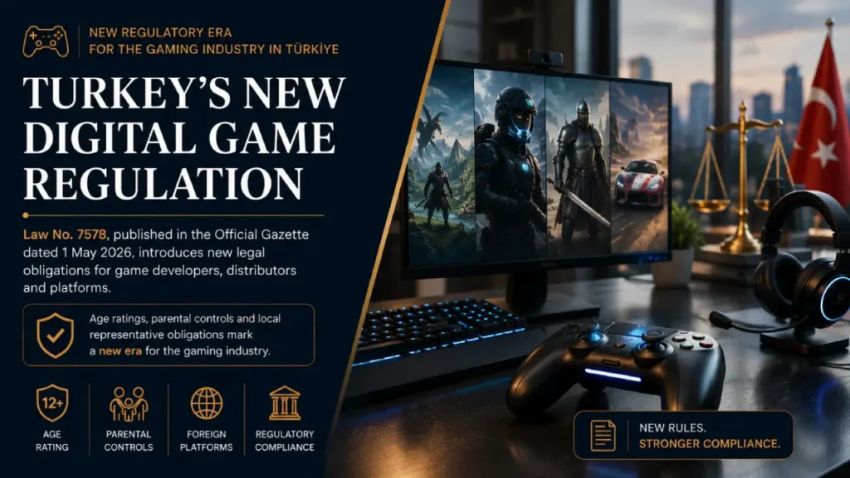
Turkey digital game regulation
What is the significance of Law No: 7578 as Turkey Digital Game Regulation?
It is helpful to note at the outset that Turkey did not yet have a standalone “Gaming Act” comparable to some sector-specific regulatory regimes. However, with the recent amendments to Law No. 5651, digital games, game developers, game distributors and online game platforms have, for the first time, been expressly brought within a structured internet law framework. Therefore, this development may be described as the emergence of a dedicated Turkey digital game regulation regime.
Advanced Terminology by Turkey’s New Digital Game Regulation
The new amendments bring core definitions for the meaning of digital games, game developers as well as game distributors and online gaming platforms within a more structured legal framework for the first time. Indeed, according to the Law in question,
- Game is used to mean as digital games distributed or updated via the Internet, which can be played online or offline in electronic environment,
- Game distributor is used to refer to real or legal persons who manage relations with sales channels for the purpose of delivering digital games produced or published by the content provider to end users, coordinate the production and management of license keys, use digital rights management systems, and provide financial or technical intermediary services in this process,
- Game developer: Real or legal persons who design a digital game or game content, develop their software, or manage the development process,
- Game platform: Real or legal persons who provide software or technical infrastructure for the display, sale, distribution, download or playing of digital games and related additional content over the Internet, and who enable or coordinate users’ access to games or content, license management, or interaction between users,
New Compliance Obligations for Game Platforms under Turkey’s New Digital Game Regulation: Age Rating, Local Representative and Parental Control Requirements
It is worth reiterating that the new regime covers important norms and principles for including foreign gaming companies, online game stores, digital distribution channels and platform operators.
The Highest Age Criteria
Under new Additional Article 5 to the Law No. 5651 on the Regulation of Publications on the Internet and Combating Crimes Committed by Means of Such Publications, a game platform may not offer games that have not been duly age-rated. However, it may offer unrated games provided that such games are classified according to the highest age criterion. Without prejudice to its responsibilities and obligations arising from its status as a content provider or hosting provider, the game platform is obliged to remove content that has not been duly rated.
Transparency, Visibility and Accessibility
A foreign-based game platform with more than one hundred thousand daily accesses from Türkiye is obliged to designate a real or legal person representative in Türkiye and notify the Authority of the information regarding such representative, in order to ensure compliance with notifications, communications or requests to be sent by the Authority, the Union, judicial or administrative authorities, as well as the fulfilment of other obligations under this Law. The game platform shall make the representative’s contact details available on its website in a manner that is easily visible and directly accessible.
Parental Approval Control Panel Set-Up
The game platform shall provide clear, understandable and user-friendly parental control tools including the control of account settings and parental permission or approval mechanisms for any fee-based transactions, such as purchases, rentals and paid memberships, subject to parental permission or approval.
Sanctions for Game Platforms: Administrative Fines from TRY 1 Million to TRY 30 Million
A game platform that fails to comply with the obligations regulated under this Article and the obligations set out in the regulation to be issued by the Authority shall be notified by the Authority. If the obligation subject to the notification is not fulfilled within thirty days from the date of notification, an administrative fine ranging from one million Turkish liras to ten million Turkish liras may be imposed on the game platform by the President. If the obligation subject to the notification is not fulfilled within thirty days from the date of notification of the administrative fine, a further administrative fine ranging from ten million Turkish liras to thirty million Turkish liras may be imposed once again.
Strategic Legal Challenges Under the New Gaming Regime
While the statutory text outlines clear operational requirements, the practical application of Law No. 7578 introduces complex corporate dilemmas that international gaming enterprises must resolve immediately.
The Mobile App Store and Distribution Platform Dilemma
The law’s broad definition of a “Game Platform”—encompassing any entity providing the technical infrastructure for the display, sale, or download of digital games—directly impacts global tech giants. Under this scope, major marketplaces like Apple App Store, Google Play, Steam, Epic Games Store, and console networks (PlayStation, Xbox) bear heavy platform liabilities.
These storefronts are no longer neutral intermediaries; they are legally obligated to police content and ensure that every game distributed on their network within Turkish territory complies with the new age-rating and parental approval mandates. Gaining market access in Turkey will now require seamless synchronization between individual game developers and the distribution platforms hosting them.
The Algorithmic Trap of the “Highest Age Criterion”
One of the most commercially dangerous elements of Additional Article 5 to Law No. 5651 is the default penalty for unrated games. If a developer fails to secure a formal age rating, the platform can still host the game, but it must filter and classify it under the highest age criterion (18+).
For indie developers or studios producing family-friendly, educational, or casual mobile games, this default classification is an algorithmic catastrophe. An automatic 18+ tag will:
- Completely restrict the game from appearing in recommendations for younger demographics.
- Trigger severe visibility drops across global store search algorithms.
- Drastically diminish ad-network monetization and lower user acquisition rates.
Proactive, local age-rating alignment is vital to prevent minor games from being mistakenly buried under adult-content restrictions.
Beyond Fines: The Impending Risk of Access Blocking (Erişim Engeli)
While the immediate text emphasizes escalating administrative fines from TRY 1 Million up to TRY 30 Million, foreign investors must look at the larger legislative picture. Because these regulations are built directly into Law No. 5651—Turkey’s primary internet censorship and regulation law—the statutory enforcement mechanisms extend beyond financial penalties.
Under the broader framework of Law No. 5651, persistent non-compliance with regulatory authorities, failure to remove unrated harmful content, or refusing to establish local contact points can legally escalate to bandwidth throttling or total access blocking (erişim engeli) within Turkish territory. For an online multiplayer ecosystem or live-service game platform, an access block means immediate loss of market share.
How Pi Legal Consultancy Protects Your Gaming Operations
With foreign-based game platforms facing strict local representation mandates if they exceed 100,000 daily accesses from Turkey, securing a trusted local partner is paramount. Pi Legal Consultancy provides comprehensive compliance management and localized legal defense for the digital gaming sector:
- Official Local Representation: Serving as your legally designated, compliant real or legal representative in Turkey to manage communication with administrative and judicial bodies.
- Age-Rating and Compliance Audits: Evaluating your game mechanics and monetization models to ensure alignment with Turkish parental approval panels and rating criteria.
- Litigation and Fine Appeals: Representing your corporate interests before courts and the Authority to dispute or minimize administrative sanctions.
Conclusion
One needs to bear in mind that the Law No. 7578 in the Official Gazette dated 1 May 2026, made significant amendments for the Law No. 5651. Indeed revised Law No. 5651 has a stronger point by stipulating legal definitions for the digital gaming platforms, age-rating obligations, parental control requirements and a local representative obligation for certain foreign-based game platforms exceeding the statutory daily access threshold from Turkey. In the final analysis, it is beyond doubt that this development particularly reflects Türkiye’s broader policy direction towards stronger digital platform accountability, child protection and enforceable regulatory oversight in online services.
For international game developers, publishers, distributors and platform operators, the key issue is no longer only market access, but also regulatory compliance.
The content of this article is intended to provide a general guide to the subject matter. Specialist advice should be sought about your specific circumstances.
[View Source]