

A decision by the Turkish Competition Board ("Board") to revoke the full immunity previously granted to a leniency applicant would bring to the surface a structural tension that lies at the very heart of any leniency programme: The obligation to cease participating in the infringement on the one hand, and the obligation to maintain strict confidentiality of the application on the other. Such a development would raise a fundamental question that Turkish competition law has not yet squarely addressed and one that has major implications for the future of active cooperation in Turkey.
Background
Where the Board revokes the full immunity previously granted to a leniency applicant ("the Applicant") pursuant to Article 6 of the Regulation on Active Cooperation for Detecting Cartels ("Leniency Regulation") on the grounds that the company failed to fulfil the condition stipulated under subparagraph (c) of Article 6 of the Leniency Regulation which requires that "unless otherwise indicated by the competent unit on the grounds that it would hinder the detection of the cartel, the undertaking concerned shall cease to participate in the cartel subject to the application", the consequences may be far-reaching. One can readily envisage a situation in which full immunity is revoked with respect to one aspect of the infringement, such as the exchange of competitively sensitive information, whilst remaining in effect with respect to another, such as a price-fixing arrangement in a distinct product market.
What makes such a situation particularly significant is not the revocation itself, but the circumstances that may render full cessation of the infringement practically impossible. Specifically, the legal requirement that the leniency application remain confidential and not be disclosed to the very employees who are engaging in the conduct at issue.
The Core Tension: Confidentiality vs. Cessation
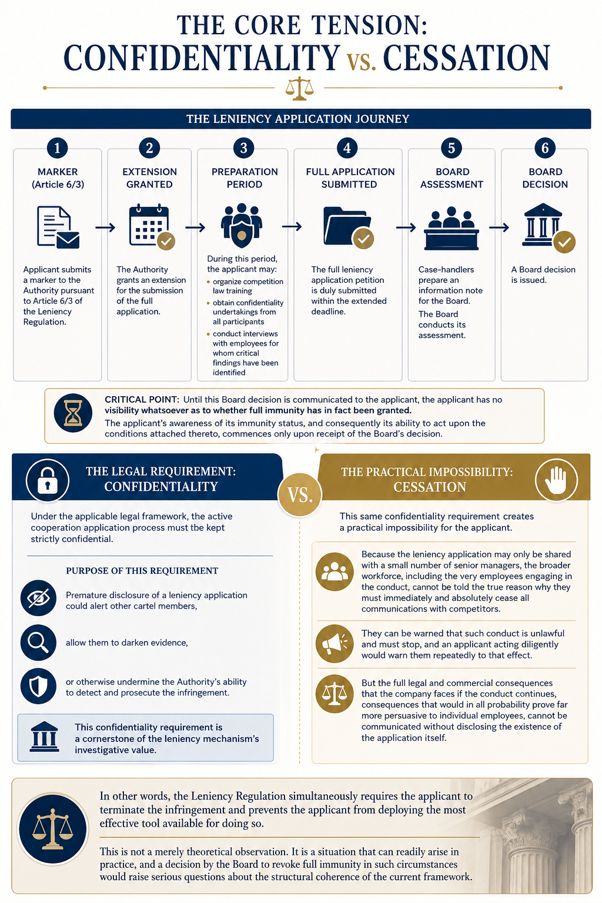
An applicant in such a position would typically submit a marker to the Authority pursuant to Article 6/3 of the Leniency Regulation, following which the Authority grants an extension for the submission of the full application. During this period, the applicant may organize a competition law training, obtain confidentiality undertakings from all participants, and conduct interviews with the employees for whom critical findings have been identified. The full leniency application petition would then be duly submitted within the extended deadline. Following the submission of the full application, the case-handlers prepare an information note for the Board, and the Board conducts its assessment. A Board decision is then issued. Critically, until this Board decision is communicated to the applicant, the applicant has no visibility whatsoever as to whether full immunity has in fact been granted. The applicant's awareness of its immunity status, and consequently its ability to act upon the conditions attached thereto, commences only upon receipt of the Board's decision.
Under the applicable legal framework, the active cooperation application process must be kept strictly confidential. The purpose of this requirement is well-established: Premature disclosure of a leniency application could alert other cartel members, allow them to darken evidence, or otherwise undermine the Authority's ability to detect and prosecute the infringement. This confidentiality requirement is thus a cornerstone of the leniency mechanism's investigative value.
However, this same confidentiality requirement creates a practical impossibility for the applicant. Because the leniency application may only be shared with a small number of senior managers, the broader workforce, including the very employees engaging in the conduct, cannot be told the true reason why they must immediately and absolutely cease all communications with competitors. They can be warned that such conduct is unlawful and must stop, and an applicant acting diligently would warn them repeatedly to that effect. But the full legal and commercial consequences that the company faces if the conduct continues, consequences that would in all probability prove far more persuasive to individual employees, cannot be communicated without disclosing the existence of the application itself.
In other words, the Leniency Regulation simultaneously requires the applicant to terminate the infringement and prevents the applicant from deploying the most effective tool available for doing so. This is not a merely theoretical observation. It is a situation that can readily arise in practice, and a decision by the Board to revoke full immunity in such circumstances would raise serious questions about the structural coherence of the current framework.
The Marker Period: When Does the Cessation Obligation Arise?
A further dimension of this problem concerns the temporal scope of the cessation obligation and the legal status of the marker that precedes the formal leniency application.
Where an applicant first submits a marker to the Authority pursuant to Article 6/3 of the Leniency Regulation, and the Authority grants an extension in order to provide additional information, following which the full leniency application is submitted, a critical question arises: From which point in time does the obligation to cease cartel activity arise, the date of the marker, the date of the completed application, or the date on which the Board's decision granting immunity is communicated to the applicant? As set out above, the applicant has no knowledge of whether immunity has been granted until the Board's decision is formally communicated. It would be manifestly unreasonable to expect an undertaking to comply with a cessation obligation attached to an immunity grant of which it is not yet aware. Furthermore, following the Board's decision, the Authority will typically initiate a preliminary investigation and conduct dawn raids on the other parties to the infringement and potentially on the applicant itself. Until such dawn raids are carried out, requiring the applicant to cease all communications with the other infringing parties would risk alerting those parties to the existence of the application, thereby enabling the destruction of evidence and fundamentally undermining the investigative purpose of the leniency mechanism.
The marker mechanism serves a distinct and well-defined purpose. Its primary function is to allow the leniency applicant a reasonable period of time to gather evidence, whilst also encouraging leniency applications and ensuring the predictability of the leniency mechanism. The marker is not the moment at which the leniency application is legally complete and valid; it is merely an interim protective measure designed to secure the applicant's position in the queue whilst internal preparations are finalized. Similarly, even the date of the completed application cannot serve as the appropriate trigger for the cessation obligation, given that the applicant does not yet know whether immunity has been granted. It would accordingly be appropriate for the obligation to cease cartel activity to commence only after the dawn raids have been conducted by the Authority. This sequencing serves a dual purpose: (i) it ensures that the applicant is not held to an obligation of which it has no knowledge, and (ii) it preserves the evidentiary integrity of the investigation by preventing premature disruption of the communication channels through which the infringement is being carried out.
It would accordingly frustrate the fundamental objectives of the leniency programme to require cessation at any point prior to the completion of the Authority's initial investigative steps. Denying immunity on the grounds of continued conduct during the marker period or the period between the full application and the dawn raids would undermine the very purpose of leniency, which is to encourage cooperation and uncover cartels. Requiring the applicant not to continue participating in the cartel during a period in which (i) the applicant does not know whether immunity has been granted, and (ii) premature cessation would risk the destruction of evidence by other cartel members, would not be in line with the spirit of the regulation, which is to reward companies for raising suspicions during internal audits and to facilitate the effective detection of cartels.
This interpretation is reinforced by a broader principle of leniency law. In cases where there is no clear provision and interpretation is required, the resolution should favour the applicant. This principle has been described in the doctrine as one of the two vital principles in the regulation and implementation of leniency programmes1, and the Board itself has adopted it as a matter of policy2. Applying this interpretive lens, evidence relating to the period prior to the date on which the leniency application was completed should not be taken into account in assessing whether the cessation obligation was fulfilled.
Broader Policy Implications
The effectiveness of any leniency programme depends on the willingness of undertakings to come forward voluntarily, often at considerable internal cost, reputational risk, and commercial disruption. If companies observe that a comprehensive, proactive, and transparent cooperation process — involving audits, training, disciplinary sanctions, and full substantive cooperation with the Authority — can nonetheless result in the loss of immunity due to the conduct of individual employees whom the applicant was legally prevented from fully informing, the incentive to apply for leniency is materially weakened.
This is precisely the situation that the Board has historically sought to avoid. The Board's established approach to undertakings applying for leniency, particularly where no prior investigation has been initiated against them, has always taken these incentive considerations into account.The Board, as a policy priority,has adopted the use of its discretion in a manner that does not undermine the applicability of the leniency programme.
Such a situation would therefore call for a careful recalibration. As a practical solution, it is submitted that the leniency applicant should, in both the marker application and the subsequent full application, expressly communicate to the Authority the procedural structure that the applicant considers necessary for the effective operation of the leniency mechanism namely, that the Board should first notify the applicant of the grant of immunity, and that the cessation obligation should not be triggered until after the dawn raids have been conducted. This proactive communication would serve to place the Authority on notice of the applicant's position and would provide a basis for the Authority to manage the sequencing of the investigation in a manner consistent with the objectives of the leniency programme. At a minimum, the Board should consider: (i) Whether the cessation obligation under Article 6(c) of the Leniency Regulation should be interpreted as arising only after the Board's decision granting immunity has been communicated to the applicant and the initial dawn raids have been completed; (ii) whether the confidentiality obligation should be modulated to permit disclosure to a wider group of key employees in limited and controlled circumstances; and (iii) whether, where an undertaking has demonstrably taken every reasonable measure within the bounds of the applicable legal framework, the loss of immunity represents a proportionate and legally sound outcome. Such an approach is essential for preserving the effectiveness and credibility of the leniency programme.
Conclusion
An immunity revocation in such circumstances would represent a significant development in Turkish competition law leniency practice. It would expose a structural tension, embedded in the current design of the Leniency Regulation, between the obligation to terminate the infringement and the obligation to maintain confidentiality of the application. Until this tension is explicitly addressed either through regulatory amendment or authoritative Board guidance, applicants navigating the leniency process will face a dilemma that no amount of good faith effort can fully resolve.
Footnotes
1 Gökşin Kekevi, Leniency Programs: Losing the Battle, Winning the War, Competition Journal, April-May-June 2008/34, pp. 21-22.
2 Beypazarı decision of the Turkish Competition Board dated 18.05.2022 and numbered 22-23/379-158.
The content of this article is intended to provide a general guide to the subject matter. Specialist advice should be sought about your specific circumstances.


