
ANGOLA: President authorised to grant supplementary tax incentives for oil blocks
On 13 August 2026, the Angolan National Assembly unanimously approved six Legislative Authorisation Bills, authorising the President to legislate on supplementary tax incentives for six offshore oil concession areas (Oil Blocks 17/25, 19, 32/21, 33/24, 34 and 35).
The bills authorise the President to issue Presidential Legislative Decrees that derogate from the ordinary petroleum tax regime laid down in Law 13/04 of 24 December 2004 on the Taxation of Petroleum Activities. Under that authorisation, the decrees may grant additional tax incentives, including a reduced rate of petroleum production tax, a higher limit on recoverable investment costs, a reduced concession rate, and customs relief on equipment imported for exploration purposes. The Bills do not themselves specify the incentives but define the object, purpose, extent, and duration of the authorisation. The applicable rates, thresholds, and conditions will be established in the Presidential Legislative Decrees issued pursuant to the authorisation.
The six bills take effect upon their publication in the Official Gazette. The definitive tax details will be set out in the Presidential Legislative Decrees to be issued under the authorisation, which had not been published at the time of writing.
BOTSWANA: 14% standard VAT rate on private medical services suspended pending stakeholder consultation
On 30 July 2026, the Botswana Unified Revenue Service (“BURS”) has issued an official public notice announcing the immediate suspension of the 14% Value Added Tax (“VAT”) on private medical services to allow for extensive stakeholder and public consultations prior to any implementation.
The suspension follows the enactment of the VAT Act, 2026, which removed private medical services from the VAT exemption list with effect from 1 July 2026, thereby subjecting such services to the standard VAT rate of 14%. Prescription medicines were also removed from the exempt category and placed on the zero-rated list.
BURKINA FASO: Additional tax on undeveloped land being enforced
In Official Notice No. 2026-007/MEF/SG/DGI/DRI-K of 13 August 2026 the General Directorate of Taxes (Direction Générale des Impôts, (“DGI”)) announced that it has begun enforcing the additional tax on undeveloped or insufficiently developed residential and non-residential land nationwide.
Implementation will proceed by geographical area as verification and tax assessment work is completed. The first phase covers residential and non-residential plots laid out by the National Urban Land Development Company (Société nationale d'aménagement des terrains urbains, SONATUR) in the Kadiogo region, including the Ouaga 2000 area, where land-development inspections have been conducted since July 2024. Affected holders are invited to collect their assessment notices from the Ouaga VIII Tax Centre or the Komsilga Departmental Tax Centre, depending on the location of the plot.
Tax assessment notices are deemed served one month after publication of the official notice, with payment due within two months of service. A further three-month grace period applies to late payment, subject to a 10% penalty on the tax due. Failure to pay by the end of the grace period results in withdrawal of the plot, which is then incorporated into the State's land registry.
CAMEROON: Real-time VAT collection for petroleum products and butane gas clarified
In Circular No. 00000666/MINFI/DGI of 14 July 2026, the Directorate General of Taxation (DGI) has clarified the real-time collection, payment, and recovery of VAT on petroleum products and commercial butane gas. The circular explains the application of Order No. 00000449/MINFI of 22 May 2026, which applies to relevant transactions carried out from 1 January 2026.
VAT becomes chargeable when petroleum products are withdrawn from depots operated by the Cameroon Petroleum Depots Company (Société Camerounaise des Dépôts Pétroliers, (“SCDP”)), delivered directly by the National Refining Company (Société Nationale de Raffinage, (“SONARA”)), or first used in a transaction treated as a self-supply. For commercial butane gas, VAT becomes chargeable upon delivery by a producer or distributor.
The tax is calculated using the regulated monthly price structure. VAT is imposed at the overall rate of 19.25% on 10 price components for petroleum products and six components for commercial butane gas. The circular distinguishes between the:
- Debtor, which is responsible for the taxable transaction;
- Actual taxpayer, which bears the VAT included in the regulated price and may deduct or reclaim it; and
- Statutory collector, which calculates, withholds and remits the tax.
The SCDP acts as the statutory collector when products are withdrawn from its depots. SONARA performs this role where it delivers products directly without passing through the SCDP depots. For the importer's margin and cabotage components, the importer remains liable for VAT on the quantities transferred, while the SCDP calculates the tax based on those quantities.
The mechanism relies on a withholding certificate generated by the DGI's electronic system. Only a system-generated certificate entitles the actual taxpayer to deduct or reclaim the VAT. Statutory collectors must remit the tax within 45 days of the withdrawal or delivery into the dedicated Treasury account.
As a transitional measure, VAT on May 2026 withdrawals was payable by 15 July 2026. VAT relating to withdrawals made from January to April 2026 must be paid in six equal monthly instalments from 15 July to 15 December 2026, together with the VAT due for withdrawals made from May to October 2026, respectively.
Any VAT already paid under the previous arrangements is credited against the outstanding amount.
DEMOCRATIC REPUBLIC OF THE CONGO: Finance Law 2026 enacted
The 2026 Amending Finance Law No. 26/032 was promulgated and entered into force on 7 August 2026. It was published in the Official Journal on 17 August 2026. The Law largely confirms the measures proposed in the draft Amending Finance Bill, 2026, with limited changes concerning mining taxation, environmental levies and the taxation of income.
The main differences from the draft Finance Bill include:
Mining Taxation
- Effective 1 October 2026, a mining royalty applies to mining by-products of economic interest, defined as mineral substances present in trace or ultra-trace quantities recoverable through specific industrial processes. Such products’ gross commercial value is determined based on the measured mineral content, quantity marketed or exported, international market price and a recovery rate set by interministerial order. Previously, minimum content thresholds applied;
- Mining companies with State participation must declare dividends due to the State by 5 July and pay them within eight days of receiving a collection notice. If the ordinary general meeting is not held by 30 June, the dividends become automatically due. The State may also require, before the general meeting, an advance payment of up to 50% of its dividend share if the company reports a profit.
Environmental Taxation
- A new parafiscal levy applies to imports of electrical, electronic and pneumatic equipment throughout the country for the benefit of the Environmental Intervention Fund (Fonds d'Intervention pour l'Environnement, FIPE), with rates and collection rules to be set by an interministerial order;
- A new carbon tax applies to greenhouse gas emissions exceeding the regulatory threshold. However, holders of mining and quarrying rights are exempt from the carbon tax in respect of all their excavation, processing and operating sites, as they are already subject to the pollution tax; and
- The land-clearing tax no longer applies to operations carried out solely on arable savanna, agropastoral land or secondary vegetation.
Other
- Interest on savings accounts is now taxable as movable capital income for personal income tax purposes. Previously, such interest was not subject to tax on income from movable capital but was included in an individual's business income and taxed accordingly.
All other provisions of the 2026 Amending Finance Law were adopted as proposed in the draft Amending Finance Bill.
DEMOCRATIC REPUBLIC OF THE CONGO: Rates for digital service taxes set
Interministerial Order No. 015/CAB/MIN/EN/AKIM/MLNS/EME/ALM/2026 of 20 July 2026 sets the rates of duties, taxes and fees applicable to digital activities and services under the Digital Code, effective from 20 July 2026.
The charges apply to businesses and individuals carrying on digital activities or services from the DRC or to customers in the DRC. They are denominated in USD or as a percentage and are payable in Congolese francs at the official daily exchange rate. The charges fall into three categories:
- Charges for authorisations relating to the supply of digital services, including data centre construction, hosting, cloud computing, ranging from USD2 000 for essential digital services to USD15 000 for data centre construction;
- Charges for approvals relating to declared activities, including Internet exchange points, data centres and digital platforms, ranging from USD100 to USD100 000 depending on the applicable tier; and
- Fines for carrying on digital activities or services without the required authorisation or approval, ranging from 100% to 200% of the value or cost of the relevant title.
The applicable rates depend on the activities and operator location, with foreign operators generally being subject to higher charges than local operators. Title renewals are taxed at 100% of the title's cost, and modifications at 25%.
Penalties relating to turnover reporting failures amount to 25% of the duties due for late or incomplete returns, 50% for failure to file, 75% for false returns and 100% in the event of a repeat offence.
DEMOCRATIC REPUBLIC OF THE CONGO: Start-up treatment under new digital charges clarified
In Official Notice No. 030/CAB/MIN/EN/SUK/SKL/ALM/2026 of 1 August 2026, the DRC has confirmed that digital start-ups remain eligible for tax, parafiscal, customs and foreign exchange advantages under article 384 of the Digital Code, notwithstanding the new duties, taxes and fees applicable to digital activities and services.
Forthcoming implementing measures will specify the treatment of Congolese start-ups under Ordinance-Law No. 22/030 of 8 September 2022 on the promotion of entrepreneurship and start-ups.
EQUATORIAL GUINEA: New tax identification number codification approved
During its second session on 10 August 2026, the Interministerial Council has approved a decree establishing a new codification of the tax identification number (Número de Identificación Fiscal, (“NIF”)) applicable to natural persons, legal persons and entities without legal personality.
The measure is presented as an update and systematisation of the existing NIF framework, intended to modernise tax identification, improve the traceability of economic and financial operations and align national procedures more closely with the standards of the Economic and Monetary Community of Central Africa (CEMAC) and the Financial Action Task Force (FATF/GAFI). The NIF remains the unique alphanumeric identifier required for tax compliance, opening bank accounts and related administrative acts.
The instrument remains at the preliminary draft stage. No text of the draft decree has been published, and no decree number has been assigned yet.
EQUATORIAL GUINEA: Draft 2027 Budget presented
On 14 August 2026, the General Directorate of Budgets has presented the draft 2027 Finance Budget to the Finance Ministry's eighth ordinary governing council.
The draft Budget explicitly links a projected moderate increase in non-oil revenues to ongoing tax reforms as part of a broader revenue-diversification strategy amid declining oil production. Although it does not specify proposed tax measures, it indicates that several tax reforms are under consideration. Further details on tax reforms are expected to emerge as the draft proceeds to the Interministerial Council and parliament.
ESWATINI: E-Invoicing guidelines for accrediting electronic fiscal device solutions issued
On 13 August 2026, the Commissioner General of the Eswatini Revenue Service (“ERS”) has issued the ERS e-Invoicing System Technical Guidelines for the Accreditation of Electronic Fiscal Device (“EFD”) Solutions. The Guidelines prescribe the technical, administrative and operational requirements for registering, testing, accrediting and maintaining EFD solutions used with the ERS e-Invoicing System.
The Guidelines form part of the operational and technical framework for VAT e-invoicing and apply to:
- EFD suppliers, developers, installers, maintainers and support providers;
- Applicants seeking registration, technical or administrative review, accreditation, update approval or continued accreditation;
- Accredited suppliers;
- Taxpayers using, intending to use or required to use an accredited EFD solution, to the extent applicable; and
- ERS officers involved in registration, review, accreditation, inspection, revocation, publication, support, monitoring or administration of EFD solutions.
The Guidelines are to be read with the VAT Act, 2011, the amended Third Schedule and the VAT (Electronic Submission of Fiscal Data and Return-Supporting Records) Notice 2026. Those underlying instruments prevail in the event of inconsistency.
The accreditation framework requires:
- A POS or E-SDC solution to complete the applicable review and receive accreditation from the Commissioner General before it may be used for fiscalisation;
- Suppliers to register in the ERS e-Invoicing System Accreditation Environment or Sandbox before proceeding through technical and administrative review;
- The Commissioner General to make the final accreditation decision; and
- The ERS, after approval, to publish the accredited supplier and the product's brand, model and specifications.
Where an EFD solution is used or required, taxpayers must use ERS-approved POS and E-SDC components and comply with the requirements prescribed by the Guidelines.
For business-to-business transactions, the Guidelines require additional invoice information, including the buyer’s:
- Taxpayer identification number;
- Name; and
- Physical address.
The Guidelines prescribe the treatment of adjustments and cancellations and provide that, after accreditation, suppliers must:
- Keep approved products compliant with the applicable requirements;
- Promptly correct identified deficiencies;
- Report changes affecting an accredited product's functionality or the appearance of issued invoices through Sandbox; and
- Submit a new accreditation application where such changes require the product to undergo the accreditation process again.
The Commissioner General may also require further review, update approval or reaccreditation where an update affects functionality, security, fiscal-document appearance, invoice data, audit data, communication protocols, accreditation conditions or compliance status.
The ERS may inspect EFD components at taxpayers' premises to verify that the components in use correspond with the accredited versions. Accreditation may be revoked where:
- A supplier fails to correct identified errors within the specified period;
- A supplier fails to adapt a product following applicable legal or guideline changes;
- A product used by a taxpayer differs in functions critical to fiscalisation from the approved model; or
- The supplier requests revocation.
Technical, invoice data, accreditation, and operational requirements may be deferred or introduced progressively, including item codification requirements.
The Guidelines take effect on the date on which they are published on the official ERS website, unless the Commissioner General specifies another date.
ESWATINI: Framework for electronic submission of VAT data and return-supporting records issued
Pursuant to Legal Notice No. 111 of 2026, the ERS has issued the VAT (Electronic Submission of Fiscal Data and Return-Supporting Records) Notice 2026, which came into force on 15 July 2026. The Notice prescribes the electronic manner, form, procedure, and technical requirements for submitting transaction-level fiscal data and records for supporting VAT returns. The Notice applies to:
- Taxable persons required to submit VAT returns;
- Persons required by the Commissioner General to submit further returns, information, fiscal data, or return-supporting records;
- Suppliers and service providers of electronic fiscal devices (EFDs) or related systems; and
- Any other person brought within its scope by a direction, notice, or requirement.
The Notice provides that:
- Fiscal data and return-supporting records must be submitted electronically in the form, manner, and frequency prescribed by the Commissioner. Submission may be required in real time, periodically, with a VAT return, upon request, or in another prescribed manner. Where electronic fiscal devices (EFD) use is required, only a device authorised or accredited by the Commissioner may be used;
- Each transaction must be recorded through a point-of-sale or another approved system, processed through an EFD, assigned a unique identifier, and secured as prescribed;
- The EFD must generate and securely store the fiscal data, issue a fiscal receipt, tax invoice, credit note, debit note, or other prescribed fiscal document, and transmit the data to the ERS e-invoicing system;
- Fiscal documents must contain the prescribed transaction, supplier, tax, payment, EFD, and security particulars. Tax invoices must also state the buyer's taxpayer identification number (TIN), and item-codification information must be included where applicable;
- Transmission of fiscal data and return supporting records to the ERS e-invoicing system must occur in real time or, if that is unavailable, within the prescribed period and, in any event, not later than 15 days after the relevant fiscal document is created, unless a shorter period is prescribed. Users must take reasonable steps to monitor transmission, address failures or malfunctions without undue delay, and keep the EFD operational during business operations; and
- Only accredited persons may supply, install, maintain, or support EFDs. Accredited suppliers must provide compliant devices, installation, maintenance, software updates, technical support, responses to operational failures, and secure transmission. Accreditation may be suspended or revoked for non-compliance.
GABON: OCAM Fiscal Co-operation Convention terminated
The 2026 Amending Finance Law (Law No. 002/2026 of 17 July 2026), published in Official Gazette (Special Issue) No. 123 Bis, announced that the African and Malagasy Common Organisation (Organisation Commune Africaine et Malgache; OCAM) Fiscal Co-Operation Convention (1971) ceased to have effect in respect of Gabon as of 1 January 2026. From this date, all tax-related matters previously covered by the convention are subject to the general tax law of Gabon, subject to obligations imposed by bilateral and multilateral treaties in force and international commitments binding Gabon. Provisions in legal texts referring to the convention do not apply to taxable events occurring on or after 1 January 2026.
GHANA: Income Tax Amendment Act, 2026 assented to by the President
Following their passage by Parliament on 28 July 2026 and 31 July, the following tax bills received presidential assent on 26 August 2026:
- Income Tax Amendment Act, 2026;
- VAT Amendment Act, 2026;
- Excise Act, 2026;
- Customs Act, 2026; and
- Energy Sector Levies Act, 2026.
The government has not yet communicated their effective date, but significant amendments include:
- Increasing the individual income tax bands for resident individuals as follows:
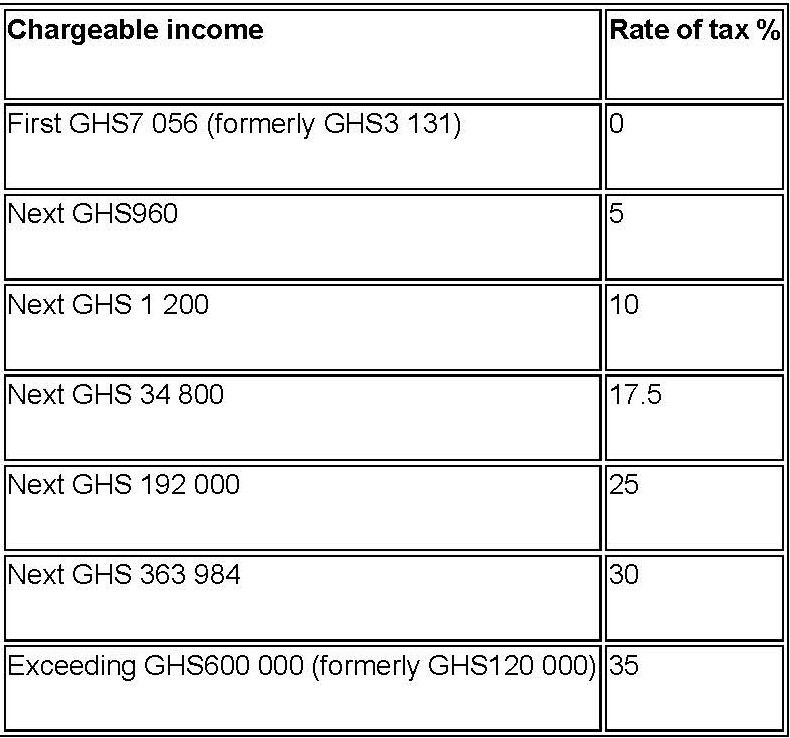
- Increasing the presumptive tax-based turnover threshold to apply to an individual with annual turnover of up to GHS 750 000 (increased from GHS200 000);
- Adjusting the VAT regime following an agreement with large-scale gold mining companies to surrender 30% of their gold to the Bank of Ghana. The Act exempts the surrendered gold from VAT; and
- Bringing factories and maritime vessels that use fuel oil, and were previously exempt, within the scope of the Energy Sector Levies regime. The Act also requires them to provide proof of reinvestment, addressing a loophole that had existed for several years.
KENYA: eTIMS – IFMIS Integration implemented
The Kenya Revenue Authority (“KRA”), in collaboration with the National Treasury, has announced the successful implementation of the integration between the Electronic Tax Invoice Management System (“eTIMS”) and the Integrated Financial Management Information System (“IFMIS”).
The integration will promote greater transparency and accountability in Government transactions, support efficient and seamless financial processes across Government entities and enhance tax compliance through automated validation of tax invoices.
All suppliers engaging in business with Government entities are hereby advised to observe the following requirements:
- Suppliers must generate valid eTIMS invoices for all supplies before submission for payment processing through IFMIS;
- The details of invoices submitted to Government entities must correspond precisely with the invoices generated and recorded in eTIMS; and
- Suppliers are encouraged to regularly verify their tax compliance status and ensure that their tax records and information are accurate and up to date.
KRA and the National Treasury remain committed to supporting all stakeholders throughout the implementation and transition period. Sensitisation programmes, technical support, and relevant guidance will continue to be provided to facilitate the smooth and successful adoption of the integrated eTIMS-IFMIS solution
LIBERIA: Strategic Plan 2025-2029 to strengthen tax compliance launched
On 20 August 2026, the Liberia Revenue Authority (“LRA”) issued a press release announcing the launch of its Corporate Strategic Plan 2025–2029, which sets out a five-year framework to strengthen domestic resource mobilisation, modernise revenue administration, improve taxpayer services, advance Liberia's fiscal sustainability, and strengthen voluntary tax compliance.
The Plan outlines five priorities: fair and effective revenue administration, voluntary compliance, institutional strengthening, technology and data, and stronger partnerships. Among other measures, the Plan aims to:
- Increase the effectiveness of tax and customs administration to maximise revenue;
- Decentralise revenue collection to increase voluntary compliance;
- Enhance taxpayer knowledge of tax laws, rights, and obligations; and
- Improve the Liberia Integrated Tax Administration System (LITAS) and the Automated System for Customs Data (ASYCUDA World) to enhance performance, strengthen security, ensure continuous availability, reduce system downtime and minimize ICT risks.
MAURITANIA: 2026 Supplementary Finance Law enters into force
The 2026 Supplementary Finance Law (Loi de Finances Rectificative pour l'année 2026), adopted by the National Assembly on 29 July 2026, amends various provisions of the General Tax Code and the Tax Procedures Code. The final version of the 2026 Supplementary Finance Law was published by the Ministry of Finance on 10 August 2026 and is in force.
Significant amendments include:
Indirect taxes
- Including electronically supplied digital services as transactions subject to VAT, including online advertising, cloud computing and data storage, electronically supplied software and applications, digital intermediation, streaming, artificial intelligence services and automated online services;
- Introducing criteria for determining whether digital services are used or exploited in Mauritania, including the location of the customer's residence or establishment, billing address, use of a Mauritanian payment instrument, IP address, Mauritanian telephone number, or other evidence establishing consumption in Mauritania;
- Requiring non-resident digital service suppliers and qualifying digital platforms to register for VAT;
- Introducing a simplified electronic VAT registration, filing, and payment regime for non-resident digital service suppliers and platforms;
- Requiring a non-resident supplier or qualifying platform to collect and remit VAT where digital services are supplied to a final consumer who is not a taxable person in Mauritania;
- Clarifying that VAT registration by a non-resident digital supplier or platform does not, by itself, create a permanent establishment or liability to other Mauritanian taxes;
- Introducing a VAT liability for digital platforms on commissions received from their intermediation activities;
- Introducing a VAT liability for a digital platform on the underlying transaction where the platform collects the price, determines essential conditions of the transaction, or acts as the contractual interface between the parties; and
- Introducing a ceiling of MRU200 per transaction on the 0.1% tax applicable to electronic payment and transfer transactions.
The simplified VAT registration, filing and payment procedures for non-resident digital suppliers and platforms are to be established by an order of the Minister of Finance. The procedures relating to enforcement measures against non-compliant digital service providers are to be established by a joint ministerial order.
Administration
- Requiring a supplier's TIN to be active, not deregistered. and not suspended on the date on which the relevant invoice is received for the related expense to be deductible;
- Introducing an obligation for taxpayers to verify the status of their suppliers' TINs through the services made available by the General Directorate of Taxes;
- Clarifying that the absence of the supplier's TIN from an invoice or import declaration results in the non-deductibility of the related expense;
- Introducing a rule under which expenses are non-deductible where supporting documents requested in writing by the tax administration are not produced during an on-site tax audit;
- Restricting the admissibility of supporting documents produced for the first time during tax litigation where the taxpayer failed to provide those documents following requests made during the tax audit;
- Reducing from 50% to 25% the proportion of purchases and services treated as non-deductible where the applicable supplier reporting obligation is not complied with; and
- Introducing new reporting and banking requirements and revising the rules governing tax audits to strengthen the traceability of financial transactions, combat the informal economy, and improve tax enforcement.
MAURITIUS: 2026 e-Filing season for individual taxpayers announced
On 28 August 2026, the Mauritius Revenue Authority (“MRA”) issued a communique on e-Filing Season 2026 for individual income tax returns, announcing 15 October 2026 as the return deadline.
The facilities to submit income tax returns and to effect the payment of tax are available on MRA website (www.mra.mu). Individual taxpayers have to use their User ID (NID or NCID or TAN) and Password to file their income tax return.
A standard tax return is required to be submitted by every individual who during the income year ended 30 June 2026:
- Derived net income which exceeds MUR500 000;
- Derived gross income from business exceeding MUR2-million;
- Derived emoluments in respect of which PAYE has been withheld;
- Derived income which has been subject to Tax Deduction at Source (TDS); or
- Had a chargeable income.
All self-employed individuals are required to submit an income tax return and pay the tax, if any, in accordance with the return. Self-employed individuals who are not required to submit a Standard Tax Return should submit a Simplified Tax Return.
An e-Appointment facility is available on the MRA website to assist with the filing and submission of tax returns. It allows taxpayers to reserve a time slot on a particular day, at their convenience. Assistance to file their income tax return will be provided through a WhatsApp Video Call on the day and time of the appointment.
MyRA, a virtual assistant configured to assist individual taxpayers on a 24/7 basis, is also available on the MRA website. The aim of this facility is to provide information to individuals on income tax in view of filing their income tax return.
The MRA appeals to all taxpayers to participate in a Taxpayer Satisfaction Survey (“TSS”) after filling their individual income tax returns. The survey aims at receiving feedback from the public on the way they interact with MRA. Taxpayers participating in the TSS will automatically qualify for a draw, which will be effected at the end of October 2026. Three cash prizes of MUR25 000, MUR15 000 and MUR10 000 respectively will be awarded to the first three winners.
MAURITIUS: Finance Act 2026 published
Mauritius has published the Finance Act, 2026, which was gazetted on 12 August 2026. Unless otherwise specified, it introduces amendments to the Income Tax Act, VAT Act, MRA Act, Customs Act, Customs Tariff Act, Excise Act, Gambling Regulatory Authority Act, Land (Duties and Taxes) Act, and the National Pensions (Non-Contributory Benefits) Regulations 1977 from the same date.
Significant amendments include:
Direct taxation
- A 10-year tax incentive for qualifying start-up enterprises that meet the specified conditions;
- Extending the 10-year income tax exemption available to captive insurance companies licensed before 19 June 2026 by an additional period not exceeding five years.
- Revising personal income tax rates as follows:*
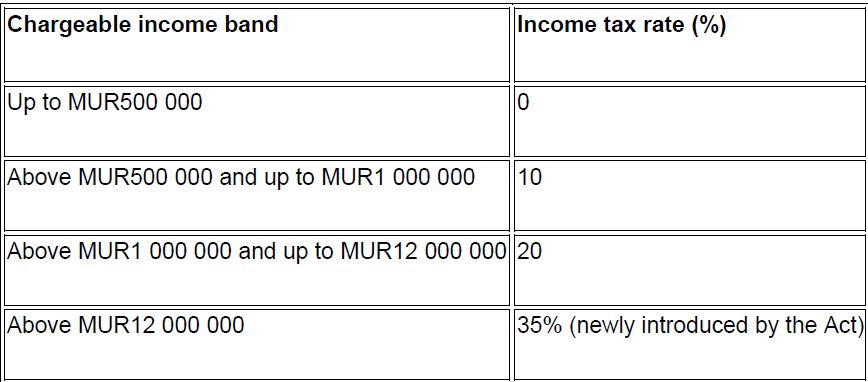
The revised rate structure applies from 1 July 2026. The new 35% marginal rate on chargeable income exceeding MUR12-million replaces the individual Fair Share Contribution from that date.
- Exempting emoluments derived by qualifying non-citizen employees engaged in solar photovoltaic manufacturing activities from income tax for four income years;
- Revising the percentage of Corporate Social Responsibility (CSR) funds that must be remitted to the Director-General from 50% to 75%;
- Restricting the reduction of the Corporate Climate Responsibility Levy (“CCRL”) through tax credits, except for the manufacturing investment tax credit and applicable foreign tax credits available under a double taxation agreement;
- Introducing transitional CCRL relief by reducing the levy payable with advance payment systems (“APS”) statements by 75%, 50%, and 25% for APS statements due during the periods 1 July 2026 to 30 June 2027, 1 July 2027 to 30 June 2028, and 1 July 2028 to 30 June 2029, respectively;
- Amending the definition of a “global business entity” to introduce specific qualifying conditions for trusts, foundations, and trustees of unit trust schemes;
- Amending the definition of "excluded person" for qualifying domestic top-up tax purposes (“QDMTT”) purposes so that investment funds and real estate investment vehicles are excluded only when they are ultimate parent entities;
- Amending the definition of "fiscal year" for QDMTT purposes to clarify the period by reference to which the EUR750-million consolidated revenue threshold and domestic minimum top-up tax are computed, including treating the calendar year as the relevant fiscal year where the deemed consolidation test is met;
- Amending the definition of "export of goods" to include international buying and selling arrangements under which goods are shipped directly from the exporting country to the final importer without being physically landed in Mauritius, as well as the sale of aviation fuel to an airline, while excluding the export of live animals;
- Introducing additional administrative and compliance clarifications for QDMTT, including reducing the late-payment interest rate from 5% to 2.5% and extending the Director-General's reassessment period for QDMTT matters from two to three years;
- Introducing a new deeming rule under which income derived by non-residents from specified ICT services supplied in Mauritius is treated as Mauritius-source income;
- Introducing a definition of specified ICT services that covers the supply of software, software licences, software applications, software maintenance services, and the remote maintenance of programmes and ICT equipment;
- Extending tax deduction at source to payments exceeding MUR300 000 for specified ICT services; and
- Extending tax deduction at source to payments for digital advertising, promotional, endorsement, and marketing services carried out through social media platforms and similar electronic means.
The direct tax measures introduced by the Act have different commencement dates. Several reporting, rate, and exemption changes apply from the income year commencing on 1 July 2026, while certain QDMTT-related provisions apply from the year of assessment commencing on 1 July 2025. Certain global business entity, deduction repeal, and start-up exemption measures apply from the year of assessment commencing on 1 July 2027. Transitional CCRL relief applies progressively based on APS due dates from 1 July 2026 to 30 June 2029.
Indirect tax
- Introducing new VAT rules for operators of online marketplaces, including:
- introducing a definition of an online marketplace as a "digital platform connecting or facilitating electronic transactions and interactions, whether directly or indirectly, between sellers and buyers for the supply of goods and services". The definition includes a website, web-based portal or gateway, application store, digital distribution platform, or any similar platform, but excludes platforms that solely process electronic payments;
- clarifying that operators of online marketplaces may be subject to the VAT rules applicable to digital or electronic services, including registration, compliance, and tax representative requirements;
- introducing a MUR3-million supply threshold for compulsory VAT registration for foreign suppliers of digital or electronic services, subject to the existing exclusion where supplies are made exclusively to VAT-registered persons;
- revising the scope of digital or electronic services to include commissions, fees, or other consideration receivable by operators of online marketplaces, while removing electronic books from that scope;
- imposing a MUR10 000 penalty where deferred VAT at importation is not declared as output tax in the taxable period in which the VAT is deferred. The Act also requires taxpayers to declare the deferred VAT in the immediately following taxable period and allows recovery of any undeclared deferred VAT under the Customs Act;
- Requiring specified accommodation providers receiving more than 50% of payments in foreign currency to remit part of their VAT liability in foreign currency;
- Revising certain penalties and enforcement measures, including:
- failure to issue fiscal invoices: A penalty of for each day of non-compliance, capped at MUR1-million in any consecutive 12-month period;
- payment deadline for penalties: penalties claimed by the Director-General must be paid within 28 days of the date of the claim; and
- offence for non-compliance: Failure to comply with specified fiscal invoicing obligations may constitute an offence punishable, upon conviction, by a fine not exceeding MUR100 000 and imprisonment for a term not exceeding two years;
- Extending VAT exemption to specified management services supplied to global business licence holders, qualifying trusts, and qualifying foundations;
- Revising VAT exemption for goods received as donations from abroad by benevolent and charitable institutions by limiting the exemption to institutions affiliated with the Mauritius Council of Social Services, receiving a government subsidy, or receiving funding from the National Social Inclusion Foundation under Funding Instrument 1 during the relevant financial year;
- Extending exemption to goods received as donations from abroad by National Sports Federations registered under the Sports Act for use in connection with sports activities;
- Extending zero-rating to specified banking and payment services supplied to non-residents and global business licence holders; and
- Introducing a requirement for general insurers to levy a new 5% insurance premium tax on premiums paid under general insurance policies entered into or renewed on or after 1 January 2027.
The indirect tax have staggered commencement dates. Measures relating to deferred VAT at importation, selected VAT time-of-supply and registration amendments, fiscal invoicing penalties, accommodation services, and the VAT exemption for specified management services will take effect on 1 October 2026. Specific VAT-related exemption amendments are deemed to be effective from 1 July 2026. The insurance premium tax regime, together with related offence and recovery provisions, will take effect on 1 January 2027.
Administration
- Introducing a compliance agreement framework that allows taxpayers and the tax authorities to resolve tax matters before the issuance of assessments, claims, or determination objections. The Act provides that a compliance agreement is final, conclusive, and binding on both parties. Any taxpayer who enters into a compliance agreement waives the right to object or appeal matters covered by the agreement;
- Allowing the exchange of information with the Ministry responsible for consumer protection regarding e-commerce traders and persons conducting business without registration under the Business Registration Act, thereby strengthening the authorities' ability to identify and monitor online and unregistered business activities;
- Extending the appeal deposit requirement to specified and additional determinations under the Income Tax Act, VAT Act, and customs, excise, and gambling legislation;
- Requiring taxpayers to pay 5% of the amount determined by the MRA or MUR5-million, whichever is lower, as a condition for lodging appeals against specified determinations under the Income Tax Act, VAT Act, and other revenue legislation; and
- Clarifying that the protection afforded to public officers under the Revenue Tribunal Act, 2025 also extends to current and former employees of the MRA. In practice, this means that MRA employees and former employees receive the same statutory protection from personal liability as public officers where they act in good faith while exercising functions connected with revenue administration or proceedings before the Revenue Tribunal.
The tax administration measures introduced by the Act have different commencement dates. The amendments relating to appeal deposit requirements under the Revenue Tribunal Act are effective from 1 September 2026. Other tax administration measures, including the compliance agreement framework and related amendments to the MRA Act are effective from 13 August 2026.
MAURITIUS: DMTT return and payment deadline extended to 30 September 2026
In a communiqué issued on 18 August 2026, the MRA has announced an extension of the deadline for filing Domestic Minimum Top-up Tax (“DMTT”) returns and paying the related tax liability. The extension applies to multinational enterprise (“MNE”) groups with fiscal years ending between 1 January 2025 and 31 May 2025. Accordingly, the filing and payment deadline has been extended from 7 September 2026 to 30 September 2026.
The MRA also confirmed that it will not impose penalties or interest if MNE groups submit their DMTT returns and pay the related tax on or before the extended deadline.
MAURITIUS: Regulations on Qualified Domestic Minimum Top-Up Tax issued
Mauritius has issued the Income Tax (Qualified Domestic Minimum Top-up Tax) Regulations 2026 under section 161 of the Income Tax Act, which were published in Government Notice No. 135 of 2026 on 8 August 2026.
The Regulations form part of Mauritius' implementation of the OECD Pillar Two framework and provide the detailed rules for applying the Qualified Domestic Minimum Top-up Tax (“QDMTT”) to in-scope MNE groups. The Regulations provide for:
- Introducing definitions for key Pillar Two concepts and detailed terminology required for the operation of the QDMTT, including GloBE income or loss, GloBE revenue, GloBE reorganisations, multi-parented groups, parent entities, partially owned parent entities and reverse hybrid entities;
- Requiring consideration of OECD Pillar Two guidance, including safe harbours, administrative guidance, commentary, examples and related materials when applying the rules;
- Prescribing the circumstances in which entities may qualify as excluded entities, including certain entities owned predominantly by excluded persons, and entities deriving substantially all of their income from excluded dividends or excluded equity gains or losses. The Regulations also clarify the treatment of investment funds and real estate investment vehicles;
- Establishing the rules for computing GloBE income or loss, requiring adjustments to financial accounting net income or loss for items such as taxes, excluded dividends, excluded equity gains and losses, certain foreign exchange gains and losses, policy-disallowed expenses, accrued pension expenses, prior-period errors and changes in accounting principles. Certain related-party transactions must also be adjusted to arm's-length amounts;
- Prescribing detailed rules for determining adjusted covered taxes, including the treatment of deferred taxes, refundable tax credits, uncertain tax positions and prior-year tax adjustments, and requiring recalculations where material tax adjustments arise or tax liabilities remain unpaid beyond specified periods;
- Introducing a deferred tax adjustment mechanism to address temporary differences and including recapture rules for deferred tax liabilities that remain outstanding for more than five years, subject to specified exceptions;
- Introducing a substance-based income exclusion for covered persons located in Mauritius, other than investment entities;
- Providing a de minimis exclusion under which the combined QDMTT liability of covered persons in Mauritius may be deemed nil where average GloBE revenue does not exceed EUR10-million and average GloBE income is either below EUR 1 million or represents a loss;
- Establishing rules for determining the location of entities and permanent establishments for QDMTT purposes, including tie-breaker provisions for dual-resident entities and rules for stateless entities;
- Introducing a transitional country-by-country reporting (CbCR) safe harbour under which the QDMTT may be deemed to be nil where the de minimis test, simplified effective tax rate test or routine profits test is satisfied;
- Requiring MNE groups to take into account deferred tax assets and deferred tax liabilities recorded in the financial accounts of all members; and
- Permitting a GloBE loss election under which a deferred tax asset equal to 15% of a net GloBE loss may be recognized and carried forward for use against future net GloBE income.
NAMIBIA: Increase in social security contribution ceiling deferred to 1 September 2026
In a public notice dated 7 August 2026, the Social Security Commission (“SSC”) has announced that the increase in the maximum basic salary used to determine contributions to the maternity leave, sick leave and death benefit fund will take effect on 1 September 2026, instead of 1 March 2026 as originally provided in the amended Regulations, published in Government Gazette No. 8975 of 15 July 2026.
Under the amended Regulations, the maximum basic salary used for contribution purposes increases from NAD11 000 to NAD12 500, while the minimum basic salary threshold remains at NAD500. Accordingly, from 1 September 2026:
- An employee with a basic wage of NAD500 per month will continue to contribute NAD4.50 per month;
- An employee with a basic salary between NAD501 and NAD12 499 per month will contribute 0.9% of the basic salary; and
- An employee with a basic salary of NAD12 500 or more per month will contribute a maximum of NAD112.50 per month, up from the previous maximum contribution of NAD99.
The increases will be implemented over 4 consecutive financial years, as set out below:
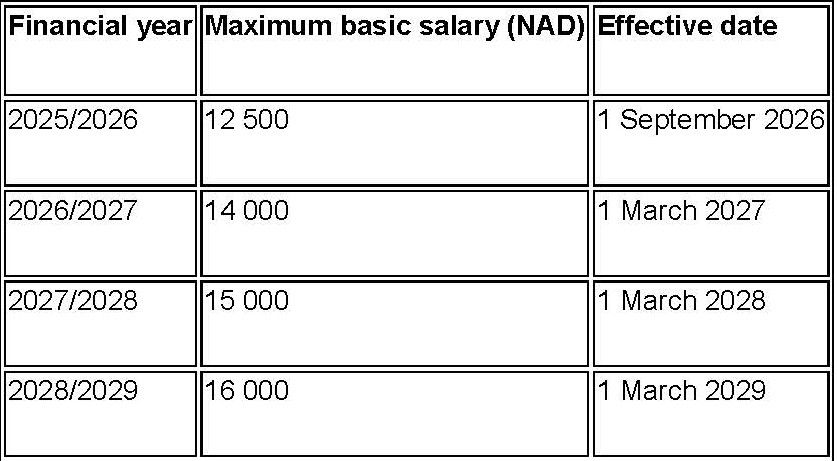
The SSC has confirmed that the amended contributions will not be applied retrospectively and requested that employers and employees update their records accordingly.
NAMIBIA & BOTSWANA: Authorised Economic Operator Mutual Recognition Arrangement launched
The Namibia Revenue Agency (“NamRA”) and the Botswana Unified Revenue Service (BURS) have launched the Authorised Economic Operator (“AEO”) Mutual Recognition Arrangement (“MRA”) pilot on 18 August 2026. The pilot aims to provide reciprocal recognition and enhanced customs facilitation for accredited AEO traders in Namibia and Botswana. The pilot phase will allow Namibia and Botswana to validate procedures and refine implementation processes ahead of the full implementation of the MRA, expected in April 2027.
Under the MRA, accredited AEO traders in Namibia and Botswana will receive customs facilitation benefits, including:
- Faster clearance of goods;
- Reduced inspections, where appropriate;
- Improved predictability; and
- Greater supply chain efficiency.
The AEO MRA forms part of the regional customs cooperation and trade facilitation under the Southern African Customs Union (SACU). The AEO programme is established under the World Customs Organization (WCO) SAFE Framework of Standards and provides trade facilitation benefits to compliant and trusted businesses.
NIGER: Draft ordinance amending 2026 Finance Law approved
At a meeting on 21 August 2026, the Council of Ministers has approved a draft ordinance amending Ordinance No. 2025-44 of 31 December 2025 enacting the Finance Law for the 2026 budget year. The general state budget is increased by 2% compared with the initial finance law, following the government reshuffle, additional security needs and higher crude oil prices.
NIGERIA: New guidelines for application, processing and issuance of advance tax rulings issued
On 31 August 2026, the Nigeria Revenue Service (“NRS”) issued Information Circular No. 2026/22, providing guidelines for the application, processing and issuance of advance rulings. The Guidelines set out the procedures, requirements and administrative framework governing advance rulings under sections 73 to 76 of the Nigeria Tax Administration Act, 2025 (“NTAA”).
The Guidelines aims to provide guidance on how taxpayers can request an advance ruling, specify the information required in an application, and clarify the circumstances under which the NRS may issue, reject, modify or withdraw an advance ruling. It also aims to explain the legal effect and validity of an advance ruling and provide administrative guidance for taxpayers.
NIGERIA: Supplementary production tax credits and profit oil reset for deep offshore oil and gas projects introduced
On 11 August 2026, the President signed the Deep Offshore Oil and Gas Projects Incentives (Tax Remission) Order, 2026, introducing a supplementary production tax credit and a Profit Oil Reset for qualifying deep offshore oil and gas projects, together with new eligibility, application, and local content requirements. The Order, which is effective from 6 August 2026, follows the Notice of Tax Incentives on Deep Offshore Oil and Gas Production 2024, and retains several of the production tax credit incentives introduced under the 2024 Order.
NIGERIA: Guidance on VAT withholding and administration issued
The NRS has issued the Guidelines on the Withholding of VAT to provide clarity on the implementation of the provisions relating to the withholding of VAT under the Nigeria Tax Act, 2025 (“NTA”), and Information Circular No. 2026/05 on the Clarification of the Changes in the Administration of VAT to clarify the provisions of VAT in line with relevant provisions of the NTA and the NTAA.
The Guidelines replace the earlier Information Circular No: 2023/14 of 29 December 2023, while the Circular replaces the FIRS Information Circular No. 2022/14 of 4 April 2022.
The Guidelines provide for:
- The appointment of persons as VAT withholding agents;
- Obligations of appointed VAT withholding agents;
- VAT withholding by federal, state and local governments and their ministries, departments and agencies;
- VAT withholding procedures and remittance requirements;
- VAT treatment of transactions between appointed withholding agents;
- VAT treatment of supplies by non-resident suppliers;
- Record-keeping requirements for VAT withholding agents;
- Correction of errors in VAT withholding schedules;
- Filing of VAT withholding returns;
- Treatment of VAT withheld by suppliers and entitlement to VAT credits and refunds; and
- Penalties for non-compliance.
The Circular provides for the:
- Determination of the place of taxable supply;
- General time of supply rules and special time of supply rules for connected persons, periodic supplies, progressive contracts, and instalment credit agreements;
- Valuation of taxable supplies, including supplies between connected persons and imported supplies;
- Treatment of input and output VAT;
- Appointment and obligations of VAT withholding agents;
- Implementation of the Electronic Fiscal System (EFS);
- Penalties for failure to comply with the fiscalisation requirements;
- VAT registration, filing and remittance obligations;
- VAT refund procedures; and
- Penalties for non-compliance with VAT obligations.
NIGERIA: Guidelines on the taxation of virtual assets issued
On 31 July 2026, through Information Circular No. 2026/21, the NRS issued Guidelines on the Taxation of Virtual Assets to establish an administrative framework for taxing virtual assets and transactions involving them. The circular does not specify a commencement date.
The Guidelines address:
- Asset classification;
- Applicable taxes;
- Valuation and computation;
- Collection and remittance;
- Taxpayer and virtual asset service provider (“VASP”) obligations; and
- Non-compliance.
The Guidelines apply to persons who:
- Acquire, dispose of, exchange or otherwise deal in virtual assets;
- Receive income or payments in virtual assets;
- Operate as VASPs or peer-to-peer (P2P) marketplace operators;
- Derive taxable income, profits or gains from virtual assets; or
- Provide virtual-asset services.
Key highlights of the Guidelines are as follows:
- Virtual assets are classified into six categories including:
- category 1: cryptocurrencies and exchange tokens;
- category 2: stablecoins and payment tokens;
- category 3: security and investment tokens;
- category 4: utility and governance tokens;
- category 5: non-fungible tokens (“NFTs”); and
- category 6: sovereign digital currencies;
- Gains from disposals of assets in categories 1–4 are subject to income tax, and eligible token transfers are subject to stamp duty;
- Tax treatment of NFTs depends on the transaction's economic substance and the holder's status as creator, investor or trader;
- A single transaction for virtual assets may generate more than one liability, including income tax, VAT and stamp duties;
- Resident individuals are liable to income tax on income, profits and gains from virtual-asset transactions, including disposal gains, employment income, professional and consultancy fees, business income, mining and staking rewards, decentralised-finance (DeFi) rewards, investment yield, liquidity-mining incentives, protocol rewards, royalties, taxable airdrops and hard-fork distributions, and other chargeable virtual-asset income;
- Resident individuals' income is recognised at the asset's fair market value (“FMV”) when the taxpayer acquires unrestricted ownership or control. Taxpayers must disclose the income in their annual returns and provide the prescribed supporting documents;
- An employer who remunerates an individual in virtual assets must report the quantity paid and their FMV in USD as of the payment date;
- Individual income tax on virtual asset income is imposed at the applicable progressive rates under the personal income tax regime;
- Companies are liable to income tax on profits from virtual-asset transactions, including profits from trading, exchange operations, transaction fees, brokerage, custody, wallet administration, token issuance, mining, staking, DeFi activities and investment gains;
- Non-residents deriving Nigerian income, profits or gains from virtual-asset activities are taxable under the NTA and NTAA. The significant economic presence and Nigerian-source income rules apply in the same way as they do to other taxable businesses;
- Companies, including VASPs, are subject to income tax at the applicable corporate rate of 30% on gains or profits derived from virtual-asset transactions, with the tax being self-assessed and paid in accordance with the filing and payment provisions of the NTA;
- Employment income paid in virtual assets is valued at its FMV and converted into naira at the applicable Central Bank of Nigeria/Nigerian Autonomous Foreign Exchange Market (CBN/NAFEM) rate on the payroll date;
- Professional fees received in virtual assets are valued at FMV, converted into naira at the transaction date's CBN/NAFEM rate, and remain subject to withholding tax and VAT where applicable;
- Mining, staking, DeFi and liquidity rewards and protocol incentives are taxable on receipt;
- The VAT rate specified for taxable VASP service fees is 7.5%;
- Non-resident VASPs supplying taxable digital services to persons in Nigeria must comply with the registration and compliance rules for non-resident suppliers. A resident company receiving the services must self-account for VAT if the non-resident supplier fails to charge it;
- Stamp duty at 1.5% applies to token-to-fiat and fiat-to-token transfers and must be withheld and remitted by the VASP or other recognised intermediary facilitating the transaction;
- the principal collection rates are as follows:
- 1% withholding tax on gross disposal proceeds deducted at source for categories 1, 3, and 5 assets, where applicable;
- no withholding tax on category 2 stablecoin disposals, with any gain reported by self-assessment;
- 10% withholding tax on staking, mining, airdrop and DeFi income; and
- 5% or 10% withholding tax on professional and consultancy fees;
- Gains and losses on virtual asset disposals are computed in US dollars and netted annually;
- Virtual-asset losses may be set off only against virtual asset gains;
- Capital losses may be carried forward indefinitely for use against future virtual asset gains;
- Persons engaged in virtual-asset activities are required to register for tax and obtain a tax identification number (TIN). In addition, VASPs and P2P marketplace operators must require a valid TIN for account activation and comply with withholding tax deduction, stamp duty collection, VAT accounting, return filing, tax remittance and record-keeping obligations; and
- Imposing of administrative penalties for non-compliance with tax registration, filing returns, record-keeping, withholding, remittance and tax-payment obligations, including specific penalties applicable to VASP or P2P marketplace operators.
NIGERIA: Guidelines on income tax and VAT refund claims issued
The NRS has issued Guidelines on Tax Refund(s) dated 28 June 2026. The Guidelines provide operational guidance on the conditions, procedures and requirements applicable to tax refunds under the NTAA and the NTA.
The Guidelines state that the legal basis for tax refunds is derived from sections 55 and 56 of the NTAA and section 155(2) of the NTA, which empower the NRS to process and pay refunds of excess or overpaid taxes in accordance with prescribed statutory conditions and timelines.
The Guidelines:
- Specify the circumstances under which a taxpayer may qualify for a refund, including:
- payment of tax in excess of the amount due;
- overpayment arising from assessment errors;
- double or erroneous tax payments;
- payments intended for another tax authority but paid into NRS accounts;
- withholding tax remitted at rates exceeding statutory rates; or
- payments intended for other government agencies but made to the NRS; and
- wrong remittances by banks, ministries, departments or agencies (“MDAs”) or taxpayers, and any other qualifying refund recognized by the NRS;
- Classify refund claims into three categories:
- refunds of excess tax arising from overpayment or excess payment of tax by a taxpayer. All claims under this category are subject to a tax refund audit to verify the correctness of the claim and the taxpayer's compliance with applicable tax laws. Approved refunds are payable only after all outstanding tax liabilities have been settled. Alternatively, the taxpayer may elect to set off the refund against existing tax liabilities;
- refunds to designated banks that have over-remitted tax collections into NRS accounts. The Guidelines identify four circumstances in which banks may apply for refunds, namely over-remittances, double or multiple remittances, wrong remittances of taxes intended for State Internal Revenue Services into NRS accounts and transposition errors resulting in incorrect remittance amounts. The Guidelines expressly prohibit designated banks from offsetting excess remittances against future tax collections, requiring a formal refund application instead; and
- other refund claims arising from payments wrongly made into NRS accounts by MDAs, corporate organizations, enterprises, non-governmental organizations or individuals. Such refunds are processed after verification that the payment was not due to the NRS or resulted from an error or overpayment;
- Provide that:
- refund applications may be submitted electronically through the NRS tax administration platform or manually by application addressed to the Executive Chairman of the NRS. Applications are required to contain the applicant's name and tax ID, the basis of the claim, the relevant tax type, the amount claimed, the relevant tax period, details of the underlying transaction, any other relevant information, and a signed declaration confirming that the claim is true, correct and complete in all material respects;
- refund applications must be accompanied by supporting documentation. In addition, claims must be submitted within six years of the end of the relevant year of assessment. Refund claims will not be processed unless the taxpayer has filed all outstanding tax returns;
- non-VAT tax refunds are to be settled within 90 days after the relevant tax authority reaches a decision on the claim. Instead of a cash payment, the approved refund may also be applied as a set-off against the taxpayer's outstanding tax liabilities;
- Specify the circumstances under which refund applications may be suspended or discontinued, including applications submitted by unauthorised persons, applications that omit the required declaration, applications that omit the supporting documentation, voluntarily withdrawn applications, exhaustion of withholding tax credit notes, and statute-barred claims;
- Empower the NRS to first recover any outstanding tax liabilities from the refundable amount, irrespective of the tax type that generated the refund. Any remaining balance is then paid to the taxpayer or applied as a credit against future tax liabilities;
- Establish a separate framework for VAT refunds, which provides that:
- VAT refund applications may be submitted electronically through the NRS tax administration platform or manually to the relevant Executive Director of the NRS and must contain details of the applicant, the basis of the claim, the amount claimed, the relevant transaction period, and supporting information;
- VAT refund applications must be submitted within 12 months of the date of the transaction giving rise to the claim. Failure to comply with this deadline results in forfeiture of the refund entitlement;
- Situations in which VAT refunds may arise include: cases where input VAT exceeds output VAT, where VAT was incurred on humanitarian donor-funded projects, where taxpayers cannot recover input VAT because output VAT has been deducted at source, errors or omissions resulting in excess VAT payments, and VAT paid on exempt or zero-rated items;
- Valid VAT refund requests are to be processed within 30 days of receipt. Within that period, the NRS must either refund the excess VAT or apply the refundable amount against any outstanding tax liability at the taxpayer's request;
- VAT refund applications are required to include a schedule of the refund claim, supporting documentation relating to zero-rated supplies where applicable, evidence of VAT remittance, NRS payment receipts, import duty documents where relevant, exemption certificates, and any other documents required by the Service;
- A person obtaining a VAT refund through a false or fictitious claim is liable to repay 100% of the VAT refunded together with interest at the prevailing Central Bank Monetary Policy Rate. Fraudulent claims involving other taxes attract repayment of 50% of the refunded amount, together with applicable interest. Other offences are subject to penalties prescribed under the relevant tax legislation.
REPUBLIC OF THE CONGO: Deadline for mandatory electronic tax payment set
Through Circular No. 1097/MFBPP/CAB, issued by the Ministry of Finance, Budget and Public Portfolio on 24 August 2026, the Republic of the Congo has set 1 October 2026 as the date from which all taxpayers under the large enterprises unit, medium enterprises unit and petroleum and gas subcontractors unit must file returns electronically through E-TAX. In addition, they must pay all taxes and duties, including those issued under recovery notices (avis de mise en recouvrement, AMR), exclusively through the FOUTA electronic platform (launched on 3 August 2026) under Ministerial Order No. 1009/MFBPP/CAB of 22 May 2026.
Until 30 September 2026, taxpayers within these units whose commercial banks are not yet connected to FOUTA may continue paying taxes through the single payment desk (Guichet Unique de Paiement, GUP), provided that they submit a written declaration confirming that they do not hold an account with a bank already connected to FOUTA. In addition, small and very small enterprises may continue using the GUP after 30 September 2026, but are encouraged to move to E-TAX and FOUTA.
REPUBLIC OF THE CONGO: Mandatory certified E-invoicing rollout commenced
Communiqué No. 07-8/MFBPP/DGID/P.SFEC of 30 July 2026 announced that on 1 August 2026, the Directorate General of Taxation and State Property (DGID) began the phased deployment of the certified electronic invoicing system (“SFEC”) pursuant to Decree No. 2026-101 of 31 March 2026.
The first phase covers large and medium-sized enterprises, oil and gas subcontractors, and all their service providers and suppliers, regardless of their size or tax residence.
Businesses that had not yet adapted their invoicing systems to the SFEC are required to take the necessary compliance measures without delay. Businesses unable to connect to the SFEC through an API on 1 August 2026 because they were migrating to new invoicing systems or awaiting the internal validation of their API keys may temporarily register on the e.facture online platform to issue certified electronic invoices.
Derogations from the requirement to use a certified electronic invoicing system may be granted only in the circumstances specified in article 29 of Decree No. 2026-101.
SIERRA LEONE: 2026 Supplementary Budget presented
On 31 July 2026, Sierra Leone presented the 2026 Supplementary Government Budget and Statement of Economic and Financial Policies proposing additional tax administration measures to be implemented during the second half of 2026.
Proposed measures intended to strengthen domestic revenue collection, improve tax compliance, modernise tax administration, and enhance customs enforcement include:
- Implementing the recommendations arising from the tax administration diagnostic assessment tool (TADAT), including integration of the integrated tax administration system (ITAS) with electronic cash registers (“ECRs”), commercial banks, and SICPA's product tracking system for excisable goods, and integration of the automated system for customs data (ASYCUDA) with SICPA's fuel marking system and commercial banks;
- Rolling out 10 000 additional ECRs to improve goods and services tax (GST) collection;
- Expediting implementation of GST on digital services with support from the African Tax Administration Forum (ATAF);
- Establishing and operationalising a revenue court to expedite the resolution of tax disputes and prosecution of tax evaders;
- Implementing the customs revenue enhancement plan, including the use of risk analysis data to conduct targeted post-clearance audits; and
- Modernising customs administration by implementing the national electronic single window and fully operationalising the end-to-end customs integrated processing platform by September 2026.
UGANDA: Tax Amendment Bills assented to
On 20 August 2026, the President assented to the Income Tax (Amendment) Bill, 2026 and the Excise Duty (Amendment) Bill, 2026. Significant amendments include:
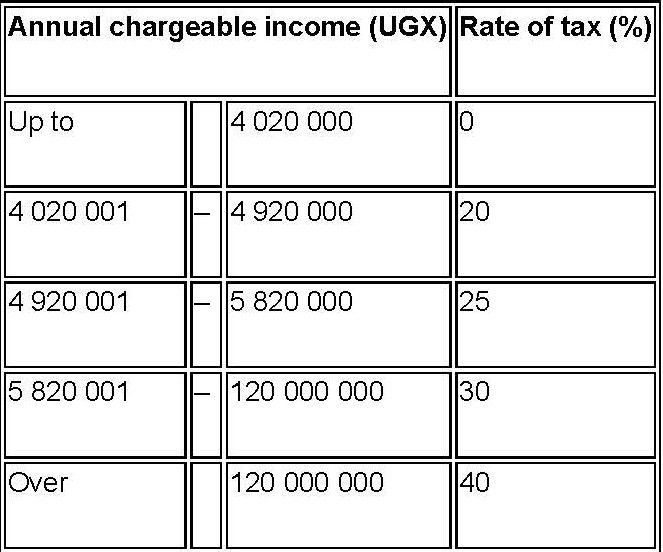
- Revising the income tax rates applicable to resident individuals by increasing the monthly tax-free threshold for employment income from UGX235 000 to UGX335 000 (equivalent to UGX4.02-million per annum). The individual income tax bands have also been revised as follows:
- Introducing withholding tax on:
- commissions paid by a telecommunication service provider for telecommunication retail services at a rate of 10%;
- public entertainer fees at a rate of 6%;
- winnings from gaming activities at a rate of 15%. This extends the scope of withholding tax on winnings solely derived from betting activities to those arising from gaming activities;
- interest paid by a resident company in respect of debentures to a non-resident company at a rate of 5% of the gross amount, provided that the debentures were issued by the company outside Uganda to raise a foreign loan, the debentures were widely issued to fund the company operations in Uganda, or the interest is paid outside Uganda to a bank or financial institution of a public character;
- Introducing withholding tax as a final tax on:
- payment of commission to an insurance agent;
- payment of a commission for telecommunication retail services, mobile network services or provision of mobile money services to resident individuals; and
- public entertainers;
- Excluding royalty payments from the scope of the digital service tax (DST), with royalty income derived by non-residents from Ugandan sources continuing to be subject to taxation under the ordinary withholding tax regime;
- Redefining “tax earnings before interest, tax, depreciation and amortisation” (“EBITDA”) for purposes of the interest limitation rules, excluding brought-forward tax losses from the calculation of deductible interest. EBITDA is defined as gross income less allowable deductions (excluding interest deductions), depreciation and amortisation;
- Expanding the list of institutions whose income is exempt from tax to include the Arab Bank for Economic Development in Africa (BADEA) and the Uganda Red Cross (URC);
- Introducing a requirement for a person who has entered into a controlled transaction(s) to account for the transaction(s) in a manner consistent with the arm's length principle. A controlled transaction in this case means a transaction between associates;
- Expanding the meaning of royalty to expressly include payments made as consideration for software; and
- Allowing a deduction for a bad debt in respect of business carried on by a microfinance deposit-taking institution, or tier 4 microfinance institution where it has taken all reasonable steps to pursue payment and which it reasonably believes will not be satisfied.
ZIMBABWE: Ratification Instrument for Convention and Protocol on Mutual Administrative Assistance in Tax Matters deposited
On 31 August 2026, Zimbabwe deposited its instrument of ratification for the multilateral Convention on Mutual Administrative Assistance in Tax Matters, as amended by the 2010 protocol. The convention and the amending protocol will enter into force three months after the instrument of ratification has been deposited.
The content of this article is intended to provide a general guide to the subject matter. Specialist advice should be sought about your specific circumstances.
[View Source]