

Empowerment and education are not just social goods; they are strategic tools for employers navigating digital acceleration, climate transition and fierce competition for talent. As the G20 prioritises inclusion, skills mobility and jobs of the future, employers in Africa can convert policy momentum into measurable workplace outcomes. Legal, Human Resources ("HR") and leadership teams can translate G20 ambitions into programmes that strengthen capability, advance equity and manage risk.
Why this matters now
Current G20 themes - education and skilling, MSME inclusion and gender equity, digital governance and the just transition - are shaping expectations. Access to capital, procurement and cross‑border markets is increasingly linked to evidence of fair work, investment in human capital and responsible technology deployment. Regulators, investors and unions expect demonstrable progress on pay equity, workplace dignity, safety and opportunities for youth and women. In this context, empowerment and education align compliance with long‑term value creation.
A parallel macro context is the intensifying debate on debt sustainability and the fiscal space available to fund education, health, gender equality and climate resilience. Civil‑society coalitions have criticised the pace and depth of G20 debt reforms and called for more decisive action on restructuring frameworks and creditor burden‑sharing. Emerging‑market debt has reached record levels, with many developing countries facing elevated borrowing costs that crowd out social investment and raise the cost of capital. For employers, these conditions translate into tighter public and private budgets, delayed payments in supply chains, and greater scrutiny of how employment practices contribute to inclusive growth. Navigating this environment strengthens the case for measurable empowerment and education initiatives that deliver productivity gains and social impact.
Build learning ecosystems that deliver
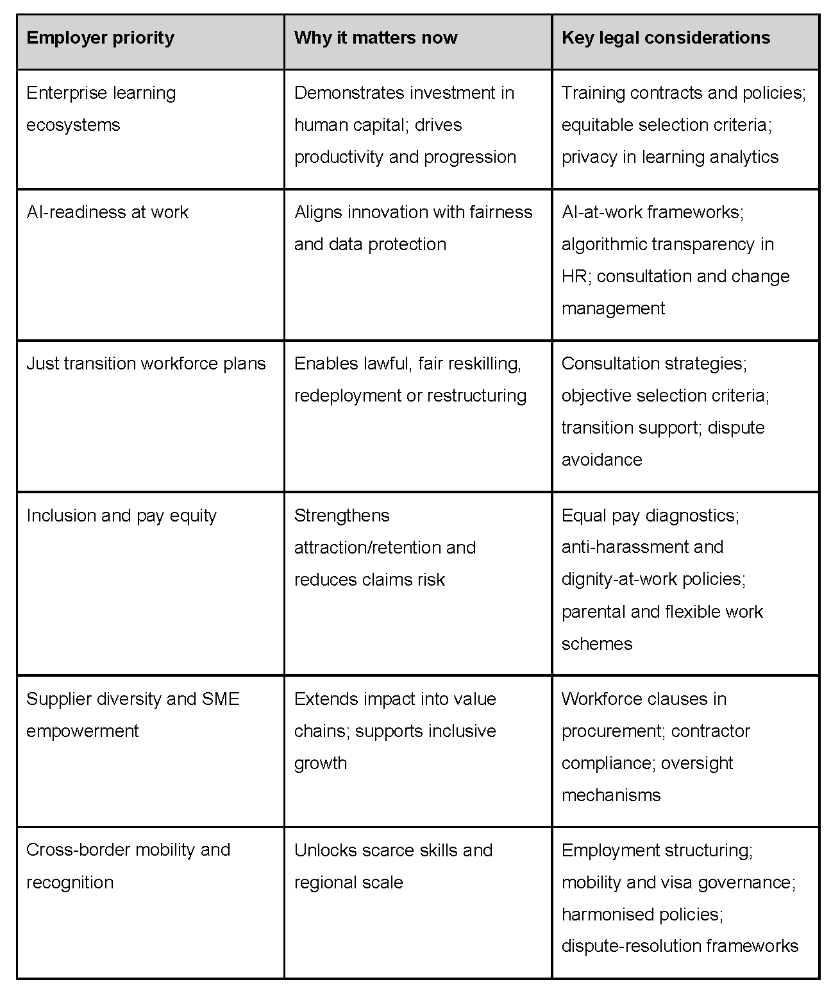
Empowerment begins with credible learning architecture. Employers are moving beyond ad‑hoc training to ecosystems that blend classroom, on‑the‑job and digital learning, anchored to competency frameworks and career pathways. Effective models integrate apprenticeships and learnerships for youth, recognition of prior learning for experienced workers, and targeted reskilling for roles most exposed to automation or decarbonisation. Cross‑border operations are prioritising recognition of qualifications to enable mobility, while ensuring local labour standards and social protections travel with workers. Key legal foundations include training contracts, bursary and study‑assistance schemes, data protection in learning analytics and fair selection criteria.
Equip for the digital and green transition
As AI, data‑driven workflows and automation reshape roles, employers should align technology adoption with workforce education and safeguards. Priorities include clear policies on AI at work, transparency in algorithmic decision‑making that touches hiring or performance, protection of employee data, and accessible training. The climate transition is likewise reconfiguring labour needs in energy, mining, manufacturing and logistics. Structured reskilling and redeployment, robust consultation, and fair severance or transition support where roles are sunset are essential. Practical steps include AI‑at‑work frameworks, data‑handling protocols and just‑transition labour plans that honour consultation duties.
Inclusion, dignity and decent work
Empowerment is inseparable from dignity at work. Gender equity, parental and carer support, anti‑harassment safeguards, disability inclusion and flexible work policies are central to attraction and retention. Pay‑equity assessments, transparent job architectures and fair performance management reduce litigation risk and build trust. Supplier diversity and inclusive procurement can extend empowerment into value chains by creating opportunities for SMEs and women‑led enterprises, while ensuring compliance with employment and procurement frameworks. Policies should align with local law, collective agreements and sectoral codes, with grievance mechanisms that resolve issues early and fairly.
Social dialogue and implementation
Education and empowerment strategies succeed when developed with, not only for, the workforce. Early engagement with unions, worker committees and health and safety representatives strengthens legitimacy. Employers benefit from documented consultation, impact assessments and clear change‑management communications that link business needs to worker opportunities. Where change affects terms and conditions or may lead to restructuring, legally sound procedures, objective selection criteria and mitigation plans are critical. Social dialogue structures should ensure consistency while respecting local statutory and collective frameworks.
Mobility, recognition and cross‑border work
The G20's focus on skills mobility and comparability of qualifications resonates across African markets and key partner corridors. Employers managing secondments, remote cross‑border work or regional centres must harmonise employment terms, benefits, data protection and health and safety standards, while navigating visas, right‑to‑work and host‑country triggers. In practice, which means careful selection of employment vehicles, compliant remuneration, portable learning credentials and clear dispute‑resolution forums. Coordinated, cross‑border governance is increasingly important as mobility and recognition policies evolve.
Turning policy into practice
Sector perspectives
Energy and resources: reskilling for clean‑energy operations and mine rehabilitation, with a premium on consultation and safety. Financial services and technology: AI training, fair automated decision‑making and cyber‑awareness, alongside refreshed job architectures and rewards. Healthcare and life sciences: acute skills shortages driving ethically managed international recruitment, credential recognition and safeguards against exploitation. Creative industries: professionalising models for employees and freelancers, building pathways for youth. Across sectors, accessible, credentialed education linked to progression is decisive.
Measuring impact
Strategies need metrics beyond training hours. Useful indicators include progression rates for under‑represented groups, redeployment success after reskilling, employee‑experience signals such as psychological safety, and dispute incidence. Transparent reporting builds confidence and can unlock financing or market access linked to social performance. Measurement frameworks should reflect local legal requirements and international norms, with attention to confidentiality and data protection. In debt‑constrained environments, it is also useful to track leading indicators such as supplier payment lags, cost of capital trends, and budget pressures that could affect headcount, pay progression and training capacity, so that mitigation plans can implemented proactively.
Where legal input helps
Employment strategies aligned with G20 priorities tend to succeed when the legal architecture is robust: policies and agreements that withstand scrutiny, well‑documented consultation, privacy‑respecting data practices, and compliant cross‑border arrangements. Strong legal foundations help convert intent into durable programmes that uplift people and performance.
The content of this article is intended to provide a general guide to the subject matter. Specialist advice should be sought about your specific circumstances.
