

Corporate authority, sponsorship and the limits of secondment: the structuring question that arises for groups entering the Kingdom through a UAE regional company.
01 Background
Foreign groups expanding into the Gulf commonly establish a regional com-pany in the UAE and enter Saudi Arabia through it. Where a joint venture is then formed in the Kingdom with a local partner, it is frequently proposed that the group’s UAE-based regional or country manager be appointed Gen-eral Manager or Managing Director of the joint venture, reporting to the board and holding authority to sign and commit the company. The analysis applies wherever the employer sits outside the Kingdom.
The question that follows is whether that individual must be employed dir-ectly by the Saudi joint venture, or whether the existing UAE employment can be preserved and the individual seconded into the Kingdom. The answer engages Saudi corporate law, Saudi employment and immigration law, and the tax position in both jurisdictions. Those regimes do not give the same answer, and the distinction between them is the source of most of the difficulty encountered in practice.
02 Corporate appointment does not require an employment relationship
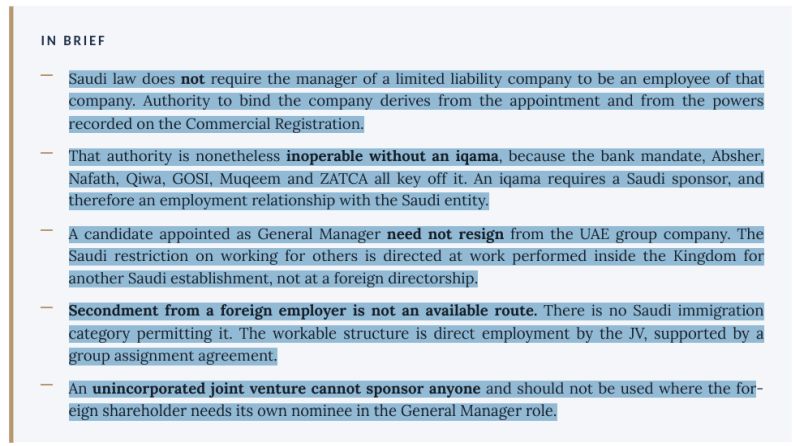
The Saudi Companies Law does not require the manager of a limited liability company to be an employee of the company. The manager’s authority to bind the company arises from the appointment itself and from the powers recor-ded on the Commercial Registration. No employment relationship is needed for the appointment to be valid or for the recorded powers to be effective as a matter of corporate law.
03 Operational capacity requires an iqama, and an iqama requires a sponsor
The corporate position does not determine the practical one. The bank man-date, Absher, Nafath, Qiwa, GOSI, Muqeem and ZATCA all operate by refer-ence to the iqama. A General Manager without an iqama cannot transact through any of them.
An iqama requires a Saudi sponsor. In practice this means an employer, a Qiwa employment contract, a work permit, GOSI registration, and salary paid by the Saudi entity through Mudad. Premium Residency is the single excep-tion to the sponsorship requirement, but it confers no advantage once the individual is on the joint venture’s payroll.
The practical conclusion is therefore the opposite of the strict legal one: although employment is not legally required for the appointment, the indi-vidual must be employed by the joint venture in order to perform the role.
04 The UAE role may be retained
Resignation from the UAE group company is not required. The Saudi restric-tion on working for others is directed at work performed inside the Kingdom for another Saudi establishment. It is not directed at a foreign directorship. The individual may hold both residencies and remain a director of the UAE company.
Two exposures then require active management rather than tolerance:
Conflicts of interest. The individual will sit on both sides of the relationship between the joint venture and one of its shareholders. This should be addressed by a standing partner authorisation together with related-party approval thresholds recorded in the articles of association and in the joint venture agreement.
Permanent establishment. The individual’s UAE signing authority should pass to a person resident in the UAE, and the individual should not conclude UAE company business from inside the Kingdom. This step should be completed before relocation, not after.
05 Secondment from a foreign employer is not available
There is no Saudi immigration route permitting a foreign employer to second staff into the Kingdom.
The structure that does work is a dual one. The individual is employed by the joint venture for Saudi purposes. Behind that, a group assignment agreement between the UAE company and the joint venture addresses cost, continuity of service and return rights.
Three limits apply to that agreement:
- It cannot reduce the individual’s Saudi statutory
- The Qiwa wage must be paid in full by the joint
- If the UAE company pays the individual and recharges the cost, the joint venture’s payment to the UAE company attracts withholding tax and reverse-charge VAT.
For that reason the joint venture should carry the salary directly.
06 Unincorporated joint ventures
An unincorporated joint venture has no legal personality, no Commercial Registration, and no capacity to sponsor. The individual would have to be employed by the local partner’s company or by another Saudi entity within the group, with authority conferred by power of attorney.
That structure preserves the immigration constraint, weakens the authority position, and places control of the foreign shareholder’s own nominee in the hands of the local partner. Where the foreign shareholder requires its own nominee as General Manager, the joint venture should be incorporated as a limited liability company or a simplified joint stock company.
07 Action points
Before the appointee commences in role:
Record the powers and their limits on the Commercial Registration. Establish dual bank signatories above an agreed threshold.
Provide for removal of the General Manager as a reserved matter in the joint venture agreement, mirrored in the articles of association.
Put indemnity arrangements and D&O cover in place. Personal exposure attaching to the registered manager does not cease on his ceasing to act.
Complete the transfer of UAE signing authority before relocation.
The content of this article is intended to provide a general guide to the subject matter. Specialist advice should be sought about your specific circumstances.
