

Automated vehicles are revolutionizing our mobility, presenting insurers and vehicle manufacturers with a pivotal question: Who will be held liable in the event of a claim?
Vehicle Keeper and their Liability Insurance
Under current law, the keeper of an automated vehicle remains the central liable party. Their liability stems from Art. 58 of the Road Traffic Act (RTA). According to this provision, the vehicle keeper is strictly liable for personal injury and property damage caused by the operation of the motor vehicle.
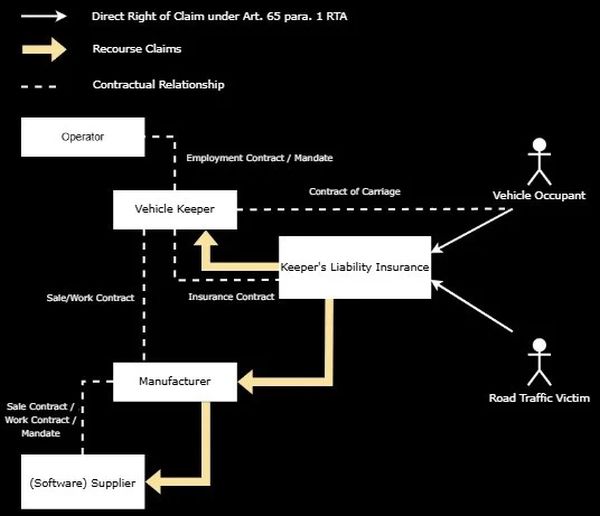
Pursuant to the RTA, there is a compulsory insurance requirement for motor vehicles used in public traffic (Art. 63 para. 1 RTA). An injured third party (e.g., a road traffic victim) can bring a claim against the vehicle keeper or directly against their insurer (Art. 65 para. 1 RTA). Typically, the road traffic victim (or their own property damage insurer) will proceed against the keeper's solvent liability insurer.
The vehicle keeper's liability insurer is jointly and severally liable with third parties who are liable to the injured party under contract, law, or tort (Art. 51 Code of Obligations [CO]). Once the insurer has settled the claim, it has two recourse options:
- Recourse against the keeper: This is possible if the damage is attributable to a breach of duty by the keeper (Art. 65 para. 3 RTA).
- Recourse against third parties: The liability insurer can also proceed against the vehicle manufacturer and its suppliers, who are liable under product liability law (Product Liability Act [PrLA]), employer's liability (Art. 55 CO), and tort law (Art. 41 CO) (cf. regulation on joint and several liability, Art. 149 para. 1 CO). In the relationship between the liability insurer and the manufacturer, the liability insurer subrogates to the legal position of the insured vehicle keeper. Consequently, the insurer can also assert the vehicle keeper's contractual claims against the vehicle manufacturer (or the counterparty to the sale/work contract) (Art. 95c para. 2 Insurance Contract Act [ICA]). This is particularly relevant for damage to the defective vehicle itself, which is not covered by product liability law and must be claimed through contractual warranty rights.
Vehicle Occupant
Driverless vehicles, as defined by the Ordinance on Automated Driving (OAD), are, as the name suggests, designed for operation without a driver. The vehicle occupant is not required to take control. They are therefore not liable for damage caused by the vehicle. If they suffer damage themselves, they can submit their claims directly to the keeper's liability insurer. If the automated vehicle is operated by a transport company, the vehicle occupant may be able to assert claims under a contract of carriage.
Vehicle Manufacturer
With increasing automation and the growing control of vehicles by automation systems, the liability of drivers will increasingly fade into the background, while the liability of manufacturers is likely to gain importance (cf. Dispatch on the amendment of the RTA, BBl 2021 3026, p. 40). In the future, other parties such as importers and garages could be interposed between the vehicle keeper and the manufacturer. For the sake of clarity, these are not considered in this article. The future development, particularly in the private use of driverless vehicles, remains to be seen.
The manufacturer's liability is primarily based on the PrLA. The manufacturer is liable for damage caused by a defective product (Art. 1 in conjunction with Art. 4 para. 1 PrLA). A product is considered defective if it does not provide the safety that a person is entitled to expect. Under the PrLA, the vehicle manufacturer, its suppliers (manufacturers of a component part), and importers are to be qualified as manufacturers.
However, product liability law does not grant claims for damage to the defective vehicle itself. Furthermore, the vehicle manufacturer is not liable under the PrLA for damage to commercially used property or for pure financial losses. The vehicle keeper or other injured parties must therefore assert such claims on other grounds:
- In the current use of driverless vehicles, such as in pilot projects, the manufacturer usually has a contractual relationship with the vehicle keeper (e.g., a sale or work contract). Warranty claims may arise from this. Separate quality assurance agreements that guarantee the proper functioning of the automated vehicles are also conceivable.
- Persons who suffer personal injury or property damage due to a defective vehicle can also assert claims against the vehicle manufacturer based on employer's liability (Art. 55 CO) or tort law (Art. 41 CO).
Technical Supplier
If suppliers are also responsible for damage alongside the vehicle manufacturer, they are jointly and severally liable to the injured party (Art. 2 para. 1 lit. a in conjunction with Art. 7 PrLA). The Product Liability Act does not provide specific rules for recourse between the manufacturer of the final product and the manufacturer of a component part. The general provisions of the Code of Obligations apply (Art. 50 para. 2 and Art. 51 CO).
A supplier's liability is established if a component supplied by them has a defect within the final product and this defect causes personal injury or property damage.
In the context of automated vehicles, manufacturers of cameras, sensors, radar-, and lidar-systems, for example, are to be classified as classic suppliers within the meaning of the PrLA. According to the revised EU Product Liability Directive (Art. 4 No. 1) and the prevailing doctrine in Switzerland, software is also considered a product, meaning its manufacturers fall under the PrLA.
If a software becomes defective after market launch due to an over-the-air update deployed by the software supplier, the software supplier is responsible under the PrLA for any resulting property damage and personal injury.
The extent to which liability for software errors or for errors during the installation of updates is regulated between the vehicle manufacturer and the software supplier depends primarily on their contractual agreements (quality assurance agreement, exclusion and limitation of liability, assumption of risk).
Operator
The operator is a new figure in road traffic law. They monitor driverless vehicles, interact with them, and communicate with the vehicle occupants if necessary (Art. 34 para. 2 OAD). Since the law does not provide for special civil liability for the operator and they will often be in an employment relationship with the keeper, their culpable conduct could be attributed to the keeper as an associate.
Claims and Recourse Chain: An Overview
Injured parties typically turn directly to the vehicle keeper's liability insurer. The insurer, in turn, examines recourse against the keeper or the manufacturer. The manufacturer, in turn, can take recourse against its suppliers.
Criminal Liability
When an automation system takes over the driving task, the criminal responsibility of the driver is eliminated. Instead, the keeper, the operator, the manufacturer, and its suppliers come into focus.
- The latter two actors are typically legal entities whose criminal liability could be governed by Art. 102 of the Swiss Criminal Code (SCC). Such corporate liability applies subsidiarily if a criminal offence cannot be attributed to a specific natural person due to the company's inadequate organisation.
- Certain criminal provisions of the RTA are of significant importance in the use of vehicles with automation systems. For example, the impairment of a vehicle's operational safety (Art. 93 RTA).
- The criminal liability of the operator is governed by the specifically created criminal provision in the OAD (Art. 49 para. 3 OAD). Some criminal provisions of the RTA are also applicable to operators, e.g., the violation of traffic rules under Art. 90 RTA or improper conduct in accidents under Art. 92 RTA.
Evidentiary Problems
For assessing criminal and civil liability, it is crucial that specific events in the automated vehicle can be reconstructed after an accident. Consequently, it is prescribed that vehicles equipped with an automated driving system must have a data storage system for automated driving (DSSAD). The requirements for this data storage system are detailed in Art. 25e and 25f RTA and in Art. 7 OAD.
What does this liability regulation mean for "the taxi and the red light"?
Click here for the fictional case study.
- Linda Pünktlich and the injured Mr Grünlich will assert their civil claims against the liability insurer of the vehicle keeper (Innovate Mobility AG).
- The insurer will examine recourse options against the keeper (including the operator), the manufacturer (Sentinel Motors Corp.), and the software supplier (CodeDrive Solutions Inc.). By analysing the data from the mandatory DSSAD, it becomes clear that the accident occurred due to a defectively programmed software update, which was duly installed by the vehicle keeper before the journey. The liability insurer will assert claims based on product liability law (cf. Art. 149 para. 1 CO) and the contractual relationship between the keeper and the manufacturer (cf. Art. 95c para. 2 ICA). The manufacturer and the software supplier are jointly and severally liable to the insurer. In the internal relationship, the manufacturer will take recourse against the supplier.
- CodeDrive Solutions Inc. could have committed assault through negligence under Art. 125 SCC against Mr Grünlich. If a criminal act or omission cannot be attributed to any natural person within the software supplier's company, the legal entity is liable under Art. 102 SCC. Mr Grünlich waives the right to file a criminal complaint, so the offence of assault through negligence will not be prosecuted.
You will learn about the data protection regulations applicable to automated driving and their impact on the fictional case study in the next post of our blog series.
Key Takeaways
- Even with automated (driverless) vehicles, the compensation of traffic victims is ensured by the direct right of claim against the vehicle keeper's liability insurer as provided for in the RTA.
- The liability of the driver is losing importance due to the automation of the driving process, while vehicle manufacturers are increasingly becoming the focus of recourse claims.
- Liability insurers have various legal bases for recourse available to them, which they are entitled to under Art. 51 para. 1 CO in conjunction with Art. 149 para. 1 CO or Art. 95c para. 2 ICA. In particular, product liability law and the contractual relationships between the keeper and the manufacturer should be mentioned here. The analysis of the DSSAD will be decisive for asserting these recourse claims.
You can find out more about this at our event "Autonomous
driving – navigating the legal complexities":
https://lunchandlearn2026.events.vischer.com/
The content of this article is intended to provide a general guide to the subject matter. Specialist advice should be sought about your specific circumstances.
