

On 23rd July 2026, Dangote Petroleum Refinery announced completion of approximately US$2.5 billion of new equity through private placement subscribed 3.7 times1. An exceptional outlier by scale and disclosure-most Nigerian private capital transactions operate under vastly different structures and disclosure regimes-the transaction is not representative of the market. But it is useful in framing the market question.
Capital can enter Nigeria at exceptional scale. The harder questions are whether it can stay, perform, and return. This is not a question of capital availability. It is a question of execution-and execution is determined by legal structure, regulatory clarity, transaction architecture, and the final measure: how much operating value created actually reaches investors as distributions.
In this article, Folake Elias-Adebowale, Precious David and Solomon Adegboyo of Udo Udoma & Belo Osagie separate the components of that journey. They distinguish publicly available deal activity from disclosed deployment value; deployment value from fund performance; fund performance from investor distributions. And they examine how legal frameworks, regulatory approvals, exit mechanics, and transaction execution determine the outcome: operating performance may create value, but market access determines price, while legal and transaction architecture determine how much of that value reaches investors.
One market, three readings
For legal and regulatory analysis, the first discipline is to separate activity data from performance evidence: deal activity indicates volume; disclosed value indicates deployment; and fund performance turns on IRR, TVPI, DPI, yield, defaults, recoveries, and distributions. Even then, a valuation gain is not the same as cash returned to LPs. Realisation depends on exit route, tax, currency conversion, settlement mechanics, and the amount ultimately distributed.

The distinction matters because deal count is not deployment value, deployment value is not fund performance, and a paper gain is not an LP distribution. The available evidence supports conclusions about the direction of Nigerian private capital, the growing use of credit, and the improving exit count. It does not support a market-wide claim that PE, VC, or private debt has generated the highest comparable net return.
While individual asset classes have dedicated metrics, like equities, fixed income, real estate, and private capital, Nigeria still lacks a comprehensive unified multi-asset public benchmark capable of directly comparing PE and VC fund performance and returns with private credit returns and losses or across diverse asset classes. Existing tracking is siloed into separate market-specific gauges, such as the NGX All-Share Index for equities or FMDQ benchmarks for fixed income.
Liquidity remains uneven. McKinsey estimates2 that more than 16,000 buyout-backed companies had been held for more than four years by the end of 2025, while average holding periods exceeded six and a half years. AVCA recorded 81 African exits in 2025 and 25 in Q1 20263. At the same time, 27% of AVCA surveyed LPs expected to slow commitments during 2026, although 87% planned to maintain or increase allocations over three years4. In other words, short-term pacing is cautious, but medium-term conviction has not disappeared. The harder task is converting that conviction into cash distributions.
Debt is gaining ground, but equity still carries the weight
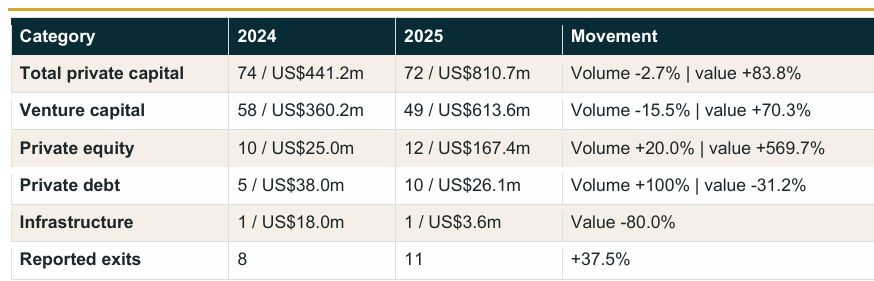
Source: AVCA, African Private Capital Research for UUBO, 8 May 2026. Disclosed values only; activity data, not fund performance data. Publication consent confirmed.
AVCA customised research records 72 Nigerian private capital transactions in 2025, flat versus 74 in 2024. Yet disclosed value surged 84% to US$810.7 million. Venture capital dominated with 49 deals worth US$613.6 million (76% of value); private equity recorded 12 transactions totaling US$167.4 million; private debt doubled in deal count to 10, but fell in value to US$26.1 million.
Venture capital remained the centre of gravity: 49 transactions worth US$613.6 million, approximately 68% of volume and 76% of disclosed value. Private equity recorded 12 transactions worth US$167.4 million, about 17% of volume and 21% of value. Private debt doubled from five to ten transactions, but disclosed value fell from US$38.0 million to US$26.1 million - approximately 14% of deal count and only 3.2% of disclosed value. One infrastructure transaction worth US$3.6 million completes the 2025 total.5
For sponsors and lenders, the point is less about substitution and more about structuring. Deal count doubled, but debt represented only 3.2% of disclosed value, while VC and PE together carried approximately 96.3%. Private credit is becoming more available for working capital, acquisition finance, receivables, infrastructure, venture debt, and portfolio company refinancings. It gives sponsors and companies another instrument to use, but it does not remove the need for equity risk capital. Credit is broadening the toolkit; but equity still absorbs uncertainty and participates in long-term upside.
Capital is back - and carry-sensitive
The regulatory question is not only whether capital enters Nigeria, but whether it can be converted, serviced, protected, and repatriated. For foreign investors and Nigerian borrowers, that analysis turns on capital importation documentation, FX access, debt service capacity, withholding tax, enforceability of security, transfer restrictions, and repatriation mechanics. Nigeria attracted US$10.37 billion of capital importation in Q1 2026, up 83.83% year on year, but 95.09% was portfolio investment and only 1.30% was FDI. These are not private capital deployment figures. They show that confidence returned first to liquid instruments.
With the MPR at 26.5% in July and headline inflation at 15.91% in June,6 investors and borrowers are now dealing with a familiar set of practical questions: carry, cost and reversibility. High rates attract yield, but they also raise borrower costs; currency stability can reverse; and hard-currency debt against naira revenue remains a structural mismatch.7 Diligence therefore has to look beyond today's exchange rate and test what happens to cash flow, covenants and distributions if rates, inflation, reserves or global risk appetite move.
The path from value to cash
In legal terms, an exit is not simply a valuation event; it is an execution process. Nigeria recorded 11 exits in 2025, up from eight in 2024 and the highest annual total in AVCA's 2021-2025 Nigeria series.8 The routes comprised three trade sales; two sales to PE firms or other financial buyers; two management buyouts or private sales; two IPO or capital markets exits; one other exit; and one write-off. Across the five-year series, trade buyers accounted for 17 of 36 exits.
In practice, negotiated exits need more than buyer interest. They require clean data, transferable licences and contracts, required consents, tax planning, security releases or transfers, workable settlement mechanics, and a route for moving proceeds. Counsel also need to test change-of-control approvals, pre emption and drag rights, completion accounts or locked-box mechanics, foreign exchange documentation, capital gains tax treatment, and the enforceability of indemnities. Legal documents do not create enterprise value, but they often determine whether value already created can move to investors without avoidable leakage or delay.
The approximately US$285 million secured facilities supporting BlueCore Gas Infraco's acquisition of the owner of Axxela illustrate the hand-off.9 An ownership transfer and equity realisation were enabled by acquisition finance. The facilities are not automatically 'private credit' merely because they were privately negotiated; they show how equity, strategic ownership and debt can operate within the same exit.
Tax and domestic capital are changing the return model
The Nigeria Tax Act 2025 took effect on 1st January 2026. For companies, following the alignment of capital gains tax with the companies’ income tax framework, chargeable gains are generally taxed at 30%, rather than the former 10% under the Capital Gains Tax Act, subject to the statutory exemptions and reliefs. The Nigeria Tax Act also brings specified indirect transfers involving offshore holding structures within the Nigerian tax scope, subject to the applicable statutory nexus and treaty position.

Simplified, fully taxable corporate gain: retained gain falls by 22.2%. Actual outcomes vary.
Tax now sits inside the exit model. For a simplified fully taxable capital gain, assuming no exemption, relief, deductible loss or treaty protection, the move from 10% to 30% reduces the retained gain from ₦90 to ₦70 for every ₦100 of chargeable gain - a 22.2% reduction. 10 This is not every transaction's result, but it is large enough to influence price, structure, escrow, indemnities and the choice between direct and indirect exit. UUBO has separately analysed the new tax and compliance framework for collective investment schemes.
Nigeria also has a substantial domestic pool that remains lightly allocated to alternatives. PenCom reported ₦31.323 trillion in pension assets at 31 May 2026, of which ₦258.335 billion - approximately 0.82% - was invested in private equity and ₦317.605 billion - approximately 1.01% - in infrastructure funds. Relevant fund categories may invest up to 15% or 10% in PE, subject to detailed limits and conditions.11 PenCom's March 2026 addendum identified a shortage of qualifying alternative asset instruments as a reason for underused limits and excess liquidity.

Selected requirements only; managers must test the full PenCom regulation and applicable fund-category limits.
The issue is not only the availability of capital; it is product qualification. Relevant requirements include a clear strategy, audited information, pre-defined exit routes, experienced SEC-registered management, prior exit experience and prescribed manager commitment.12 The capital exists, but managers still need to build instruments that qualify for it. These points should be dealt with at fund design stage because they affect governance, reporting, economics and fundraising from the outset.
Four sector signals, one practical investment test
Fintech: Nigeria processed approximately ₦1.07 quadrillion across 11.2 billion electronic-payment transactions in 2024.13 Capital implication: the market is moving beyond customer acquisition towards payments rails, switching, identity, embedded finance, cross-border settlement, profitability and consolidation. Execution test: licensing, data governance, technology ownership, fraud controls and a cap table that can support the next round or strategic sale. UUBO's public work on Flutterwave's US$250 million Series D and the proposed acquisition of Baxi by MFS Africa illustrates the progression from scale up capital to strategic consolidation.14
Banking and insurance: The banking recapitalisation programme mobilised ₦4.65 trillion through the Nigerian capital market.15 In insurance, the available capital-management routes include strategic investment, M&A, portfolio transfers and licence rationalisation. Capital implication: rights issues, private placements, strategic minority investment and ownership consolidation. Execution test: whether capital is admissible for regulatory purposes, change-of-control and fit-and-proper approvals are secured, and integration preserves the value bought. UUBO's work on emPLE's acquisition of Old Mutual's Nigerian insurance businesses is one public example.16
Gas and energy: Nigeria held 215.19 TCF of gas reserves at 1st January 2026. Capital implication: reserves become financeable only when production, processing, transport, and offtake are connected by bankable contracts. Execution test: supply rights, pipeline access, tariffs, payment security, environmental allocation, currency, and enforceable cash waterfalls. The Axxela financing shows how acquisition debt can support a change of ownership in operating gas infrastructure.17
Infrastructure and specialised credit: Long-life assets continue to face tenor, construction, and currency gaps. Capital implication: the stack may combine sponsor equity, DFI capital, specialised debt, bank finance, guarantees, and refinancing. Execution test: who bears completion, demand, payment, and regulatory risk, and whether the allocation survives stress. UUBO's publicised work on ARM Investment Managers' ₦200 billion private debt programme and a US$15 million senior secured Afrigreen facility for Westa Solar illustrates two distinct non-bank credit models.18
Across regulated sectors, investability depends on the legal and regulatory conditions that turn revenue potential into bankable cash flow. The most credible cases are regulated platforms with reliable cash flow, institutional governance, clear licence status, enforceable contracts, credible approval pathways, and a practical route to liquidity.
Different capital for different parts of the relay
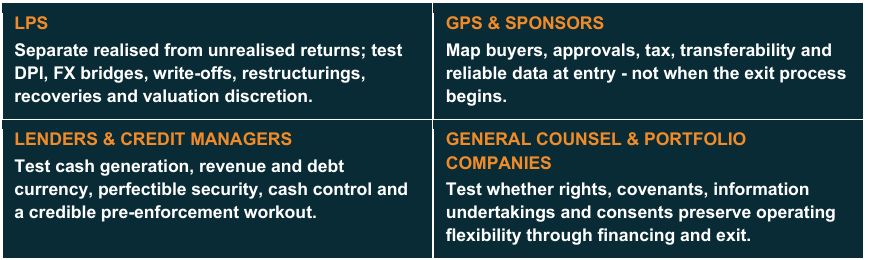
Complementary capital, not a replacement cycle
The practical implications are different for each participant. LPs should separate realised from unrealised performance. Sponsors should map buyers, approvals, tax, and transferability at entry, not only when exit discussions begin. Credit managers should test cash generation, currency mismatch, perfectible security, and pre-enforcement workouts. Portfolio companies should ask whether rights, covenants, and information undertakings preserve enough operating flexibility.
Nigeria is not rotating wholesale from equity into debt. Equity still absorbs uncertainty and creates upside; credit can provide contractual cash flow, priority and earlier recycling where the underlying business can carry it. VC will remain essential for formation and technology-enabled scale. PE will remain central to growth, control and consolidation. Private credit should continue to expand where borrowers need flexible or longer-tenor finance and investors seek contractual income and clearer priority.
The test for the next phase is simple: capital inflow matters, but the more durable question is how much of that capital can stay in the business, perform through the cycle and return to investors.
Footnotes
1 Dangote Petroleum Refinery completion reported by Oil & Gas Journal. Note: The SEC's 23rd June 2026 action against unauthorised IPO marketing (directing operators to cease publicity, remove materials, and refund monies) was distinct from the subsequent private placement, which the SEC did not characterise as misconduct.
2 McKinsey, Global Private Equity Report 2026.
3 AVCA, African Private Capital customised member research for UUBO, 8 May 2026. Custom Nigeria deal and exit data for 2021-2025; activity data dependent on disclosure.
4 AVCA, 2025 African Private Capital Activity Report; Q1 2026 Private Capital in Africa Report; 2026 Investors Sentiment & Outlook.
5 Ibid.
6Central Bank of Nigeria, Monetary Policy Decisions, 20-21 July 2026.
7 National Bureau of Statistics, June 2026 CPI Report and current inflation dashboard.
8 AVCA, African Private Capital customised member research for UUBO, 8 May 2026. Custom Nigeria deal and exit data for 2021-2025; activity data dependent on disclosure. AVCA consent to publication confirmed.
9 UUBO public transaction announcements: Flutterwave Series D; Baxi/MFS Africa; emPLE/Old Mutual; ARM private debt programme; Afrigreen/Westa Solar; BlueCore/Axxela.
10 PwC, The Nigerian Tax Reform Acts; Federal Ministry of Finance, Transition Guidelines for Tax Acts 2025; UUBO, Tax Treatment of Collective Investment Schemes under the NTA and NTAA.
11 National Pension Commission, Monthly Report - May 2026; Revised Regulation on Investment of Pension Fund Assets; March 2026 Addendum.
12 Ibid.
13 NIBSS, Nigeria’s Payment Revolution: How NIBSS, CBN Are Building Africa’s Most Robust Digital Infrastructure
14 UUBO public transaction announcements: Flutterwave Series D; Baxi/MFS Africa; emPLE/Old Mutual; ARM private debt programme; Afrigreen/Westa Solar; BlueCore/Axxela.
15 Securities and Exchange Commission Nigeria, Successful ₦4.65 Trillion Banking Recapitalisation.
16 UUBO public transaction announcements: Flutterwave Series D; Baxi/MFS Africa; emPLE/Old Mutual; ARM private debt programme; Afrigreen/Westa Solar; BlueCore/Axxela.
17 NUPRC, National Annual Petroleum Reserves Position as at 1st January 2026.
18 UUBO public transaction announcements: Flutterwave Series D; Baxi/MFS Africa; emPLE/Old Mutual; ARM private debt programme; Afrigreen/Westa Solar; BlueCore/Axxela.
The content of this article is intended to provide a general guide to the subject matter. Specialist advice should be sought about your specific circumstances.
[View Source]

