
Let us examine how biological damage is calculated, which medical-legal tables and criteria apply, and why the medico-legal assessment is the key to obtaining a correct and comprehensive evaluation of the damage.
Suffering a road traffic accident, a workplace injury, or a case of medical malpractice can profoundly alter one's life.
In such circumstances, Italian law recognises the right to compensation for biological damage, namely the injury to a person's physical or psychological integrity.
But how is this compensation actually calculated in practice? What criteria are used, and what differences exist between temporary and permanent disability?
What is biological damage
Biological damage refers to the injury (temporary or permanent) to an individual's psycho-physical integrity, which is susceptible to medico-legal assessment.
It represents an impairment of health (both physical and psychological) that affects the person's normal vital activities.
Compensation is granted because the damage concerns health, which is protected under Article 32 of the Italian Constitution, and may arise from events such as road accidents, occupational injuries, or medical malpractice.
Main features of biological damage
For an injury to physical integrity to be legally defined as biological damage, it must meet the following characteristics:
- Impairment of Health. This includes both
physical injuries (e.g. fractures, wounds, disabilities) and
psychological ones (e.g. anxiety, depression, post-traumatic stress
disorder).
It must be demonstrable through medical-psychological expert reports. - Medico-Legal Assessment. The existence and extent of the damage must be proven through medical documentation, specialist examinations, and specific tests, which in some cases lead to the determination of a percentage of disability.
- Causal Link. It is essential to demonstrate the existence of a direct causal connection (nesso causale) between the harmful event (e.g. road accident, workplace injury, case of malpractice, etc.) and the injury sustained.
The law provides, in the case of biological damage:
Autonomy from pecuniary damage. Unlike pecuniary (economic) damage, which relates to financial loss such as loss of earning capacity, biological damage focuses on the harm to health per se.
Independence from Income. Compensation for biological damage is therefore due even to those without employment income (such as minors, homemakers, or pensioners), since the right to health is constitutionally protected and independent of working capacity.
Compensability.The right to compensation for this type of damage always exists.
In cases of workplace injuries, compensation is provided by INAIL (the National Institute for Insurance against Occupational Accidents), which pays an indemnity varying according to the seriousness of the injury.
Examples of biological damage
- Physical injuries such as fractures or wounds
- Loss of a limb
- Psychological harm such as anxiety, stress, or depression
- Aesthetic alterations such as scarring
- Loss or reduction of functional capacity, e.g. sexual or relational
- Loss of employment "chances" or reduction in working ability
Difference between biological damage and other types of damage
Biological damage constitutes the core element of personal injury compensation, as it represents an objective measure of harm to health.
Other types of damage may be added to it to ensure full compensation for all consequences, economic, psychological, and relational, resulting from the wrongful act.
In Italian civil law, personal injuries may give rise to different forms of compensation.
In addition to pecuniary damage, which concerns the actual economic losses suffered by the injured party (danno emergente) or loss of profit (lucro cessante) as a result of the injury, other compensable forms primarily include biological damage andmoral damage, which are often confused but are legally distinct.
The assessment of biological damage is carried out through a medico-legal examination that determines the percentage of permanent disability and the duration of temporary incapacity.
Moral damage refers to the inner suffering caused by the wrongful act: pain, anguish, fear, shame, or humiliation.
It is not linked to physical disability but to the psychological or emotional distress endured.
The judge determines its extent equitably, taking into account the gravity of the event and the personal consequences.
Biological damage protects health and psycho-physical integrity as constitutionally guaranteed rights; moral damage safeguards the emotional dimension and personal dignity.
Together, they ensure comprehensive protection of the individual and full recognition of the right to integral compensation.
Other compensable types of damage
In addition to biological and moral damage, other compensable categories may include:
- Existential (or dynamic-relational) damage.
This type of harm reflects the impairment of an individual's
ability to carry out self-fulfilling or relational
activities.
It concerns the negative impact on daily life, habits, social relationships, and recreational or leisure activities. - Thanatological Damage. This is the most severe form of biological damage, occurring when death is the immediate and direct consequence of the injury. The wrongful act becomes the direct cause of death.
It is not universally recognised and may entail reduced rights to compensation.
Biological Damage and Compensability
The compensability of biological damage is established under Article 32 of the Italian Constitution, with jurisprudential principles framing it within the scope of non-pecuniary damage pursuant to Article 2059 of the Italian Civil Code.
The specific legislative provisions governing the quantification of compensation include:
- The Code of Private Insurance: Articles 138 and 139 regulate the compensation of biological damage arising from road traffic accidents.
- Legislative Decree No. 38/2000: Governs biological damage in the employment context, setting out the forms of compensation (lump-sum or annuity) depending on the degree of disability.
- INAIL tables: Used for cases of occupational origin and occupational diseases.
- Article 7 of the "Gelli-Bianco" Law: Extends the application of compensation criteria provided by the Code of Private Insurance to cases of medical liability.
Compensation is granted for the loss of quality of life, calculated according to the age and gender of the injured person, the extent of the impairment, and the application of specific tables.
Compensability applies to both visible injuries and those that can be proven instrumentally, for which a medico-legal assessment is required to quantify the damage.
How biological damage is calculated
Biological damage is calculated through a medico-legal assessment that establishes the percentage of permanent disability, and theperiod of temporary incapacity.
The final calculation combines these two elements using recognised reference tables, such as the Milan Court Tables for serious injuries and the National Unified Table (as per Article 139 of the Code of Private Insurance) for less serious ones, to determine the compensation amount.
Main steps in calculating biological damage
To determine biological damage, a procedure must be followed comprising the following stages:
- Medico-legal assessment: a medico-legal expert examines the injured person to define the nature and extent of the injuries, determining the percentage of permanent disability (minor or severe) and the days of temporary incapacity (total or partial).
- Calculation of permanent damage: the
percentage of permanent disability is multiplied by the value of a
"point," based on age and the relevant tables.
Example: according to theMilan Court Tables, a 10% permanent disability for a 35-year-old may be calculated as 10 × €3,500 =€35,000. - Calculation of temporary damage: the daily
rate is applied to the number of days of incapacity.
For total temporary incapacity, the days are multiplied by the legally established daily amount (e.g. 50 days × €79 per day).
If incapacity is partial, a proportion is applied (e.g. 50% of the daily rate). - Sum of both components: the total compensation corresponds to the sum of permanent and temporary damage.
Differences between "micro-permanent" and "macro-permanent" injuries in calculating biological damage
The main distinction between micro-permanent and macro-permanent injuries in the calculation of biological damage lies in the severity of disability:
- Micro-permanent injuries entail a permanent disability of up to 9%, calculated using the National Unified Table.
- Macro-permanent injuries involve disabilities from 10% to 100%, calculated according to the Milan Court Tables.
For macro-permanent injuries, moral damage may also be taken into consideration, with compensation quantified as a percentage of the biological damage.
Micro-permanent injuries (up to 9%):
- Severity: minor, ranging from 1% to 9% permanent disability.
- Calculation: compensation for biological damage according to the National Unified Table.
- Possible increase: the judge may increase compensation by up to 20%, depending on the specific conditions of the injured party.
- Temporary biological damage: a fixed amount is granted for each day of total temporary incapacity.
Macro-permanent injuries (from 10% to 100%):
- Severity: significant injuries, involving a permanent disability between 10% and 100%.
- Calculation: the compensation process is more complex and is carried out using the Milan Court Tables, which the Court of Cassation considers the most appropriate reference.
- Moral damage: it is possible to quantify moral damage, estimated between one quarter and one half of the biological damage.
- Assessment criteria: the calculation takes into account the nature of the injury, the age of the injured person, and the impact on daily life, and may include the judge's discretionary evaluation to determine a fair amount.
Biological Damage Calculation Tool
To obtain an approximate estimation of biological damage, the following online application may be used:
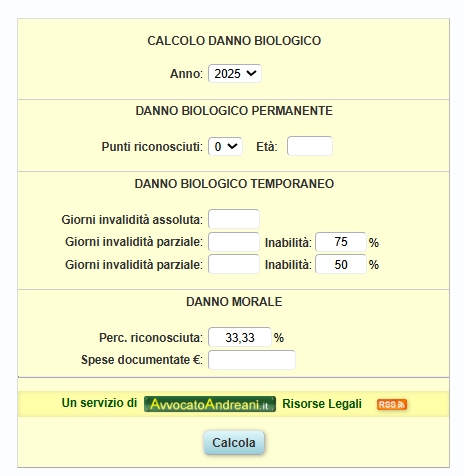
You will be asked to enter essential data such as the age of the injured person, the percentage of permanent disability, and the number of days of temporary incapacity.
The calculation is based on official tables such as the Milan Court Table and the new National Unified Table (TUN), which entered into force in 2025, harmonising compensation criteria throughout Italy by considering the severity of the injury and the age of the injured party.
The tool provides an approximate estimate of biological damage, which may also include moral damage.
Important Notice: online tools provide indicative calculations based on the input data and current tables.
However, the definitive assessment of disability and the calculation of compensation must be performed by a medico-legal expert under legal supervision.
The INAIL Calculation of Biological Damage: Indemnity and Annuity
INAIL(Istituto Nazionale per l'Assicurazione contro gli Infortuni sul Lavoro – the National Institute for Insurance against Occupational Accidents) recognises compensation for health impairments sustained by workers as a result of occupational accidents or occupational diseases.
This compensation is not a civil damages award but rather an indemnity determined according to the parameters set forth in Legislative Decree No. 38/2000 and based on INAIL's specific tables.
Lump-sum indemnity (permanent disability from 6% to 15%)
For impairments ranging between 6% and 15% permanent disability, INAIL grants a one-off lump-sum payment
The amount depends on the following factors:
- thedegree of impairment;
- theage and gender of the worker;
- thevalues updated annually by ministerial decree.
Monthly annuity (permanent disability ≥16%)
Where permanent disability equals or exceeds 16%, INAIL recognises a life annuity, consisting of two components:
- a portion for permanent biological damage;
- a portion for reduced working capacity.
This system is autonomous from the civil law system of damages but does not preclude the possibility of seeking further judicial compensation where the indemnity does not fully cover the harm suffered.
The importance of the medico-legal assessment
The medico-legal assessment is essential, as the medico-legal expert certifies the damage, quantifies the degree of disability (temporary or permanent), and establishes its causal link with the injurious event, thereby providing the basis for calculating compensation.
The preliminary medico-legal assessment (pre-perizia medico-legale)
A crucial step in the medico-legal consultancy process is the preliminary assessment(pre-perizia).
This preliminary evaluation is particularly important when biological damage results from an adverse event in a hospital setting, such as a surgical operation or inappropriate medical treatment, i.e. in the context of alleged medical malpractice.
The pre-perizia serves to verify the actual existence of biological damage caused by the event and to establish the grounds for a more in-depth medico-legal report (perizia medico-legale).
During the preliminary assessment, the medico-legal expert examines the patient, collects their medical history, and evaluates all available clinical evidence.
This includes reviewing medical records, diagnostic test results, and any other documentation that may clarify the nature and extent of the damage suffered.
The purpose is to determine, on a preliminary basis, whether the adverse event has caused an impairment that can be classified as biological damage.
One of the most crucial aspects in managing cases of biological damage is the demonstration of a causal connection between the adverse event and the actual damage sustained.
It is not sufficient merely to prove that the damage exists; it must also be shown that it is directly connected to the medical event in question.
The preliminary medico-legal assessment provides the first indications of the existence of this link, identifying possible correlations between the medical intervention or treatment received and the resulting injuries or impairments.
Detailed medical documentation is essential not only for the pre-perizia but for the entire medico-legal process.
These records constitute the foundation upon which the medico-legal expert builds the case; obtaining and preserving them is therefore fundamental.
The subsequent medico-legal report (Perizia medico-legale)
Through a thorough medico-legal assessment, the expert can:
- Verify the Damage. By means of medical examinations, analysis of clinical documentation, and specific tests, the expert confirms the existence and seriousness of the injuries.
- Establish the Causal Connection. Determines
the direct link between the traumatic event (accident, medical
error, workplace injury) and the damage suffered.
This causal nexus is essential to attribute legal liability. - Quantify the Disability. The medico-legal
expert classifies the injuries by assigning a percentage of
disability, which serves as the basis for calculating
compensation.
This evaluation is objective and follows specific medico-legal criteria, often with reference to standardised tables. - Provide the Basis for the Compensation Claim. The medico-legal report is the principal evidentiary element used by the lawyer to construct the legal strategy and initiate the compensation claim, whether through an out-of-court settlement or judicial proceedings.
- Offer an Impartial Evaluation. It provides a scientific and impartial assessment of the medical issues relevant to the case, ensuring an equitable application of the law.
Without a detailed and accurate medico-legal report, it is extremely difficult, if not impossible, to demonstrate the extent of biological damage and obtain adequate compensation.
Cases in which biological damage is recognised as compensable
Biological damage is compensable when a lesion to physical or psychological integrity is established, caused by a wrongful act (fatto illecito) such as a road accident, workplace injury, medical error, or exposure to harmful substances.
For minor injuries, medical proof of the lesion's actual existence, visible or instrumentally verified, is required.
The following are the main cases in which biological damage is recognised:
- Road traffic accidents: where the injury is caused by another person's wrongful conduct.
- Workplace injuries or occupational diseases: where the harm results from the injured person's professional activity.
- Medical malpractice: in cases of medical errors resulting in physical or psychological injury.
- Exposure to hazardous substances: such as asbestos or other carcinogenic agents, capable of causing illness and health damage.
- Wrongful acts: any conduct, whether intentional (doloso) or negligent (colposo), that violates the law and causes harm to health.
Essential requirements for biological damage
To summarise, the following are the key requirements for an injury to be classified as biological damage:
- Injury to Integrity: the injured person must have sustained a lesion to their psycho-physical integrity, whether permanent or temporary.
- Wrongful Act: the injury must result from a wrongful act, i.e. one that contravenes existing laws — such as an accident, a negligent act, or an intentional offence.
- Medical Proof: in the case of minor injuries,
a medical report confirming the existence and extent of the damage
is indispensable.
Serious injuries are, of course, easier to document. - Certainty of Damage: the damage must be real and demonstrable — not hypothetical or speculative.
Difference Between Temporary and Permanent Disability
In the context of biological damage, distinguishing between temporary disability and permanent disability is fundamental, as it affects both the legal recognition of the injury and the calculation of economic compensation.
Temporary disability refers to the healing period required to return to normal daily life, while permanent disability refers to a lasting physical or psychological impairment, quantified as a percentage.
Temporary disability concerns the inability to perform normal activities for a certain number of days, whereas permanent disability refers to the impairment that remains even after clinical recovery.
Temporary disability
Temporary disability indicates an impairment of psycho-physical capacity that is fully resolved after a certain period of time.
During this period, the individual is unable, wholly or in part, to carry out normal daily or work-related activities.
Main features:
- It has a limited duration (days, weeks, or months);
- It can be total or partial:
- Total: the person is entirely unable to carry out their usual activities (e.g. due to hospitalisation or complete immobilisation);
- Partial: the person retains some autonomy, but with limitations (e.g. pain, reduced mobility).
Practical examples of temporary disability
Possible cases of temporary disability include:
- An office employee who, following a leg fracture, remains at home for 40 days (total temporary disability), and subsequently works for a month on crutches (partial temporary disability).
- A person who suffers a mild head trauma and experiences headaches and difficulty concentrating for two weeks.
How temporary disability is calculated
Compensation is determined on the basis of the number of days of incapacity and the degree of limitation, applying medico-legal tables (for instance, €100 per day for total disability and a proportionally lower amount for partial disability).
Permanent disability
Permanent disability occurs when the injury causes irreversible consequences, and the victim never fully recovers their health.
It represents a definitive impairment of psycho-physical integrity, affecting daily life, social interactions, and work capacity.
Main Features:
- Irreversibility of the damage;
- Impact on future quality of life;
- Assessment expressed as a percentage of permanent disability (from 1% to 100%), determined by the medico-legal expert.
Practical examples of permanent disability
Possible cases of permanent disability include:
- Partial loss of sight or hearing;
- Permanent limitation of a limb following a road accident;
- Chronic post-traumatic disorder affecting serenity and concentration.
How permanent disability is calculated
Compensation depends on:
- The age of the injured person (the younger the person, the higher the compensation);
- The percentage of disability;
- The Milan Court Tables, which are the national standard reference.
In calculating compensation for biological damage, temporary and permanent disability affect the result in different ways, since they represent two distinct phases of health impairment: the period of illness and the residual impairment.
Liquidation of biological damage
The liquidation of biological damage is the procedure through which the court or the insurance company determines, in concrete terms, the amount owed to the victim for the injury to their psycho-physical integrity.
It is a complex operation that combines technical, medical, and legal elements.
Criteria for liquidating biological damage
The liquidation of biological damage, representing the injury to the person's psycho-physical integrity, follows the following steps and criteria:
- Medico-legal assessment: a medico-legal expert examines the injured person to ascertain the nature and extent of the injuries and the percentage of residual permanent disability.
- Temporary Incapacity: for each day of temporary incapacity (whether total or partial), a standardised sum is awarded (for example, approximately €39.37 per day of total incapacity, an amount that may be updated annually).
- Permanent Disability: for permanent disability
(expressed in percentage points), specific tables are used that
cross-reference the degree of disability with the age of the
injured party at the time of the harmful event.
The economic value of each percentage point decreases as age increases, due to the reduced remaining life expectancy.
Reference Tables
There are two main systems of tables in Italy:
- National Tables (for minor injuries): for
injuries of slight severity (up to 9% permanent disability), the
National Unified Tables provided for by the Code of
Private Insurance (Article 139, Legislative Decree No. 209/2005)
apply.
These tables establish fixed amounts, periodically updated. - Milan Court Tables (for major injuries): for
injuries exceeding 9% disability, reference is generally made to
the so-called Milan Court Tables, recognised nationwide by
case law to ensure uniform treatment.
These tables jointly consider standard biological damage and subjective suffering (moral damage).
Personalisation of damage
The base amounts provided by the tables may be subject to personalisation (an increase of up to 50% for injuries above 9%) in the presence of specific and proven individual circumstances that render the damage more serious than the standard case — for example, particular consequences on the victim's personal or professional life.
Moral Damage
Moral damage (the individual's inner suffering) is generally considered included within the overall liquidation of biological damage according to the Milan Court Tables.
However, it may be compensated separately, with rigorous proof, in exceptional circumstances.
In summary, liquidation is a complex process requiring medico-legal expertise and the application of specific statutory and jurisprudential criteria.
Calculations of biological damage
During the recovery phase, an economic amount is calculated for each day of incapacity.
The value depends on:
- the number of days of incapacity;
- the degree of total or partial incapacity;
- the medico-legal tables (e.g. those of the Milan Court).
Practical example:
An individual remains totally incapacitated (100%) for 30 days, and partially incapacitated (50%) for a further 30 days.
If the table provides €100 per day for total incapacity:
- 30 × €100 = €3,000 (total)
- 30 × €50 = €1,500 (partial)
The total amount for temporary disability would therefore be €4,500.
This sum compensates for the suffering and reduced capacity to live normally during the recovery period.
When a permanent impairment remains, permanent disability comes into play, which has a far greater impact on overall compensation.
For instance, if the injured person is a 35-year-old woman and the medico-legal expert determines a 10% permanent disability, the Milan Court Table may value each percentage point at approximately €3,500.
Thus, 10 × €3,500 = €35,000 in permanent biological damage.
In the overall calculation of biological damage, the following components are added together:
- Temporary Disability: for the period of illness or incapacity;
- Permanent Disability: for the residual, lasting harm to health.
Summary:
- 45 days of total temporary disability → €4,500
- 10% permanent disability (age 35) → €35,000
Total compensation:€39,500.
Possible
In addition to these two main components, the judge may award:
- an increase for personalisation (up to 30%) if the injury has particularly severe consequences on the individual's life;
- moral damage, if distinct inner suffering is proven;
- medical and pecuniary expenses related to treatment or reduced earning capacity.
Timeframes for obtaining compensation for biological damage
The time required to obtain compensation for biological damage depends on the type of procedure chosen and the complexity of the case.
In general, the process may follow two possible routes:
1. Out-of-Court phase (with the insurance company)
In most cases, the insurer is required to make an offer within 90 days from the formal request for compensation, provided that the medical documentation is complete.
If the insurance company acknowledges liability, payment may be made within three to six months of submitting the medico-legal report.
In cases involving medical malpractice or workplace injuries, timeframes are often longer, since they usually require a preliminary technical assessment or an evaluation by INAIL.
2. Judicial phase (court proceedings)
If no agreement is reached, the injured party may bring a claim before the civil court.
In such cases, the timeframe is significantly longer: compensation proceedings may last from one to three years, depending on the court and the expert examinations ordered.
The judge, after appointing a court-appointed technical consultant (CTU), determines the amount due on the basis of the Milan Court Tables or the national tables.
The duration may be reduced through assisted negotiation or civil mediation, mechanisms aimed at reaching an earlier settlement.
How to expedite the procedure
To accelerate the compensation process, it is advisable to:
- Submit a complete and well-documented medico-legal report immediately;
- Engage a lawyer specialised in compensation law, who can handle relations with the insurance company and assess the technical timeframes for liquidation;
- Use assisted negotiation to avoid lengthy court proceedings.
Legal assistance in calculating and claiming compensation
Legal assistance in calculating and claiming compensation for biological damage is essential to ensure the correct indemnity is obtained.
A lawyer can assist the injured party in the quantification of damage (through a medico-legal expert's report), in proving the causal link, and in negotiating with the insurance company or the person responsible for the damage.
The Boccadutri Law Firm assists its clients throughout all stages — from the medico-legal assessment to negotiation with insurance companies — guaranteeing efficient and personalised case management.
Do not hesitate to contact our International Law Firm for advice and assistance.
FAQ – Calculation of biological damage
What is biological damage and when is one entitled to compensation?
Biological damage is the temporary or
permanent injury to a person's psycho-physical integrity,
ascertainable through a medico-legal assessment.
It is compensable when the injury results from a
wrongful act (e.g. road traffic accident,
medical error, occupational injury, or exposure to harmful
substances).
How is biological damage calculated?
The calculation is based on a medico-legal assessment that determines the percentage of permanent disability, and the number of days of temporary incapacity.
The economic value is then established by applying the Milan Court Tables (for serious, or macro-permanent, injuries) or the National Unified Table (for minor, or micro-permanent, injuries).
The final compensation corresponds to the sum of permanent and temporary damage, with a possible personalisation increase of up to30–50%, depending on the circumstances of the case.
What is the difference between temporary and permanent disability in the calculation of biological damage?
Temporary disability refers to the healing period during which the victim cannot normally carry out daily activities.
Permanent disability refers to the definitive impairment of psycho-physical integrity that persists even after recovery.
What are the Milan Court Tables and why are they important?
The Milan Court Tables constitute the principal national reference for the quantification of biological damage in Italy.
They establish the monetary value of each percentage point of disability based on age, and the parameters for moral damage and the personalisation of compensation.
Is it possible to increase the compensation amount?
Yes.
The judge may personalise the compensation by increasing it by up to 50% above the standard tabular value, where the circumstances of the case justify it.
How is biological damage calculated by INAIL?
INAIL grants a lump-sum indemnity for permanent disability between 6% and 15%, and a monthly annuity for disability exceeding16%.
The amount depends on the injured worker's age, degree of impairment, and reference remuneration.
How long does it take to obtain compensation for biological damage?
Timeframes depend on the complexity of the case and the method of resolution:
Out-of-court phase (settlement with the insurer): approximately 4 to 12 months;
Judicial phase: from 1 to 3 years, depending on the court's schedule and the required expert assessments.
What if the insurance company disputes the extent of the damage?
If the insurer contests or reduces the claimed amount, the injured party may:
request an independent medico-legal counter-assessment;
attempt assisted negotiation or civil mediation;
as a last resort, initiate court proceedings.
Can compensation be claimed for temporary injuries as well?
Yes. Even non-permanent injuries, resulting in a temporary period of incapacity, entitle the injured party to compensation per day of illness or incapacity, calculated according to the relevant medico-legal tables.
The content of this article is intended to provide a general guide to the subject matter. Specialist advice should be sought about your specific circumstances.
[View Source]