

Overview
Ireland is the only English-speaking jurisdiction whose corporate rescue processes are automatically recognised and enforceable across the European Union*. The Examinership process has also been recognised in the US, the UK and many other third country jurisdictions.
Examinership Highlights
The Process
Examinership in Brief
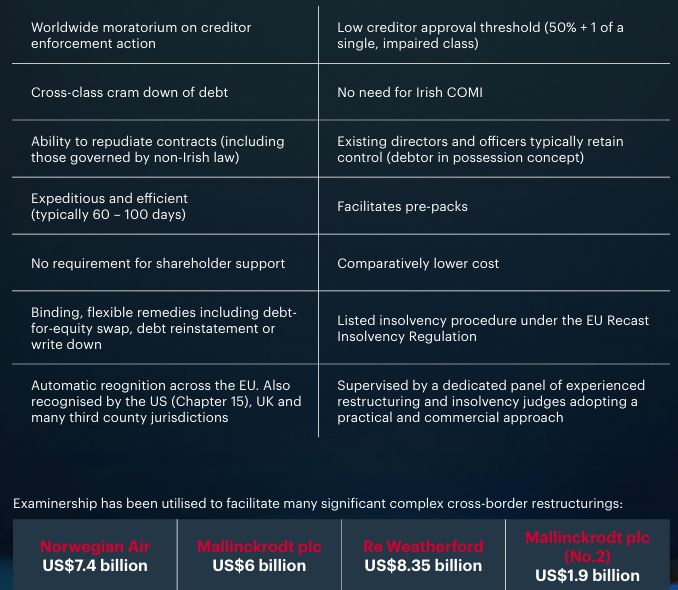
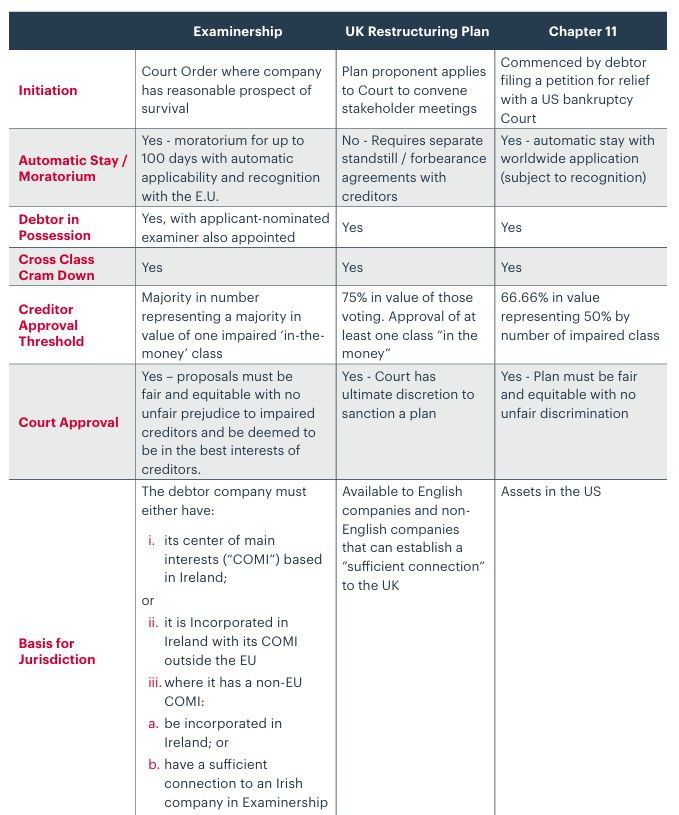
Examinership is a powerful and flexible Court supervised corporate rescue process available to companies in financial difficulty, but which otherwise have a reasonable prospect of survival as a going concern post-restructuring. It is broadly comparable to Chapter 11 of the US Bankruptcy Code and the restructuring plan in the UK. See a comparison table discussing the three processes on page 7.
The regime confers an automatic stay of up to 100 days on creditor enforcement action during which a court-appointed “Examiner” (a qualified insolvency and restructuring professional) formulates a scheme of arrangement (Scheme) which is presented to creditors and ultimately the court for approval. If approved, the Scheme is binding on the company, its members and creditors. While additional approval thresholds exist, the key voting threshold is that one class of impaired, in-the-money creditors approves the Scheme (acting by a majority in number representing a majority in value of those voting). Class composition is determined by reference to legal rights and treatment under the Scheme.
Examinership can be readily used in conjunction with other international processes (for example in the case of Mallinckrodt plc) and is capable of recognition and enforcement internationally. Whilst Examinership is principally a rescue process - and one that has an underlying objective of protecting enterprise and employment - a creditor-led Examinership can result in the effective enforcement of security or other senior debt obligations through debt for equity conversions or other restructuring strategies. For further information, see our in depth Examinership briefing here.
Third party releases
In Purdue Pharma, the US Supreme Court effectively ruled that non-consensual third party releases were prohibited without creditor consent. In the UK, the Court of Appeal ruled in Thames Water that releases against third parties are permitted only where “necessary in order to give effect to the arrangement proposed for the disposition of debts and liabilities of the company to its own creditors”.
Examinership, however, allows such releases when there is a clear connection between the claims being released and the debtor-creditor relationship, providing a more predictable and facilitative environment for restructuring.
USA
The Examinership process is capable of recognition under Chapter 15 of the US Bankruptcy Code as “foreign main proceedings” and has been so recognised on a number of occasions.
See Norwegian Air case study further below.
UK
Critically, Examinership has the benefit of recognition in the UK under section 426 of the Insolvency Act 1986 (UK). The result of this recognition ensures that, not only will the scheme be binding and effective on stakeholders, but that it can be used to restructure English law debt (and therefore work around the “rule in Gibbs” which prevents debt obligations governed by English law from being discharged by foreign insolvency proceedings without consent.)
See re Silverpail Dairy (Ireland) Unlimited Company v. McCarthy [2023] EWHC 895 (Ch).
Can non-Irish incorporated companies avail of Examinership?
There are several ways for a company to come within the jurisdiction of the Irish Courts for Examinership:
1. COMI or Establishment in Ireland
Companies incorporated elsewhere but with their Centre of Main Interest (COMI) in Ireland can avail of Examinership. COMI shifting is legally permissible, but the Court requires clear evidence that the shift is genuine. Timing is critical in that regard. COMI must be established before filing, and the Court - while adopting a pragmatic and open approach to recognising a COMI migration - will scrutinise whether the move occurred sufficiently in advance and that the evidence demonstrates a real shift, rather than a paper exercise.
Factors likely to be persuasive in demonstrating a COMI shift to Ireland include:
- Relocation of head office functions and decision-making;
- Operational presence (staff, board meetings) in Ireland;
- Irish banking and treasury arrangements; and
- Contractual nexus and documented strategic rationale.
2. Irish Incorporation with COMI outside the EU
An Irish-incorporated company can petition for Examinership even if its COMI is outside the EU. Incorporation alone gives the Court jurisdiction, provided the statutory tests are met (insolvency or likely insolvency, and a reasonable prospect of survival supported by an Independent Expert’s Report) and the company does not have its COMI in another EU jurisdiction.
3. Related Company Jurisdiction
A company without COMI in Ireland (or any EU country) can still be brought into Examinership if it is a “related company” to an Irish entity already in the process and it has a sufficient connection to Ireland.
While the ‘sufficient connection’ test is fact sensitive, the Irish Courts will adopt a pragmatic and commercial approach in their determination. Relevant factors will include whether the relevant entity:
- has any assets in Ireland (including any shares in any Irish companies);
- is party to any contracts (including servicing, loan or finance agreements, containing an Irish law clause;
- has an Irish bank account(s) or participate in the group’s cash pooling arrangements;
- engages any Irish service providers and / or provide any services to any Irish entities; and
- has a claim against any Irish entity (litigation, creditor, inter-creditor or otherwise).
Recent high-profile examples of non-Irish incorporated companies being the subject of an Examinership include Norwegian Air Shuttle ASA (2021) and Mac Interiors (2023).
Case Study
Norwegian Air
The Examinership process was utilised by Norwegian Air to effect one of the most innovative and complex restructurings in Europe.
The overall restructuring facilitated a reduction in the Norwegian Air group’s debt (including English and US law governed debt) by NOK 63 - 65 billion (approx. US$7.5 billion), the termination of English law governed aircraft orders of approximately NOK 85 billion (approx. US$10 billion) in aggregated value and raised up to NOK 6 billion (approx. US$720 million) in new capital through public share and debt offerings.
Norwegian Air Shuttle ASA (NAS) was the Norwegian-incorporated parent company of the group whose shares were listed on the Oslo Stock Exchange and was the main operating company within the group. The Court derived its jurisdiction to appoint an examiner to NAS, as NAS was a related company to its five direct and indirect Irish incorporated subsidiaries to which the examiner was being appointed.
The connections included substantial direct and indirect Irish subsidiaries of NAS and its wider commercial operations located in the State. These NAS subsidiaries included an operating airline, the corporate structure through which its aircraft were owned or leased and whose liabilities were guaranteed by NAS and a separate subsidiary that hold the group’s intellectual property rights.
A significant feature of the Examinership was the Court’s approval of the proposed repudiation of NAS’s English law aircraft leases, sub-leases, and related guarantees, despite NAS falling outside of the terms of the EU Recast Insolvency Regulation 848/2015. The Court determined that, on the basis that they had jurisdiction to place NAS into Examinership, that jurisdiction included all of the tools and processes that were available in an Examinership
The Irish Examinership was the lead restructuring process for NAS and the only process for the Irish incorporated companies. It was supplemented and implemented in Norway through a parallel Norwegian law reconstruction process, again demonstrating, that an Examinership can be used in parallel with another international restructuring process to secure the implementation of a complex cross border restructuring.
A further unique feature of the Examinership was the structure and timing of the proposed investment (which had a minimum target amount of NOK 4.5 billion (€433.6 million).) The examiner presented the Examinership scheme for approval to the creditors and to the court before binding investment commitments were in place. In order to protect creditors, the Examinership scheme (and the Norwegian reconstruction plan) was structured so the terms of the restructuring, in particular the write-down of obligations to creditors, would not take effect unless and until the minimum capital investment of NOK 4.5 billion was raised. In approving this aspect of the Examinership, the Court demonstrated a willingness to deviate from established practice and provide the necessary flexibility to facilitate the complex capital raise required to secure the airline’s survival.
Further examples of multi-jurisdictional Examinerships
Mallinckrodt plc | US $6 billion
In 2022, the Irish High Court approved a significant scheme of arrangement for Mallinckrodt plc, a pharmaceutical company facing $5.3 billion in long-term debt primarily due to lawsuits related to its opioid marketing practices. This case is notable as it was the second largest Examinership in Ireland’s history and highlighted the Irish Courts’ willingness to implement a US Chapter 11 plan through an Examinership.
It was a specific condition of the confirmation of the Chapter 11 plan that the Irish High Court would confirm the proposed Examinership scheme of the Irish parent company without material modification.
Mallinckrodt plc (No. 2) | US $1.9 billion
In 2023, Mallinckrodt plc was once again facing insolvency due to unforeseen challenges that negatively impacted its financial performance. This resulted in a further Chapter 11 plan in the USA and an implementation scheme (by way of Examinership) in Ireland. The company was burdened with $3.8 billion in debt, struggling with rising interest rates, disappointing product sales. Again, the Irish proposals mirrored the Chapter 11 plan that had already received the approval of the US Courts.
Influenced by the strong creditor support for the new scheme, which included a significant reduction of loan obligations from $3.6 billion to $1.75 billion through a debt-for-equity swap, along with a $1 billion reduction in opioid reparations due to a one-time $250 million payout, the Irish High Court sanctioned the new scheme.
Re Weatherford | US $8.35 billion
In 2019, the Weatherford group initiated an Examinership process for its Irish parent company, Weatherford International plc, as part of a global restructuring that began under US Chapter 11 in Houston, Texas. At that time, Weatherford was one of the largest oilfield service companies globally, employing around 24,500 people and operating over 250 subsidiaries in more than 80 countries, with a market capitalisation of $20 billion.
The Examinership facilitated a restructuring plan that allowed investors to exchange $7.4 billion in public notes from the group’s subsidiaries for 99% equity in the Irish parent company (which required the cancellation of existing shares and associated rights as well as debt cram down). This marked the first instance of combining US Chapter 11, Irish Examinership, and a Bermudan scheme of arrangement in a single restructuring effort.
This restructuring demonstrated the feasibility of using both Irish and US processes to efficiently reorganise the capital structure of an Irish-registered, US-listed company, providing certainty for all stakeholders.
International restructuring comparison table
The content of this article is intended to provide a general guide to the subject matter. Specialist advice should be sought about your specific circumstances.
[View Source]

