

Introduction
The Government of India announced the Union Budget 2026 on 1 February 2026 ("Budget 2026"). Budget 2026 primarily has a theme of maintaining stability, fiscal discipline, sustained growth and moderate inflation. It focuses on structural reforms aimed at enhancing ease of doing business, attracting foreign investment, and strengthening key sectors/industries. Further, it aims at building a robust financial sector, efficient capital allocation and encouraging growth of cutting-edge technologies, including AI applications.
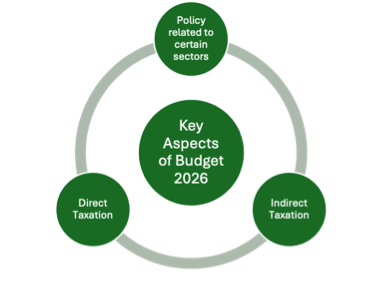
In this snapshot, we highlight (i) key proposals pertaining to specific industries/sectors, (ii) changes to the direct tax regime, and (iii) changes to the indirect tax regime that businesses and stakeholders should be aware of.
Key proposals pertaining to specific industries/sectors
- Biopharmaceutical Sector: The 'Biopharma SHAKTI (Strategy for Healthcare Advancement through Knowledge, Technology and Innovation)' shall work towards developing India as a global Biopharma manufacturing hub, with an outlay of INR 10,000 Crores (~USD 1.09 billion) over the next 5 years. The strategy will build the ecosystem for domestic production of biologics and biosimilars.
- Semiconductor Industry: The Budget launched the 'India Semiconductor Mission (ISM) 2.0' which aims to expand India's semiconductor sector capabilities, to produce equipment and materials, design full stack Indian IP, and fortify supply chains.
- Electronic Industry: The 'Electronics Components Manufacturing Scheme 1.0', launched in April 2025, aims to strengthen India's electronics manufacturing ecosystem. The Government has proposed to enhance the outlay to INR 40,000 crore (~USD 4.36 billion), to reinforce India's position as a global hub for electronics component manufacturing.
- Container and Cargoes: The Government has allocated a budget of Rs. 10,000 crores (~USD 1.09 billion) over 5 years for container manufacturing to create a globally competitive container manufacturing ecosystem. Additionally, to promote environmentally sustainable movement of cargo, the government is set of launch various schemes like Coastal Cargo Promotion Scheme, Dedicated Freight Corridors, etc. To further support supply chain companies in clearing cargo, various trust-based systems are proposed to be introduced for giving them preferential treatment and minimize verification process.
- Textile Industry: For the labour-intensive textile sector, the Government has proposed various programme like the National Fibre Scheme for self-reliance in natural fibres like silk, wool, etc., Further, a textile expansion and employment scheme has been proposed to modernise traditional clusters with capital support for machinery, technology upgradation and common testing and certification centres. Further, it has been proposed to set up Mega Textile Parks to focus on bringing value addition to technical textiles.
- Micro, Small, and Medium Enterprises ("MSMEs"): Focusing on creating "Champion SMEs", the Budget introduces a dedicated INR 10,000 crore (~USD 1.09 billion) 'SME Growth Fund', to incentivize enterprises based on select criteria. The Budget also proposed the top up of the 'Self-Reliant India Fund' with INR 2,000 crore (~USD 218 million) to continue support to micro enterprises and maintain their access to risk capital.
- Infrastructure Sector: The Government will continue to prioritise large-scale infrastructure development, with a focus on Tier II and Tier III cities, as emerging growth centres. To accelerate asset monetisation, dedicated Real Estate Investment Trusts (REITs) will be established for recycling real estate assets of Central Public Sector Enterprises (CPSEs). Additionally, to support private developers, an 'Infrastructure Risk Guarantee Fund' will be set up to provide partial credit guarantees to lenders.
- Banking Sector: A 'High-Level Committee on Banking for Viksit Bharat'1will be constituted to undertake a comprehensive review of the banking and financial services sector, while safeguarding financial stability, inclusion, and consumer protection. The Budget mentions that the vision for Non-Banking Financial Companies (NBFCs) for a Viksit Bharat has been outlined with clear targets for credit disbursement and technology adoption. As an initial step toward improving scale and operational efficiency in Public Sector NBFCs, the Power Finance Corporation and Rural Electrification Corporation are proposed to be restructured.
- Foreign Investments: A comprehensive review of the Foreign Exchange Management (Non-debt Instruments) Rules will be undertaken to create a user-friendly framework for foreign investments. Further, to enhance foreign investment in the Indian capital market, it is proposed to allow Individual Persons Resident Outside India (PROIs) to invest in equity instruments of listed Indian companies through the 'Portfolio Investment Scheme.' The investment limit for an individual PROI is proposed to increase from 5% to 10%, with the overall limit for all individual PROIs raised from 10% to 24%.
- Corporate and Municipal Bonds: To strengthen India's bond markets, a market-making framework will be introduced for corporate bonds, with access to funds and derivatives on corporate bond indices. Further, total return swaps are also proposed to be introduced for corporate bonds. For municipal bonds, large cities issuing high value bonds will receive an incentive of INR 100 crore (USD ~11 million) for a single bond issuance above INR 1,000 crore (USD ~11 million), while the existing 'AMRUT scheme' will continue to support smaller and medium towns.
- Technology and Artificial Intelligence: The Government has indicated adoption of technology for the benefit of all people – farmers in the field, women in STEM, youth keen to upskill and Divyangjan (persons with disabilities) to access newer opportunities. The Government has taken several steps to support new technologies through AI Mission, National Quantum Mission, Anusandhan National Research Fund, and Research, Development and Innovation Fund.
Direct Taxation
- Introduction of the new Income Tax Act, 2025:
- With effect from 1 April 2026, the erstwhile Income Tax Act, 1961 ("Old Act") to be replaced by the new Income Tax Act, 2025 ("New Act")
- New Act to ease compliance and taxation norms
- Rules and Forms under the New Act to be notified later
- Supply of manpower and classification for
withholding:
- Supply of manpower to now be treated as 'payment to contractors for work' subject to 1% or 2% withholding, as applicable. Earlier, there was ambiguity in classification of the same either as 'professional services' subject to 10% withholding tax rate, or 'payment to contractors'. This was relevant from a tax compliance perspective because the withholding tax rates for both categories are significantly different.
- Key Corporate Taxation Revisions:
- Buyback to be taxed as capital gains. However, promoters to pay additional buyback tax to disincentivize misuse of tax arbitrage.
- Securities Transaction Tax ("STT") on Futures increased to 0.05 percent from current 0.02 percent. STT on options premium and exercise of options are both proposed to be raised to 0.15 percent from the present rate of 0.1 percent and 0.125 percent respectively.
- Set-off of brought forward Minimum Alternate Tax ("MAT") credit accumulated up to 31 March 2026 (under Old Act) now governed under the New Act. Set-off allowed only up to 25% of the corporate tax liability computed under the New Act.
- Further, under the New Act, MAT is proposed to be made the final tax. Accordingly, no further MAT credit accumulation for corporates from 1 April 2026 under the New Act
- Extension of timeline for tax returns and
revisions:
- Extension for revision of tax return for a tax year from 31 December to following 31 March
- Extension for filing tax returns for non-audit business extended from 31 July to 31 August
- Ease of compliance for withholding taxes on the sale of
immovable property in India by a non-resident:
- Earlier, withholding required a separate Tax deduction Account Number ("TAN")
- Now, tax proposed to be deducted and deposited through resident buyer's PAN based challan instead of requiring TAN.
- Rationalizing assessment and penalty
proceedings:
- Currently, assessment proceedings for a given tax year run in their own structured manner whereas the penalty proceedings, if any, run independently.
- Now, both assessment and penalty proceedings to be integrated in one common order.
- Further, no interest liability on the taxpayer on such penalty amount for the period of appeal before the first appellate authority irrespective of the outcome of appeal process.
- The quantum of pre-payment now reduced from 20% to 10% on core tax demand.
- Taxpayer allowed to update tax return for a given year even after reassessment proceedings initiated for such year, subject to payment of prescribed additional tax.
- Penalties for certain technical defaults to be converted into a fee and prosecution framework has been relaxed by decriminalising many minor non-compliances.
- Extension of period of deduction for units in
International Finance Service Centre ("IFSC") and
rationalization of tax rate:
- To increase the competitiveness of IFSC, it is proposed to increase the period of deduction to 20 (from earlier 10) consecutive years out of 25 (from earlier 15) years for units in IFSC.
- Post expiry of period of such tax deduction, business income of these units from IFSC will be taxed at rate of 15%.
- Enhanced tax framework to support Information
Technology Sector:
- Common safe harbour margin of 15.5 percent introduced for all IT services.
- Significant enhancement of threshold for availing aforesaid safe harbour margin from INR 300 crore to INR 2,000 crore
- Safe harbour margin approved by automated process without requirement of a tax officer. If approved, such safe harbour can be adopted by taxpayer, at its choice, for 5 continuous years.
- Fast track advance pricing agreement ("APA") introduced for IT companies with an outer limit of 2 years for conclusion of such APA.
- Boosting global business and investment:
- Tax holiday till 2047 to any foreign company that provides cloud services to customers globally by using data centre services from India. Such cloud only services would need to be provided to Indian customers through an Indian reseller entity.
- Introduction of safe harbour of 15% on cost in case the company providing data centre services from India is a related entity.
- Introduction of safe harbour to non-residents for component warehousing in a bonded warehouse at a profit margin of 2 percent of the invoice value.
- Provision of tax exemption for 5 year to a foreign company who provides capital goods, equipment or tooling, to any contract manufacturer in a custom bonded zone producing electronic goods on behalf of such foreign company for a consideration.
- Provision of exemption to global (i.e., non-India sourced) income of a non-resident expert, for a stay period of 5 years under notified schemes
- Non-applicability of Minimum Alternate Tax ("MAT") provisions to non-resident paying tax in India under presumptive income schemes i.e., largely targeting non-resident professionals.
Income Computation and Disclosure Standards (ICDS) to be merged into/incorporated in the Indian Accounting Standards (IndAS) itself. No separate accounting requirement based on ICDS from the tax year 2027-28.
Indirect Taxation
- Promotion of exports of marine, leather, and textile
products:
- Increase in the limit for duty-free imports of specified inputs used for processing seafood products for export, from the current 1% to 3% of the Freight on Board ("FOB") value of the previous year's export turnover.
- Extending duty-free imports of specified inputs, which is currently available for exports of leather or synthetic footwear, to exports of Shoe Uppers as well
- Extension of time period for export of final product from the existing 6 months to 1 year – This is for exporters of leather or textile garments, leather or synthetic footwear and other leather products.
- Extending Basic Customs Duty
("BCD") Exemptions to below
categories of imports:
- Energy – import of capital goods used for manufacturing Lithium-Ion Cells for battery energy storage systems, import of sodium antimonate for use in manufacture of solar glass
- Nuclear Power – BCD exemption extended on imports of goods required for Nuclear Power Projects till the year 2035 and this is expanded for all nuclear plants irrespective of their capacity
- Critical Minerals – import of capital goods required for processing of critical minerals in India
- Consumer Electronics – import of specified parts used in the manufacture of microwave ovens
- Civil Aviation and Defence Aviation – import of components and parts required for the manufacture of civilian, training and other aircrafts, import of raw materials for manufacture of parts of aircraft to be used in maintenance, repair, or overhaul requirements by Units in the Defence sector.
- Special Economic Zone:
- Special one-time measure – Concessional rates of duty for sales by eligible manufacturing units in SEZs to the Domestic Tariff Area ("DTA")
- Quantity of such sales will be limited to a prescribed proportion of their exports
- Customs Process Reforms:
- Enhancement of duty deferral period for Tier 2 and Tier 3 Authorised Economic Operators ("AEOs"), from 15 days to 30 days
- Extending validity period of advance ruling, binding on Customs Authorities, from the present 3 years to 5 years
- Facilitating immediate release of goods upon arrival – For import of goods not needing any compliance, filing of bill of entry by a trusted importer, and arrival of goods will automatically notify Customs for completing their clearance formalities.
- Reduction of transaction delays/compliance costs by migrating from current officer-dependent systems to a more automated framework – The Customs warehousing framework will be transformed into a warehouse operator-centric system with self-declarations, electronic tracking and risk-based audit.
- Ease of Doing Business – Single integrated
digital window clearance:
- Cargo clearance approvals from various Government agencies will be seamlessly processed through a single and interconnected digital window by the end of the financial year.
Conclusion
The Budget 2026 marks a decisive shift from incremental changes to structural transformation. By replacing the Income Tax Act, 1961 with the Income Tax Act, 2025, and integrating assessment and penalty proceedings, the Budget is aimed towards a digitized and non-adversarial tax regime. This creates a regulatory environment where ease of doing business is a priority. For businesses, the narrative has evolved beyond simple fiscal incentives. The targeted outlays for Biopharma, Semiconductors, and AI, coupled with the strategic support for infrastructure and MSMEs, suggest that the next phase of growth will be defined by innovation. However, as the framework shifts to a new statutory era, the immediate priority for stakeholders will be navigating the transition. Successfully leveraging these structural reforms will require not just adaptation, but a strategic re-evaluation of long-term tax and regulatory positions to align with the vision of Viksit Bharat.
The content of this article is intended to provide a general guide to the subject matter. Specialist advice should be sought about your specific circumstances.
