- in Asia
- within Intellectual Property topic(s)
- in Asia
- in Asia
- in Asia
- in Asia
- in Asia
- in Asia
- in Asia
- with readers working within the Healthcare and Law Firm industries
- within Insolvency/Bankruptcy/Re-Structuring, Food, Drugs, Healthcare, Life Sciences and Technology topic(s)
Introduction
The question of whether a foreign brand’s trans-border reputation can automatically confer trademark protection in India has long been debated. In the recent Blue Jays case, the Division Bench of the Hon’ble Delhi High Court reaffirmed the principle of territoriality in Indian trademark law, emphasizing that global recognition does not automatically translate into domestic rights. The Division Court set aside the order of the Learned Single Judge, wherein the Judge had struck down the Blue Jay trademark being registered and used by an Indian partnership firm. While setting aside the order, the Division Bench in the case highlighted that the Respondent’s trademark- Toronto Blue Jays, though recognized globally, did not have sufficient goodwill in India at the relevant time.
Background
-
- On August 19, 1998, the Appellants, Mr. Sumit Vijay and another, filed for the registration of the mark “BLUE JAY” in Class 25 for clothing. The mark was subsequently registered in their favor.
- The status of registrations held by the Respondent under Section 23 of the Trade Marks Act, 1999 ,are as under:
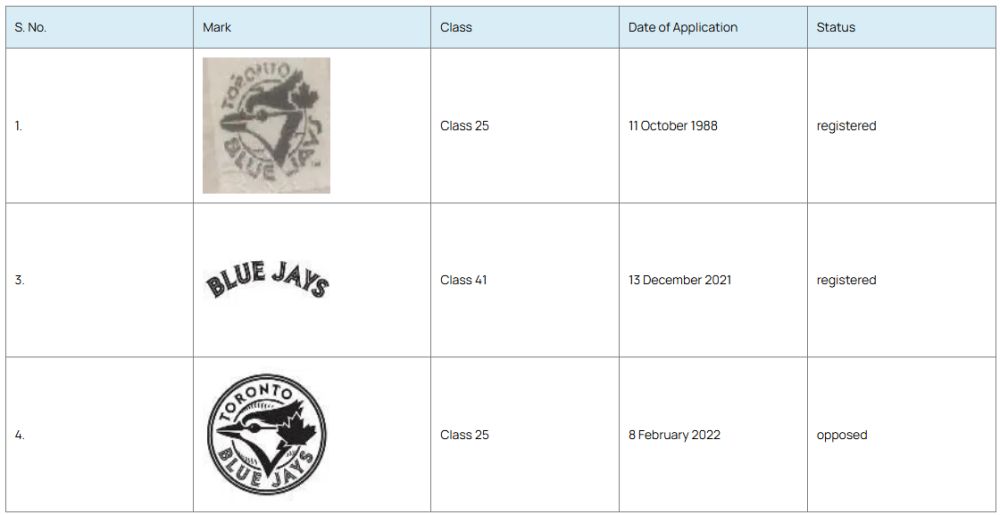
- Major League Baseball (MLB) Properties Inc., a globally recognized professional baseball league, has been using the mark BLUE JAY / TORONTO BLUE JAYS since 1976, enjoying international reputation and goodwill.
- MLB challenged the Indian registration for the mark “BLUE JAY” and filed a rectification petition under Sections 57(2) and 11 of the Trade Marks Act, 1999, seeking cancellation of the Appellants’ mark.
- The Single Judge Bench of the Delhi High Court, in its judgment dated July 01, 2025, allowed MLB’s petition, while holding that the Appellants had adopted the mark with a mala fide intent to capitalize on MLB’s global goodwill.
- The Single Judge recognized MLB’s mark as an “Earlier Trade Mark” and ordered the removal of the mark BLUE JAY from the trademark register under Section 11(10)(ii) of the Trade Marks Act.
- Aggrieved by the aforesaid order of the Single Judge Bench, the Appellants, approached the Division Bench of the Delhi High Court. .
Appellants’ Submissions
Before the Division Bench, the Appellants argued:
- There was no evidence of use of the MLB mark in India, and social media presence alone could not establish domestic goodwill.
- MLB had not provided India-specific evidence of reputation or consumer recognition.
- Baseball is not a popular sport in India, unlike cricket, and therefore MLB’s mark could not enjoy substantial recognition.
- MLB did not have a valid registration in Class 25, whereas the Appellants had a registered mark in India since 1998 for ready-made garments, which was unrelated to MLB’s activities.
- MLB’s mark should not qualify as a “well-known trade mark” under Section 2(1)(zg) or Section 11(6) of the Trade Marks Act to claim trans-border reputation.
Respondent’s Defence
MLB countered with the following points:
- Their mark had been adopted earlier, enjoyed long-standing global recognition, and was familiar to a section of Indian consumers, qualifying as a well-known trademark under the Indian law.
- The Appellants’ adoption of the mark BLUE JAY was allegedly in bad faith, intending to ride on MLB’s worldwide goodwill.
- Despite opposing the Appellants’ registration, MLB’s opposition was not sustained, leading to the mark being registered.
- Coexistence of the two marks could cause irreparable damage to MLB’s interests.
Ruling of the Division Bench
The Hon’ble Division Bench set aside the Single Judge’s judgment and restored Appellant’s BLUE JAY trademark registration, while making the following observations in the case:
- MLB’s mark did not meet the criteria of an “Earlier Trade Mark” as provided under Section 11, as it was:
- Not a prior registered mark in India,
- Not the subject of a pending registration application in India, and
- Not a well-known mark in India at the time of the Appellants’ registration.
- The mark’s global reputation was irrelevant for determining passing off claims; what mattered was goodwill in India.
- The Court emphasized that Baseball’s limited popularity in India meant that MLB’s mark had no substantial Indian recognition in 1998.
- Mere internet presence or social media following was insufficient to establish domestic goodwill without concrete evidence of recognition in India.
Conclusion
The Blue Jays case underscores the importance of the territorial principle in Indian trademark law. The judgment reaffirms the ruling upheld in the landmark case of Toyota Jidosha Kabushiki Kaisha vs M/S Prius Auto Industries Limited1, where the Hon’ble Supreme Court of India had held that Trademark rights are territorial and not global, while passing a judgment in favour of the Defendants who registered ‘Prius’ mark in India in 2020 and further highlighting that:
- Global or trans-border reputation alone may not be sufficient to challenge a registered domestic mark.
- Evidence of domestic goodwill and recognition plays a key role in assessing passing off claims.
- Courts consider India-specific evidence when evaluating claims, rather than assuming that international popularity automatically confers protection under Indian law.
The decision provides guidance for both domestic and foreign brands, emphasizing the need to demonstrate market presence and reputation within India when asserting trademark rights.
Our Coverage on LinkedIn: https://www.linkedin.com/feed/update/urn:li:activity:7431572050361667584
Footnote
1. Toyota Jidosha Kabushiki Kaisha v. M/S Prius Auto Industries Ltd., (2018) 2 SCC 1 (India).
For further information please contact at S.S Rana & Co. email: info@ssrana.in or call at (+91- 11 4012 3000). Our website can be accessed at www.ssrana.in
The content of this article is intended to provide a general guide to the subject matter. Specialist advice should be sought about your specific circumstances.
[View Source]