

INTRODUCTION
We are happy to present this edition of our IP Newsletter, which includes some of the most significant developments in the realm of intellectual property from the final quarter of 2025. This period saw courts in India and abroad continuing to engage with questions at the cutting edge of intellectual property law, particularly the growing tensions between traditional IP frameworks and rapidly evolving digital and Artificial Intelligence ("AI") driven technologies. Trade mark jurisprudence continued to grow, with courts reinforcing protection for well-known brands, trade dress, and even non-conventional marks, while ensuring that trade mark rights are not stretched beyond their legitimate limits in cases involving usage of descriptive marks, delayed enforcement, or non-commercial online expression. Copyright law also witnessed developments, ranging from robust remedies against online piracy and dishonest copying to judicial restraint in criminal enforcement and claims over generic expression. Patent law also witnessed important developments, with courts closely scrutinising patentability, inventive step, technical contribution, and reaffirming the need for reasoned decision‑making. On the global front, copyright and AI training emerged as a significant development, with landmark rulings and high-profile industry settlements.
Together, these developments reflect greater attention being paid to commercial realities, technological changes, as well as broader public interest considerations.
We hope you find this edition both informative and engaging. Happy reading!
TRADE MARK IT UP!
1. Delhi High Court Reaffirms Bata's Dominance Over the "POWER" Trade Mark
On 15 December 2025, a division bench of the Hon'ble High Court of Delhi ("Delhi High Court") upheld an interim injunction restraining Leayan Global Pvt. Ltd. ("Leayan") from using the mark "POWER FLEX" for footwear, holding it to be deceptively similar to Bata India Ltd.'s ("Bata") registered and well-established "POWER" trade mark1. Bata, a leading footwear manufacturer, adopted the mark "POWER" in the early 1970s for sports and canvas footwear and demonstrated decades of uninterrupted use, significant sales, and extensive promotional efforts, resulting in the mark acquiring strong goodwill and source-identifying significance in India.
Leayan, engaged in the manufacture and sale of footwear, allegedly launched leather shoes under the mark "POWER FLEX" in the year 2010-11 and had sought registration of the mark in Class 25, which was opposed by Bata. Bata instituted a suit alleging trade mark infringement and passing off, pursuant to which the single bench of the Delhi High Court had granted an interim injunction restraining the use of "POWER FLEX" as a trade mark, while permitting limited descriptive use of the phrase "THE POWER OF REAL LEATHER" by Leayan as its tagline. Both parties preferred appeals against this order.
Dismissing the appeal filed by Leayan, the division bench held that Bata was the registered proprietor of the word mark "POWER" in Class 25 (the relevant class for footwear) since March 1975 and hence, Leayan could not claim any rights in the mark POWER FLEX for footwear. The Delhi High Court noted that the addition of the word "FLEX" was descriptive and did not sufficiently distinguish Leayan's mark. Applying the test of the average consumer of imperfect recollection, the Delhi High Court found a clear likelihood of confusion and association. Importantly, it rejected Leayan's argument that "POWER" was merely descriptive, holding that Leayan was estopped from taking such a plea after seeking statutory protection for "POWER FLEX" itself. The injunction against "POWER FLEX" was accordingly affirmed.
The Delhi High Court further clarified the scope of Section 30(2)(a) of theTrade Marks Act, 1999("Trade Marks Act")2, holding that descriptive use of common words in advertising taglines is permissible provided such use does not assume a trade mark function or receive undue visual prominence. Accordingly, the division bench also did not interfere with the single bench's decision on use of the impugned tagline.
2. Hashtags and Free Speech: Madras High Court Protects Non-Commercial Online Expression
On 25 November 2025, the Hon'ble High Court of Madras ("Madras High Court") passed an order, declining to grant an interim injunction restraining Joy Crizildaa ("Crizildaa") from using the expression "Madhampatty Pakashala" as a hashtag on social media platforms.3
Madhampatty Thangavelu Hospitality Pvt. Ltd. ("Madhampatty Hospitality"), which operates a well-known catering business under the name "Madhampatty Pakashala", instituted the suit alleging that Crizildaa, a celebrity stylist, had made social media posts disparaging the goodwill and reputation of the company. It was alleged that Crizildaa had maliciously propagated false and scandalous allegations by tagging the company and its associated brands in posts relating to her personal dispute with Madhampatty Rangaraj, a director of the company. Madhampatty Hospitality contended that these posts wrongfully linked the private affairs of an individual director with the company and resulted in significant reputational harm and financial loss.
Crizildaa opposed the plea, arguing that the suit was not maintainable and that her posts constituted non-commercial, nominative use of the trade mark in the course of criticism, which was permissible in law.
The Madras High Court held that Madhampatty Hospitality had not prima facie established that Crizildaa's posts were made with the intent to injure the company's trade mark or business, nor that the alleged remarks had caused actual loss of revenue. It further noted that a separate suit had been filed by the director seeking protection of his personality rights and decided to hear both matters together as they involved overlapping issues. Accordingly, the Madras High Court declined interim relief and adjourned the matter for joint consideration.
3. The Shape of Luxury: Delhi High Court Declares the Hermès Birkin Bag a Well-Known Trade Mark
The Delhi High Court, by way of a judgement dated 24 November 2025 declared the three-dimensional shape of Hermès International's ("Hermès") Birkin bag a "well-known trade mark" under Section 2(1)(zg) of the Trade Marks Act.4 The decision represents a rare judicial recognition of product shape as a well-known mark and significantly strengthens protection for iconic luxury designs in India.
Hermès instituted proceedings against Macky Lifestyle Pvt. Ltd. ("Macky") for manufacturing and selling handbags that slavishly copied the distinctive shape of the Birkin bag, including its rectangular structure, flap design, strap configuration, and lock mechanism. Macky also used the "Hermès" word mark and ultimately conceded infringement, consenting to a permanent injunction. Hermès, however, sought a declaration of well-known status to prevent future dilution by third parties.
The Delhi High Court assessed the claim under Section 11(6) of the Trade Marks Act. It noted the Birkin bag's extensive global reputation, continuous use since 1984, presence in popular culture, and recognition among the relevant Indian consumer base as a symbol of luxury. The Delhi High Court emphasised that the bag's shape itself functions as a source identifier, even in the absence of any logo or branding. In view thereof, the Delhi High Court granted a permanent injunction and declared four marks as well-known, including the three-dimensional shape of the Birkin bag. The ruling affirms that product configurations, if sufficiently distinctive and famous, can enjoy trade mark protection across all classes, offering enduring protection beyond the limited term of design rights.
4. Delhi High Court Upholds ITC's Rights in "GOLD FLAKE" Trade Dress
The Delhi High Court confirmed an interim injunction restraining the defendants from manufacturing or selling cigarettes under the marks "GOLD FLAME" and "GOLD FIGHTER", holding that such use infringed and passed off ITC Limited's ("ITC") well-established trade marks and trade dress. 5
ITC, a leading manufacturer of cigarettes, has been using the "GOLD FLAKE" mark and its distinctive gold-and-red packaging since several decades. The defendants were engaged in the sale of cigarettes bearing the marks "GOLD FLAME" and "GOLD FIGHTER", along with packaging closely resembling ITC's trade dress. An ad interim injunction had earlier been granted restraining such use. The present proceedings arose from an application filed by the defendants seeking vacation of that injunction.
The Delhi High Court found that ITC's marks had acquired a strong source-identifying character through extensive and continuous use, and that the "GOLD FLAKE" brand was widely associated with ITC in the market. It further held that the competing marks were visually and phonetically similar, were used for identical goods, and targeted the same class of consumers. The Delhi High Court also noted that the defendants' packaging closely replicated ITC's trade dress, which, when applied to the same category of products, amounted to passing off.
The Delhi High Court took into account the regulatory framework governing cigarette packaging, under which a substantial portion of the pack is mandatorily occupied by statutory health warnings. In this limited space, similarities in branding and trade dress were found to assume greater significance and materially increase the likelihood of consumer confusion, particularly in a market where cigarettes are frequently sold as loose sticks.
The Delhi High Court further observed that the word "GOLD" bore no descriptive connection to cigarettes and that ITC's long-standing use had resulted in substantial goodwill and reputation in the composite mark "GOLD FLAKE". In view of the identity of goods, consumer base, and trade channels, the Delhi High Court found no grounds to interfere with the interim relief already granted.
Accordingly, the injunction restraining use of the impugned marks was confirmed and made absolute.
5. Trade Mark Evolution: India Accepts Its First Olfactory Trade Mark
The Controller General of Patents, Designs and Trade Marks of India ("CGPDTM") has accepted an application for an olfactory trade mark for the first time, marking a significant expansion of non-conventional trade mark protection in the country. The application bearing no. 5860303, filed by Sumitomo Rubber Industries Limited ("Sumitomo"), sought registration of a "floral fragrance / smell reminiscent of roses as applied to tyres" in relation to "tyres for vehicles" falling in class 12, on a proposed to be used basis.6
Historically, smell marks have faced challenges across the globe particularly due to the requirement of graphical representation under the trade marks law. Internationally, the European Court of Justice ("ECJ") inRalf Sieckmann v. Deutsches Patent und Markenamt,7 laid down an important standard by rejecting a smell mark application and holding that olfactory trade marks are registrable only if they can be represented in a manner that is clear, complete, precise, and intelligible to both manufacturers and consumers. The ECJ also observed that graphical representation of olfactory trade marks was particularly difficult.
Sumitomo overcame this barrier by submitting a scientifically developed seven-dimensional vector model, created in collaboration with researchers at the Indian Institute of Information Technology, Allahabad. The model translates the sensory perception of the rose fragrance into objective, verifiable data, enabling consistent identification and comparison. This representation was accepted by the CGPDTM as satisfactory of the graphical representation requirement under the Trade Marks Act.
The CGPDTM further held that the scent was inherently distinctive and arbitrary for tyres, serving no functional purpose. This arbitrariness allowed the scent to function as a badge of origin rather than a product characteristic.
This decision aligns India with jurisdictions such as the United Kingdom, where Sumitomo already enjoys protection for the same mark, and signals a growing judicial and administrative openness to sensory branding. This development opens the door for protection of non-visual brand elements in India, particularly for companies seeking differentiation in saturated markets, while also raising future enforcement and evidentiary challenges in relation to proof of infringement.
6. Pharmaceutical Trade Marks and Public Interest: Bombay High Court Applies Stricter Scrutiny to "GLIMET" Dispute
In a recent judgement, the Hon'ble High Court of Bombay ("Bombay High Court") granted an interim injunction restraining Adwin Pharma ("Adwin") from using the mark "ELGIMET" for its anti-diabetic medication. The order was passed in a suit instituted by Laboratories Griffon Pvt. Ltd. ("Griffon"), the registered proprietor of the mark "GLIMET," used for medicines containing combinations of Gliclazide and Metformin.8
Griffon contended that Adwin's mark "ELGIMET" was deceptively similar to "GLIMET" and was likely to cause confusion in the market, particularly given that both products were prescribed for diabetes. Adwin argued that the marks were distinguishable and that the medicines were Schedule H drugs, dispensed only on prescription, thereby reducing the likelihood of confusion. Rejecting Adwin's submissions, the Bombay HighCourt reaffirmed the settled principle that pharmaceutical trade marks are subject to a stricter test of deceptive similarity due to the serious public health consequences that may arise from confusion. The Bombay HighCourt found that "ELGIMET" could easily be pronounced as "GI-MET" by dropping the silent 'E,' rendering it phonetically almost identical to "GLI-MET." Structurally, both marks were derived from the same active ingredients, and while such derivations may generally be considered weak, the Bombay High Court held that Griffon's prior registration and use entitled it to protection against deceptively similar variants.
The Bombay HighCourt further acknowledged the realities of the Indian healthcare market, observing that medicines are often dispensed by pharmacists or purchased by caregivers, increasing the risk of error by consumers with imperfect recollection. In view of the likelihood of confusion and the overriding public interest in preventing medication errors, theBombay High Courtgranted interim relief restraining Adwin from using the impugned mark.
7. Bombay High Court Restrains Unauthorized Use of "The New Indian Express"
The Bombay High Court restrained Express Publications (Madurai) Pvt. Ltd. ("Express Publications") from using the title "The New Indian Express" outside the territories and purposes contractually permitted under a long-standing family settlement governing the Indian Express Group.9
The dispute arose from a settlement executed in 1995 following a family and business division within the Indian Express Group, the terms of which were recorded as a consent decree in 1997 and supplemented in 2005. Under the settlement, Indian Express (P) Ltd. ("IEPL") retained ownership of the title and trade mark "Indian Express", while Express Publications was permitted limited use of the derivative title "The New Indian Express" solely for publishing an English-language daily newspaper in specified southern states and Union Territories. No broader territorial or commercial use was permitted.
In 2024, Express Publications organised an event in Mumbai under the banner "The New Indian Express" and used the title in promotional material. IEPL instituted proceedings alleging breach of the settlement and unauthorised use of its trade mark and sought interim relief.
The Bombay HighCourt held that the consent decree and supplemental agreement were binding and governed the parties' rights exhaustively. It found that Express Publications, as a permitted user, could not assert rights beyond those expressly granted under the settlement, nor claim independent goodwill in the title. The Bombay HighCourt rejected arguments based on alleged acquiescence or past conduct, holding that contractual trade mark rights could not be expanded informally.
Finding a prima facie breach of the settlement, the Bombay HighCourt granted interim relief restraining Express Publications from using "The New Indian Express" outside the permitted territories or for any unauthorised purpose.
8. Invisible Infringement: Delhi High Court Condemns Trade Mark Use in Meta Tags
The Delhi High Court has restrained Amar Ujala Limited and others ("AUL and Ors.") from using the brand name and trade mark "AAJ TAK" in third-party websites. The proceedings were initiated by Living Media India Ltd. ("Living Media"), proprietor of the news channel AAJ TAK.10
Living Media alleged that several news websites had embedded the "AAJ TAK" trade mark within their meta tags and source code, despite operating under different domain names. It was contended that this practice amounted to trade mark infringement. AUL and Ors. argued that their use of the AAJ TAK mark amounted to fair use, as they had only done so with the intention to name Living Media as the source of the story, and was therefore covered under Section 52(1)(a) of the Copyrights Act, 1957 ("Copyright Act"), which allows limited use of copyright protected works under the fair dealing exception.11 However, AUL and Ors. undertook to remove the infringing links, and tendered statements to the effect that Living Media's registered trade mark "AAJ TAK" would not be used in their meta tags or as part of the source code. The Delhi High Court recorded the undertaking given by AUL and others and, upon satisfaction of its compliance, disposed of the suit.
9. Geo-Blocking and Cross-Border Infringement: Delhi High Court Grants Relief to Dream11
The Delhi High Court granted interim relief in favour of Sporta Technologies Pvt. Ltd. ("Sporta"), operator of the fantasy sports platform "Dream11", in a trade mark infringement action against American Dream 11 ("AD11"), a US-based fantasy gaming entity.12 The proceedings arose from Sporta's allegations that AD11 had adopted the mark "Dream11", along with a closely resembling logo, user interface, and website layout, in a manner calculated to mislead Indian consumers and unfairly trade upon Sporta's goodwill and reputation in the Indian market.
AD11 argued that it operated exclusively in the United States and Canada and did not target Indian consumers. Nevertheless, AD11 stated that it would undertake geo‑blocking of its website, discontinue the offering of its mobile application under the "Dream11" name, and cease targeting users in the Indian market. However, Sporta argued that AD11 already had incorporated a company in India. The Delhi High Court directed that AD11 would be bound by its undertaking. Additionally, it also directed that AD11's social media pages on platforms such as Facebook, X, LinkedIn, and Instagram which were accessible in India, to be taken down until the next date of hearing.
AD11 agreed to discontinue the use of the "Dream11" mark in India, following which the Delhi High Court referred the parties to mediation. However, the mediation proceedings did not culminate in a settlement. The matter remains pending before the Delhi High Court.
10. Trade Dress Must Be Judged Holistically: Bombay High Court Remands "SNT" Popcorn Dispute
The Bombay High Court set aside an interim injunction restraining SNT and Co. ("SNT") from using the mark "SNT" for popcorn maize products and remanded the matter to the Trial Court for fresh consideration. The Bombay High Court held that deceptive similarity in trade dress disputes must be assessed holistically and that the Trial Court had failed to apply this standard.13
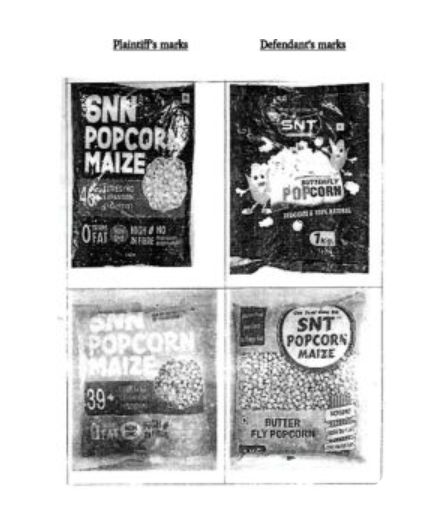
The dispute arose from a suit instituted by Shah Nanji Nagis Exports (P) Ltd. ("SNN Exports"), which claimed rights in the registered word mark "SNN" in Class 31 and alleged that SNT's use of the mark "SNT" along with similar packaging amounted to infringement and passing off. The Trial Court granted an interim injunction restraining SNT from using its mark, despite SNT's objections that SNN's registration was limited to a word mark and did not extend to trade dress.
On appeal, the Bombay High Court noted that the Trial Court had not adequately analysed the rival packaging. While the Trial Court recorded a conclusion that the packets were deceptively similar, it did not demonstrate how this conclusion was reached. The Bombay High Court observed that several visual and design elements highlighted by SNT, including colour schemes, imagery, layout, and descriptive features, were not meaningfully examined.
The Bombay High Court emphasised that in trade dress disputes, courts must assess the overall visual impression of the competing packages as perceived by an end consumer, rather than focusing selectively on individual elements. While distinctive features may be discussed, the ultimate inquiry must be whether the trade dress, viewed as a whole, is likely to cause confusion.
In view of the absence of a reasoned comparison, the Bombay High Court set aside the injunction and directed the Trial Court to reconsider the application for interim relief afresh.
11. Kerala High Court Dismisses Rectification Plea Against "INDIA GATE" Trade Mark
The Hon'ble High Court of Kerala ("Kerala High Court") dismissed a Special Jurisdiction case filed by Pas Agro Foods ("PAF") seeking cancellation of the registered trade mark "INDIA GATE" owned by KRBL Ltd. ("KRBL") under the Trade Marks Act.[14]The dispute arose after KRBL, the registered proprietor of the "INDIA GATE" mark, instituted an nfringement suit in the District Court at Delhi ("Delhi District Court"), which granted an interim injunction and ordered seizure of allegedly infringing goods belonging to PAF. Subsequently, PAF filed a rectification petition before the Kerala High Court to remove "INDIA GATE", which was registered at the Trade Marks Registry in New Delhi ("Delhi Registry"), from the Register.
KRBL challenged the maintainability of the petition due to lack of territorial jurisdiction. PAF argued that as its goods were seized in Kerala, the cause of action had arisen here, conferring jurisdiction on the Kerala High Court. It further contended that Section 57, Trade Marks Act referred only to "High Court", and not to a court exercising appellate jurisdiction. KRBL further contended the suit was prematurely instituted.
The Kerala High Court ruled in favour of KRBL. Regarding jurisdiction, it held that a rectification petition is maintainable only before the High Court that has appellate jurisdiction over the Trade Marks Registry where the mark is registered. It found that the use of the phrase "the High Court" in Sections 47 and 57 of the Trade Marks Act indicates a specific High Court, not any High Court where a cause of action may arise. On prematurity, the Kerala High Court held that where no rectification petition is pending at the time of filing an infringement suit, Section 124, Trade Marks Act requires the trial court to first be prima facie satisfied about the plea of invalidity and to frame an issue before a rectification petition can be pursued.
Accordingly, the petition was dismissed.
12. Trade Mark Infringement: Distinctiveness of Non-Descriptive Marks
The Delhi High Court allowed an appeal filed by WOW! Momo Foods Pvt. Ltd. ("WOW! MOMO") and restrained the respondents, Wow Burger and another, from using device marks containing the words "WOW BURGER", holding it to be deceptively similar to WOW! MOMO's registered trade marks.14
To view the full article please click here.
The content of this article is intended to provide a general guide to the subject matter. Specialist advice should be sought about your specific circumstances.
